
Free Safe Operating Procedure (Clothing Rack Handling) Template
Download our free Safe Operating Procedure (Clothing Rack Handling) template.
Free Safe Operating Procedure (Clothing Rack Handling) Template
DOCX • 126 KB + PDF
Updated Oct 2026
No signup required
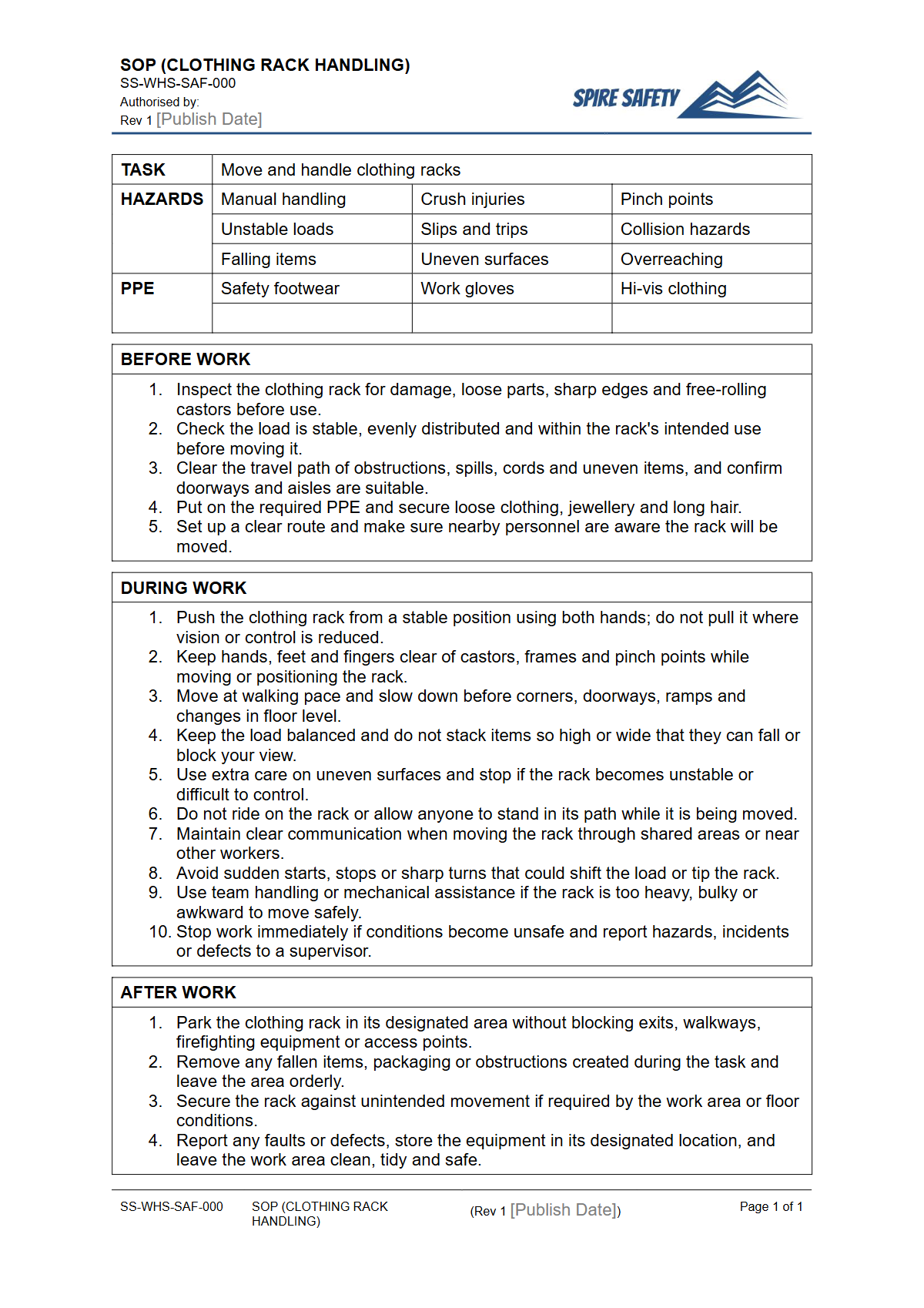
Purpose of the Free Safe Operating Procedure (Clothing Rack Handling) Template
Effectively managing workplace safety in a retail or warehouse setting involves identifying and controlling risks for all tasks, including seemingly simple ones. This Free Safe Operating Procedure (Clothing Rack Handling) Template provides a structured framework for documenting the safe steps required to move and handle clothing racks.
Its main purpose is to help prevent common injuries, such as sprains, strains, and other musculoskeletal disorders, which frequently arise from hazardous manual tasks. By implementing a clear Safe Operating Procedure, your organisation can standardise safe work practices, assist in worker training, and build a key component of your broader WHS management systems.
Video walkthrough
How to use the Free Safe Operating Procedure (Clothing Rack Handling) Template
To get the most value from this Free Safe Operating Procedure (Clothing Rack Handling) Template, you must adapt it to the specific equipment, environment, and processes within your workplace. The document is provided as an editable DOCX file, allowing you to add, remove, or modify steps to reflect your unique operational requirements.
A PDF version is also available for easy printing and distribution once your customisations are complete.
Important Note
This template is a starting point. We have drafted it to align with Australian WHS principles, but it is not a complete, out-of-the-box solution.
You must conduct your own risk assessment and customise the document to ensure it is suitable for your specific workplace. This includes consulting with your workers and incorporating site-specific details like rack types, floor surfaces, and emergency procedures.
If you need assistance with this process, consider engaging general WHS consulting services.
When should a Clothing Rack Handling Safe Operating Procedure be used?
This Safe Operating Procedure should be referenced whenever workers are required to handle or move loaded or unloaded clothing racks. Key situations include receiving new stock from delivery vehicles, transporting racks from a stockroom to the retail floor, rearranging the shop layout, consolidating merchandise during a sale, and returning racks to storage.
These tasks often require related safety procedures, such as those outlined in a step ladder SOP when accessing items at height.
Who should use this SOP?
The SOP is designed for all personnel whose duties involve interacting with clothing racks. This primarily includes retail sales assistants, stockroom staff, visual merchandisers, and warehouse team members.
Managers and supervisors should also be thoroughly familiar with the procedure to ensure they can effectively oversee its implementation, conduct training, and monitor adherence. The effectiveness of SOPs is often a key focus of WHS compliance audits.
Integrating the SOP with Risk Assessment
Before finalising your Safe Operating Procedure, a thorough risk assessment should identify all potential hazards associated with clothing rack handling. Consider factors like the weight and stability of racks, the condition of castor wheels, the surfaces being traversed (e.g., carpet, tile, ramps), and the potential for collisions with customers or fixtures.
Documenting these risks helps justify the control measures you include in your procedure, creating a more robust safety document. This process of preparation extends to all areas of workplace safety, including being ready for medical emergencies with a clear Safe Operating Procedure for defibrillator use.
Training and Competency
An SOP is only effective when workers are trained on its contents. Training should not just involve reading the document; it must include practical demonstrations of correct lifting, pushing, and pulling techniques.
Regular refresher training ensures that safe practices remain top-of-mind and provides an opportunity to discuss any new hazards or procedural changes. Whether you're training staff on manual handling or on using specific equipment detailed in a free Air Compressor SOP, hands-on instruction is key.
Download a Structured Template for Your Business
By formalising your process with this template, you create a valuable tool for worker induction, ongoing training, and incident investigation. It forms an integral part of your overall safety management system.
To discover more tools to support your safety framework, you can browse our complete free WHS resources library for a wide range of templates and checklists.
Common mistakes
Common mistakes to avoid
- Failing to check the rack's condition, particularly the wheels and frame, before moving it.
- Overloading racks beyond their specified safe weight capacity, making them unstable and difficult to control.
- Attempting to move a heavy or awkward rack alone when it is clearly a two-person job.
- Not clearing the intended path of travel or checking for obstacles and other people before starting to move the rack.
Legal references
Legal considerations
The following legal requirements may be relevant to this type of work.
- Work Health and Safety Act (Harmonised) — Provides the primary duties for protecting workers and other people from work health and safety risks.
- Work Health and Safety Regulations (Harmonised) — Sets out requirements supporting the management of workplace hazards and risks.
The following codes may be relevant to this type of work.
- Managing WHS Risks Code of Practice — Provides practical guidance on identifying hazards, assessing risks and applying effective controls.
- Work Health and Safety Consultation, Cooperation and Coordination Code of Practice — Provides practical guidance on consulting workers and coordinating with other duty holders.
- Managing the Work Environment and Facilities Code of Practice — Provides practical guidance on safe work environments, workplace facilities and related controls.
Did you know
A Heavy Burden
A standard Z-rack used in retail can have a load capacity of over 200 kilograms. An overloaded or poorly maintained rack poses a significant risk of collapse or uncontrolled movement.
Manual Handling Injuries
According to Safe Work Australia, injuries resulting from manual handling are one of the most common types of serious workers' compensation claims, highlighting the importance of proper procedures for all lifting and moving tasks.
FAQ
Frequently asked questions
01What are the main hazards of handling clothing racks?
02Is an SOP legally required for moving clothing racks in Australia?
03How often should we review our Clothing Rack Handling SOP?
04What training should accompany this Safe Operating Procedure?
Share this resource
Free Safe Operating Procedure (Clothing Rack Handling) Template
Browse Categories
How To Use It
- 1Download and open in Word or PDF.
- 2Replace the placeholders with your business details.
- 3Get it reviewed by a WHS specialist before rollout.
Need it customised?
Our WHS consultants can adapt this template to your site, run a gap analysis, or audit what you already have in place.
Book a Free Consultation WHS consulting servicesor call 1300 156 382
Related templates
- Free Safe Operating Procedure (Club Change Room Clean) Template
- Free Safe Operating Procedure (Club Equipment Cleaning) Template
- Free Safe Operating Procedure (CNG Refuelling) Template
- Free Safe Operating Procedure (Coach Interior Cleaning) Template
- Free Safe Operating Procedure (Coach Luggage Loading) Template
- Free Safe Operating Procedure (Coating Thickness Gauge) Template