
Free Safe Operating Procedure (Club Change Room Clean) Template
Download our free Safe Operating Procedure (Club Change Room Clean) template. This DOCX and PDF resource helps you outline safe cleaning protocols.
Free Safe Operating Procedure (Club Change Room Clean) Template
DOCX • 126 KB + PDF
Updated Oct 2026
No signup required
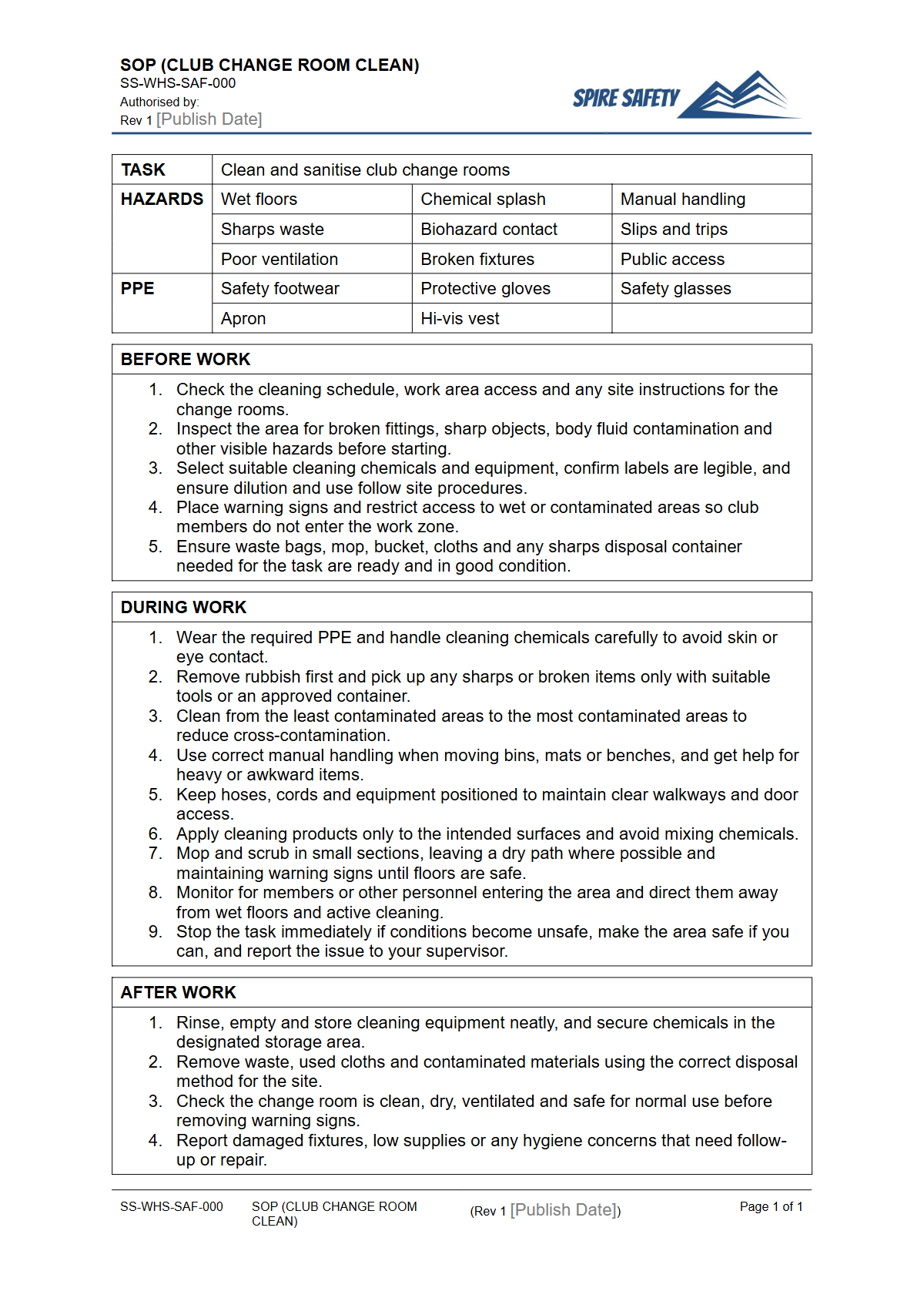
Purpose of the Free Safe Operating Procedure (Club Change Room Clean) Template
This free Safe Operating Procedure (Club Change Room Clean) template provides a structured starting point for documenting the risks and controls associated with cleaning tasks in a club or facility change room. While often seen as a low-risk activity, cleaning involves several potential hazards, including exposure to cleaning chemicals, manual handling injuries, and slip, trip, and fall risks.
A documented SOP ensures that all workers, including volunteers and new staff, perform the task consistently and safely every time.
An effective SOP is a key administrative control measure and a fundamental part of any robust safety framework. It demonstrates an organisation's commitment to managing health and safety risks by providing clear, step-by-step instructions for a specific task.
Integrating task-specific SOPs like this one is crucial for building comprehensive WHS management systems that protect workers and ensure operational consistency.
Video walkthrough
How to use the Free Safe Operating Procedure (Club Change Room Clean) Template
After downloading, you will have access to both a DOCX and PDF file. The DOCX file is fully editable, allowing you to tailor the content to the specific environment, chemicals, and equipment used in your facility.
It is crucial to review every section and add, remove, or modify steps to reflect your actual processes. Pay close attention to sections covering Personal Protective Equipment (PPE), chemical handling, waste disposal, and emergency procedures.
Important: This is a template we've developed to serve as a starting point. It is not a finished document.
You must consult with your workers and customise this Safe Operating Procedure to align with the unique hazards, equipment, and environment of your workplace. Generic, uncustomised procedures may not adequately control risks and could fail to meet your safety obligations.
When to use this Safe Operating Procedure
This SOP should be used whenever cleaning duties are performed in a change room, locker room, or similar amenities block. It is designed to be a practical tool used for worker induction, training, and as a regular reference on the job.
It should be readily accessible to all staff and volunteers involved in cleaning tasks. The SOP also serves as a valuable resource during risk assessments and incident investigations related to cleaning activities.
Documenting routine tasks helps build a proactive safety culture. While this document covers cleaning, your organisation likely has other tasks that would benefit from a formal procedure, such as using a step ladder to access storage or operating facility maintenance equipment.
Formalising these processes reduces ambiguity and improves safety outcomes.
Who should use this Safe Operating Procedure
This SOP is intended for any person responsible for cleaning club change rooms. This includes employees, casual staff, contractors, and volunteers.
Managers and supervisors should use the SOP as a benchmark for training, supervision, and performance monitoring. WHS officers and committee members can also use the document as part of their safety assurance activities, ensuring that documented controls are being implemented correctly.
The development of the SOP should be a consultative process involving the workers who actually perform the cleaning. Their direct experience is invaluable for identifying practical risks and effective controls.
Once finalised, regular reviews are essential to keep the document relevant, especially if new cleaning products, equipment, or procedures are introduced. A periodic WHS compliance audit can help identify gaps between documented procedures and actual practice on the floor.
Integrating with Other Safety Documents
A good SOP doesn't exist in isolation. It should reference, and be referenced by, other key safety documents.
For example, it should list the specific Safety Data Sheets (SDSs) for the chemicals in use and align with your facility's overall emergency plan. The procedure should specify the location of first aid kits and detail the immediate response to incidents like chemical splashes or major spills.
Many clubs and facilities maintain a range of equipment for different purposes. Standardising procedures across the board is best practice. Just as you document cleaning, consider formalising instructions for other site equipment, from a life-saving defibrillator in the first aid room to workshop tools like an air compressor used for maintenance.
By establishing a clear, documented, and consistent approach to all tasks, you create a safer and more organised work environment. You can find more templates and checklists to support your safety initiatives in our complete free WHS resources library.
Common mistakes
Common mistakes to avoid
- Using a generic template without customising it for specific workplace chemicals and equipment.
- Failing to consult with and provide training for the workers who perform the cleaning tasks.
- Not making Safety Data Sheets (SDSs) for all cleaning chemicals readily available.
- Forgetting to review and update the SOP after introducing a new product or after an incident.
Legal references
Legal considerations
The following legal requirements may be relevant to this type of work.
- Work Health and Safety Act (Harmonised) — Provides the primary duties for protecting workers and other people from work health and safety risks.
- Work Health and Safety Regulations (Harmonised) — Sets out requirements supporting the management of workplace hazards and risks.
The following codes may be relevant to this type of work.
- Managing WHS Risks Code of Practice — Provides practical guidance on identifying hazards, assessing risks and applying effective controls.
- Work Health and Safety Consultation, Cooperation and Coordination Code of Practice — Provides practical guidance on consulting workers and coordinating with other duty holders.
- Managing the Work Environment and Facilities Code of Practice — Provides practical guidance on safe work environments, workplace facilities and related controls.
Did you know
Slips, Trips, and Falls
Slips, trips, and falls are a leading cause of serious, preventable injuries in Australian workplaces, accounting for thousands of workers' compensation claims each year.
Volunteers Have Rights
Under the model WHS Act, an organisation owes the same duty of care to its volunteers as it does to its paid employees, and must provide a safe work environment for them.
FAQ
Frequently asked questions
01What is a Safe Operating Procedure (SOP)?
02Why do I need an SOP for cleaning a change room?
03Are cleaning chemicals considered hazardous substances?
04How often should a Safe Operating Procedure be reviewed?
Share this resource
Free Safe Operating Procedure (Club Change Room Clean) Template
Browse Categories
How To Use It
- 1Download and open in Word or PDF.
- 2Replace the placeholders with your business details.
- 3Get it reviewed by a WHS specialist before rollout.
Need it customised?
Our WHS consultants can adapt this template to your site, run a gap analysis, or audit what you already have in place.
Book a Free Consultation WHS consulting servicesor call 1300 156 382
Related templates
- Free Safe Operating Procedure (Club Equipment Cleaning) Template
- Free Safe Operating Procedure (CNG Refuelling) Template
- Free Safe Operating Procedure (Coach Interior Cleaning) Template
- Free Safe Operating Procedure (Coach Luggage Loading) Template
- Free Safe Operating Procedure (Coating Thickness Gauge) Template
- Free Safe Operating Procedure (Cobot Operation) Template