
Free Safe Operating Procedure (Club Equipment Cleaning) Template
Streamline your club's cleaning processes with our free Safe Operating Procedure (Club Equipment Cleaning) Template. Download your customisable DOCX & PDF now.
Free Safe Operating Procedure (Club Equipment Cleaning) Template
DOCX • 126 KB + PDF
Updated Oct 2026
No signup required
Purpose of the Free Safe Operating Procedure (Club Equipment Cleaning) Template
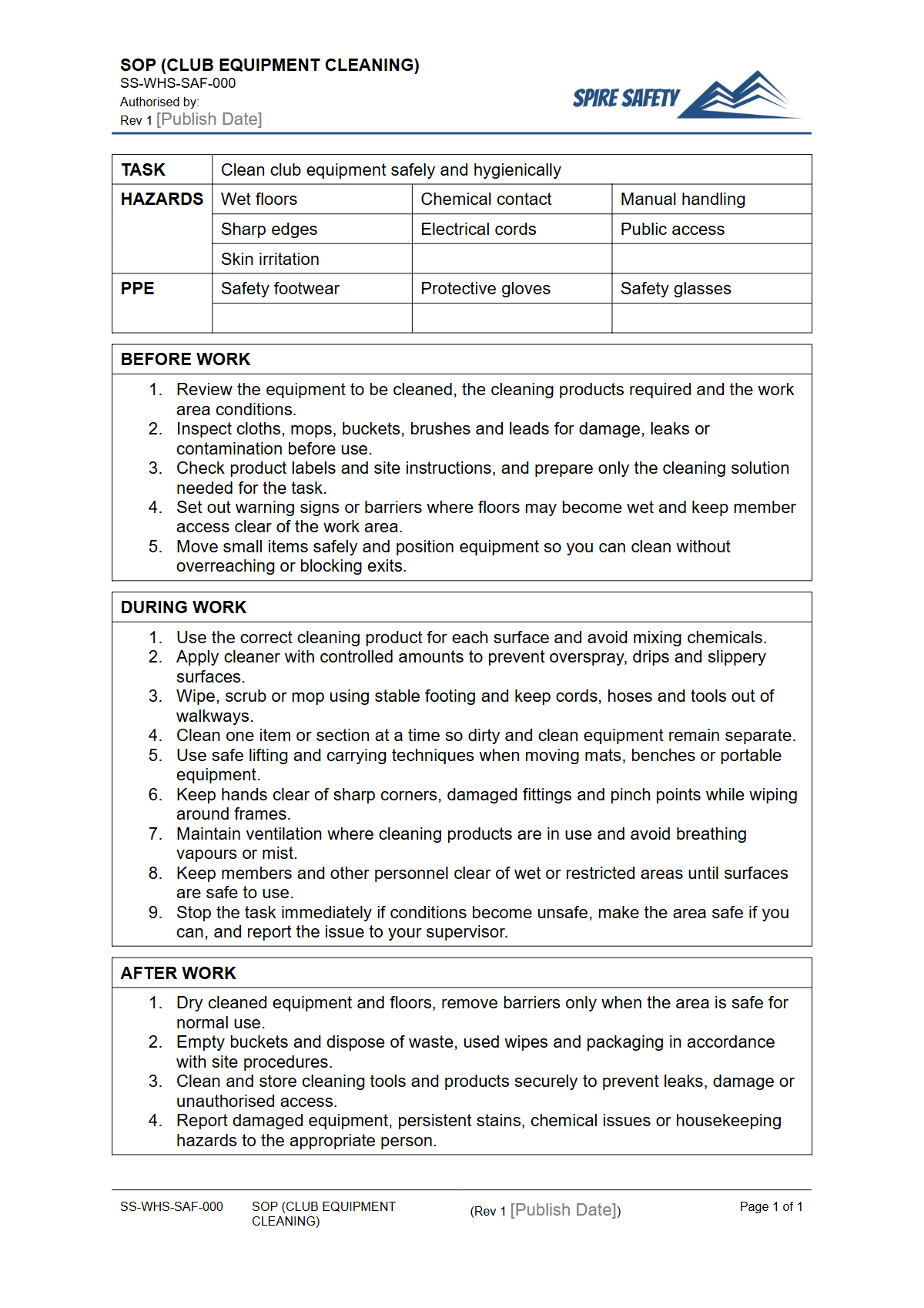
This Safe Operating Procedure (SOP) for Club Equipment Cleaning provides a structured framework for outlining the step-by-step process for safely cleaning equipment within a club, community group, or similar organisation. Establishing clear procedures is a fundamental part of managing work health and safety risks.
This template helps document the required personal protective equipment (PPE), potential hazards, and control measures associated with cleaning tasks, from kitchen appliances and gym equipment to maintenance tools.
Using a standardised SOP ensures that all workers, including employees and volunteers, perform the task consistently and safely every time. It serves as a vital training tool and a reference point for safe work practices.
A well-developed SOP is a key component of broader WHS management systems, demonstrating a commitment to proactive risk management and creating a safer environment for everyone at the club.
Video walkthrough
How to use the Free Safe Operating Procedure (Club Equipment Cleaning) Template
Our Safe Operating Procedure for Club Equipment Cleaning is a starting point designed for easy adaptation. Download the DOCX file and tailor it to the specific equipment, cleaning agents, and environment of your club.
It is crucial that you customise this document to reflect your actual workplace conditions and legal obligations.
To effectively use the template:
- Identify the Equipment: List all specific pieces of club equipment covered by this procedure.
- Consult Safety Data Sheets (SDS): For all cleaning chemicals used, refer to the SDS to identify specific hazards, handling instructions, first aid measures, and required PPE.
- Conduct a Risk Assessment: Identify all potential hazards associated with the cleaning process (e.g., chemical exposure, electrical shock from wet equipment, manual handling, slips and trips).
- Document Control Measures: For each hazard, specify the controls to be implemented. This includes engineering controls (like ventilation), administrative controls (like safety signage), and the specific PPE required (e.g., gloves, eye protection).
- Outline the Procedure: Detail the safe, step-by-step sequence for completing the cleaning task, from preparation to clean-up and waste disposal.
- Review and Consult: Involve the workers who perform the cleaning tasks in the drafting and review process. Their practical input is invaluable for creating an effective and realistic SOP.
Remember, this is a template. We are not WHS consultants for your business just by you downloading this document.
You must ensure the final document is specific to your club's operations. This SOP can be used alongside other key safety documents, such as a Safe Operating Procedure for Defibrillator Operation, to build a comprehensive safety portfolio for your organisation.
When to use it
This SOP should be used before and during any cleaning activity involving club equipment. It is particularly important when new staff or volunteers are being inducted, when new cleaning chemicals or equipment are introduced, or after an incident or near-miss has occurred.
Regular reference to the SOP reinforces safe behaviour and ensures procedures are not forgotten over time.
It should also be a central document for periodic safety training and refresher courses. If cleaning tasks involve working at height, even on a small platform, it's essential to have documented procedures for that equipment as well, such as our free Step Ladder SOP template.
Who should use it
This procedure is intended for all individuals responsible for cleaning equipment at the club, including paid employees, casual workers, and volunteers. Under Australian WHS law, an organisation has a primary duty of care to ensure the health and safety of all its workers, which includes volunteers.
Managers, supervisors, and club committee members should use this document to train workers and to monitor that the specified safe work practices are being followed. If your club needs expert assistance in defining roles and responsibilities or implementing safety procedures, engaging with a general WHS consulting service can provide valuable guidance and support.
Safety officers or WHS representatives can also use the SOP as a baseline for workplace inspections and to identify areas for improvement. Regular reviews can be integrated into your safety management schedule, and an external perspective from a WHS compliance auditing service can help verify the effectiveness of your procedures. You can find more templates to support your safety system in our free WHS resources library.
Common mistakes
Common mistakes to avoid
- Using a generic template without customising it for specific equipment and chemicals.
- Failing to provide adequate training to workers and volunteers on the documented procedure.
- Not making Safety Data Sheets (SDS) for cleaning chemicals readily available to users.
- Neglecting to include procedures for the safe disposal of chemical waste and used containers.
Legal references
Legal considerations
The following legal requirements may be relevant to this type of work.
- Work Health and Safety Act (Harmonised) — Provides the primary duties for protecting workers and other people from work health and safety risks.
- Work Health and Safety Regulations (Harmonised) — Sets out requirements supporting the management of workplace hazards and risks.
The following codes may be relevant to this type of work.
- Managing WHS Risks Code of Practice — Provides practical guidance on identifying hazards, assessing risks and applying effective controls.
- Work Health and Safety Consultation, Cooperation and Coordination Code of Practice — Provides practical guidance on consulting workers and coordinating with other duty holders.
- Managing the Work Environment and Facilities Code of Practice — Provides practical guidance on safe work environments, workplace facilities and related controls.
Did you know
Slips, Trips, and Falls
Slips, trips and falls are a leading cause of workplace injuries in Australia, with wet and slippery surfaces from cleaning being a major contributor. Maintaining clear, dry floors is a critical control measure.
Chemical Information
Under WHS regulations, your organisation must have a Safety Data Sheet (SDS) for every hazardous chemical used. The SDS must be readily accessible to any worker who may be exposed to the substance.
FAQ
Frequently asked questions
01What key information must be in a club equipment cleaning SOP?
02How often should our club review its cleaning SOPs?
03Are volunteers covered by WHS laws when cleaning club equipment?
04What is the difference between an SOP and a Safe Work Method Statement (SWMS)?
Share this resource
Free Safe Operating Procedure (Club Equipment Cleaning) Template
Browse Categories
How To Use It
- 1Download and open in Word or PDF.
- 2Replace the placeholders with your business details.
- 3Get it reviewed by a WHS specialist before rollout.
Need it customised?
Our WHS consultants can adapt this template to your site, run a gap analysis, or audit what you already have in place.
Book a Free Consultation WHS consulting servicesor call 1300 156 382
Related templates
- Free Safe Operating Procedure (CNG Refuelling) Template
- Free Safe Operating Procedure (Coach Interior Cleaning) Template
- Free Safe Operating Procedure (Coach Luggage Loading) Template
- Free Safe Operating Procedure (Coating Thickness Gauge) Template
- Free Safe Operating Procedure (Cobot Operation) Template
- Free Safe Operating Procedure (Coffee Grinder) Template