
Free Safe Operating Procedure (Coffee Grinder) Template
Download our free Safe Operating Procedure (Coffee Grinder) Template.
Free Safe Operating Procedure (Coffee Grinder) Template
DOCX • 126 KB + PDF
Updated Oct 2026
No signup required
Purpose of the Free Safe Operating Procedure (Coffee Grinder) Template
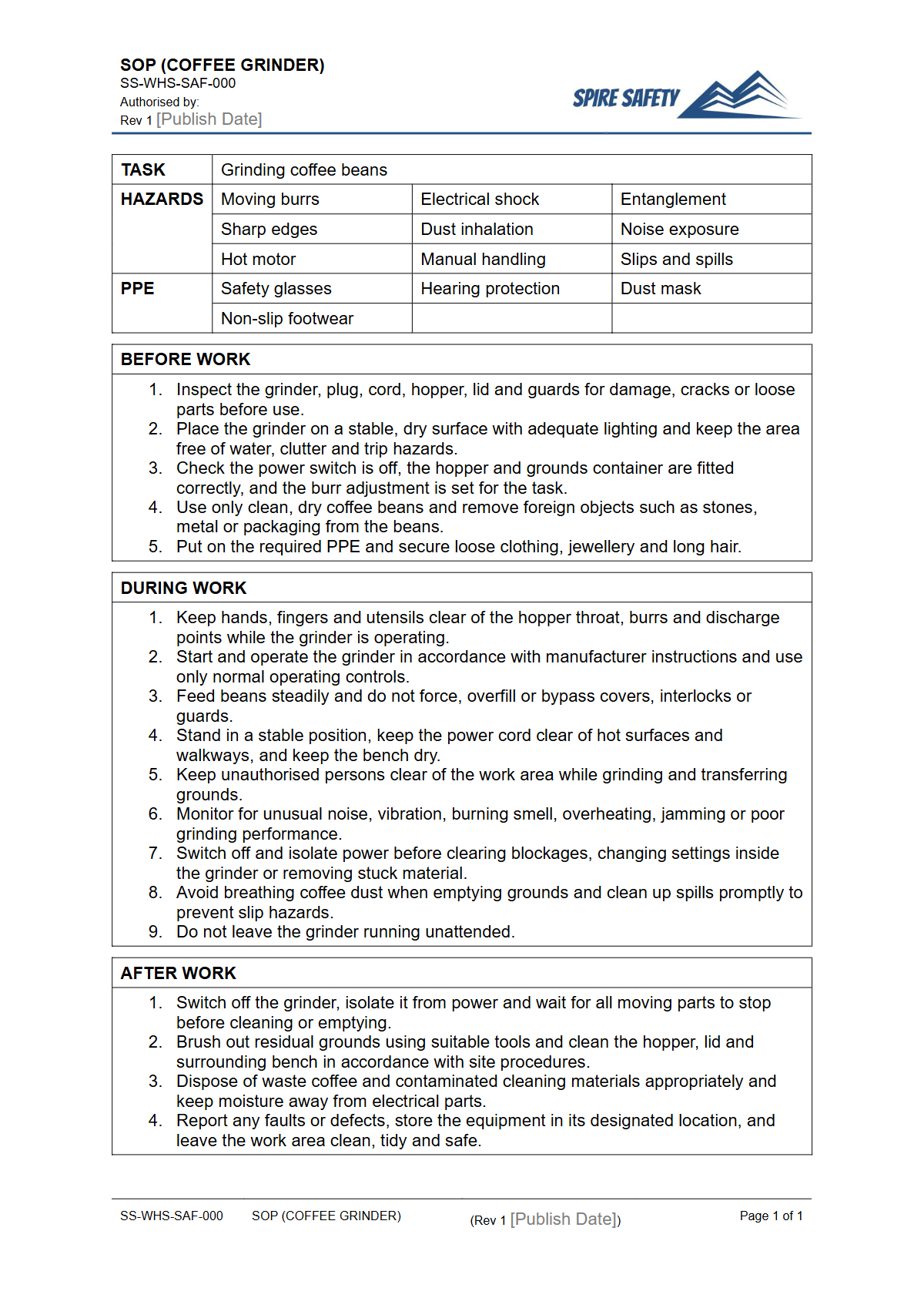
A clear and effective Safe Operating Procedure (SOP) is essential for managing the risks associated with commercial coffee grinders in a hospitality setting. This Free Safe Operating Procedure (Coffee Grinder) Template provides a structured starting point for cafes, restaurants, and other businesses to document safe work practices.
Using an SOP helps to standardise training, ensure consistent operational safety, and demonstrate due diligence in managing workplace hazards.
Operating a commercial coffee grinder presents several risks, including entanglement with moving parts (burrs or blades), electric shock, ergonomic strain from repetitive tasks, and exposure to noise and airborne dust. This template helps you outline control measures for these hazards, forming a critical component of your overall WHS management systems.
Video walkthrough
How to use the Free Safe Operating Procedure (Coffee Grinder) Template
This resource is available for download as a DOCX file for easy editing and a PDF for straightforward printing and sharing. To use it effectively, you must adapt its contents to your specific operational context.
A generic document is not sufficient for managing specific risks. While this template is aligned with Australian WHS principles, true operational safety comes from detailed customisation.
Important Customisation Note
Please note: This template is a starting point. We have developed it to be adapted. You must customise this document to reflect the specific make and model of your grinder, the unique environment of your workplace, and the tasks your workers perform. Always consult the manufacturer's instruction manual and involve your workers in the drafting and review process. If you manage multiple types of machinery, you can adapt a similar process for each, such as when creating a Free Bench Grinder SOP (Safe Operating Procedure) Template.
When to use a Coffee Grinder SOP
A Safe Operating Procedure for a coffee grinder should be a living document, integrated into your daily operations. Key times to use and review the SOP include:
- During the induction and training of new baristas or kitchen staff.
- As a refresher training tool for existing team members.
- Before operating an unfamiliar model of coffee grinder.
- When conducting risk assessments for cafe or kitchen tasks.
- Following any incident, near miss, or observed unsafe behaviour involving the equipment.
- As part of a periodic review cycle to ensure it remains current and effective. Regular reviews can be integrated into your WHS compliance auditing schedule.
Who should use this SOP
This SOP is intended for use by anyone who interacts with a commercial coffee grinder. This includes:
- Persons Conducting a Business or Undertaking (PCBUs): To meet their primary duty of care to provide a safe work environment and safe systems of work.
- Managers and Supervisors: To train, supervise, and monitor workers, ensuring they follow established safe procedures.
- Workers: Baristas, apprentices, and kitchen hands must be trained in the SOP and follow it to ensure their own safety and the safety of others.
The principles of documenting safe procedures apply to all equipment in the workplace, not just powered plant. For example, even simple equipment requires risk management, as outlined in our FREE Step Ladder SOP (Safe Operating Procedure) Template.
Key Elements of a Coffee Grinder Safe Operating Procedure
A comprehensive SOP for a coffee grinder should cover the entire lifecycle of its use. This template guides you to document key areas, including:
- Required Personal Protective Equipment (PPE): Such as safety glasses or hearing protection, if identified in your risk assessment.
- Pre-operational Checks: Steps to take before each use, like checking for damage to cords, ensuring guards are in place, and confirming the area is clear and dry.
- Step-by-Step Operating Instructions: A clear, sequential list of actions for safe operation, from starting the machine to grinding the beans.
- Cleaning and Jam-Clearing Procedures: Critical steps that emphasise isolating the grinder from power (unplugging) before any cleaning or maintenance.
- Emergency Procedures: Instructions on how to respond to an injury, electrical fault, or other emergency.
Developing robust and practical safety documents can be challenging. If you require assistance in tailoring SOPs to your business or developing a complete safety framework, consider engaging professional WHS consulting services.
Common mistakes
Common mistakes to avoid
- Failing to disconnect the grinder from the power source before cleaning or clearing a jam.
- Attempting to clear beans or grounds from the hopper or chute with fingers instead of appropriate tools.
- Assuming staff know how to use the grinder safely without providing specific training based on the SOP.
- Using a generic SOP without customising it for the specific grinder model and workplace environment.
Legal references
Legal considerations
The following legal requirements may be relevant to this type of work.
- Work Health and Safety Act (Harmonised) — Provides the primary duties for protecting workers and other people from work health and safety risks.
- Work Health and Safety Regulations (Harmonised) — Sets out requirements supporting the management of workplace hazards and risks.
The following codes may be relevant to this type of work.
- Managing WHS Risks Code of Practice — Provides practical guidance on identifying hazards, assessing risks and applying effective controls.
- Work Health and Safety Consultation, Cooperation and Coordination Code of Practice — Provides practical guidance on consulting workers and coordinating with other duty holders.
- Managing the Work Environment and Facilities Code of Practice — Provides practical guidance on safe work environments, workplace facilities and related controls.
Did you know
Noise Hazard
A commercial coffee grinder can operate at 80-95 decibels. Prolonged exposure above the workplace limit of 85 decibels can cause permanent hearing damage, making hearing protection a valid consideration in WHS risk assessments.
Blade vs. Burr
Burr grinders crush beans between two revolving abrasive surfaces, creating a more uniform particle size. Blade grinders use a spinning propeller-like blade to chop beans, which can result in more fine coffee dust, a potential respiratory irritant.
FAQ
Frequently asked questions
01Is a Safe Operating Procedure legally required for a coffee grinder in Australia?
02What are the main hazards of using a commercial coffee grinder?
03How often should we review our coffee grinder SOP?
04Can I use this template for any brand of coffee grinder?
Share this resource
Free Safe Operating Procedure (Coffee Grinder) Template
Browse Categories
How To Use It
- 1Download and open in Word or PDF.
- 2Replace the placeholders with your business details.
- 3Get it reviewed by a WHS specialist before rollout.
Need it customised?
Our WHS consultants can adapt this template to your site, run a gap analysis, or audit what you already have in place.
Book a Free Consultation WHS consulting servicesor call 1300 156 382
Related templates
- Free Safe Operating Procedure (Coffee Machine) Template
- Free Safe Operating Procedure (Coil Car) Template
- Free Safe Operating Procedure (Coil Condenser Cleaning) Template
- Free Safe Operating Procedure (Coil Grab) Template
- Free Safe Operating Procedure (Coil Lifter) Template
- Free Safe Operating Procedure (Coil Slitter) Template