
Free Safe Operating Procedure (Coil Lifter) Template
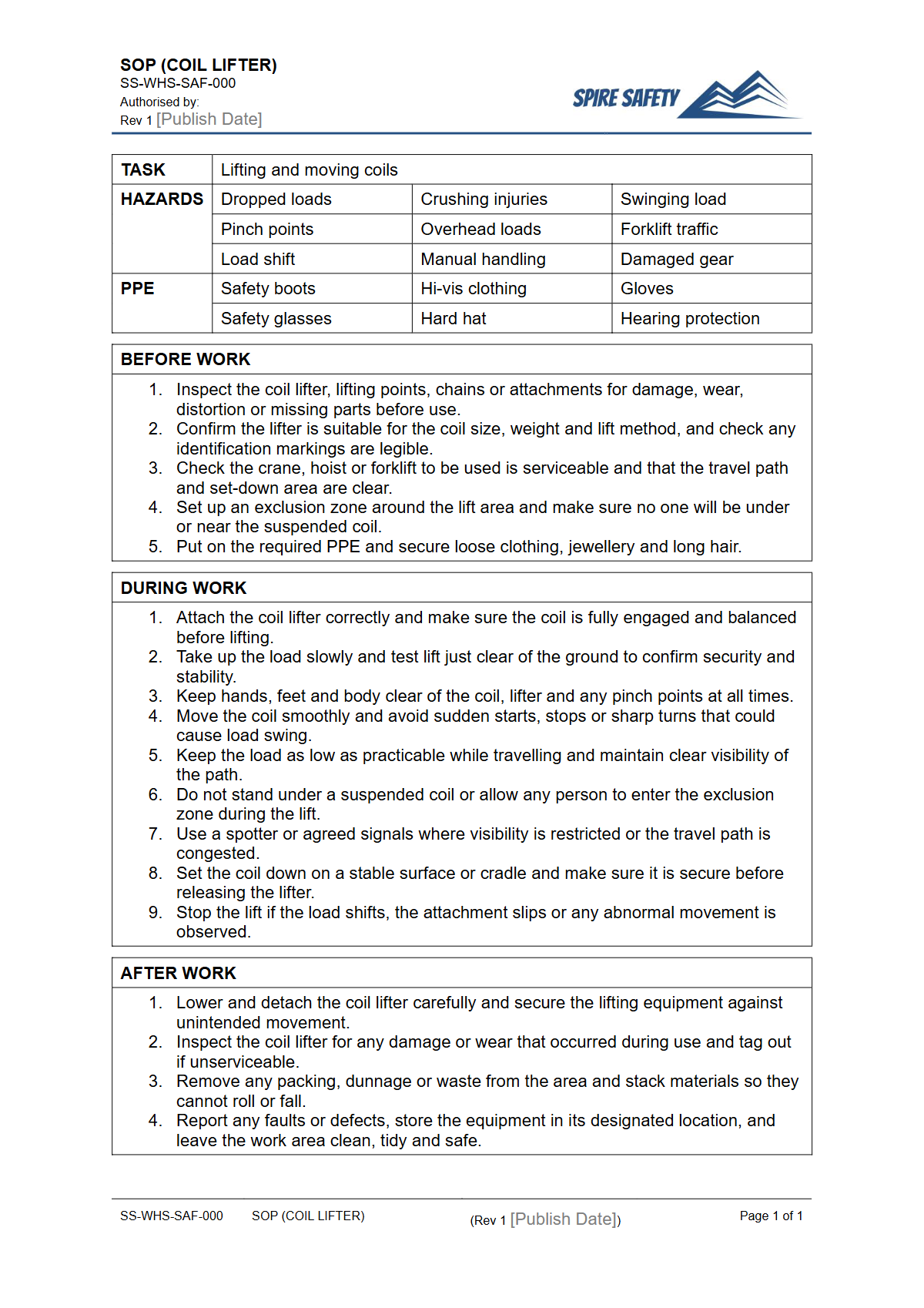
Download our Free Safe Operating Procedure (Coil Lifter) Template. This customisable DOCX & PDF helps you create a structured SOP for coil lifter use.
Free Safe Operating Procedure (Coil Lifter) Template
DOCX • 126 KB + PDF
Updated Oct 2026
No signup required
Purpose of the Free Safe Operating Procedure (Coil Lifter) Template
Operating a coil lifter involves significant risks, including dropped loads, crushing injuries, and mechanical failure. A Safe Operating Procedure (SOP) is a crucial administrative control that provides clear, step-by-step instructions on how to perform a task safely.
This Free Safe Operating Procedure (Coil Lifter) Template offers a structured framework for documenting the specific safety measures required at your workplace. It guides you in outlining pre-operational checks, safe lifting techniques, and emergency procedures to minimise the risk of incidents.
Using this template helps your organisation meet its duty of care by formalising safety processes, ensuring consistency in operator training, and providing a clear reference for workers. A well-defined SOP is a fundamental component of managing risks associated with high-risk plant and equipment. Documenting these processes is as important for specialised lifting equipment as it is for creating a brake press safe operating procedure.
Video walkthrough
How to use the Free Safe Operating Procedure (Coil Lifter) Template
This resource is available as a fully editable DOCX file for easy customisation and a PDF for straightforward printing and distribution. To use the template effectively, download the file and methodically work through each section, replacing the placeholder text with information specific to your site's coil lifter models, work environment, and personnel.
Important: This document is a template, not a finished procedure. To be effective and support your safety obligations, we stress that you must customise it to reflect the unique hazards and control measures of your workplace.
Consultation with operators and supervisors during this process is essential for creating a practical and effective SOP. Properly implemented SOPs are a key part of effective WHS management systems.
When to use a Safe Operating Procedure
A Safe Operating Procedure for a coil lifter should be developed and implemented before any worker is permitted to operate the equipment. It serves several key functions throughout the lifecycle of the equipment and its use in your operations.
It should be used as a primary training document for new operators to ensure they understand the established safe work method from the beginning.
The SOP should also be used for conducting refresher training, verifying competency, and as a reference tool for infrequent users. Following any workplace incident or near-miss involving a coil lifter, the SOP must be reviewed and updated to incorporate any learnings.
The same detailed approach is needed when documenting procedures for other machinery, such as with a safe operating procedure for a plasma cutter. This continuous review ensures the document remains relevant and effective.
Who should use it
This template is designed for use by Persons Conducting a Business or Undertaking (PCBUs), managers, supervisors, and WHS professionals responsible for workplace safety. These individuals can use the template to draft, review, and authorise the final procedure.
Once finalised, the SOP becomes an essential tool for operators, who must be trained on its contents and follow it diligently during their work.
Supervisors should use the SOP to guide their oversight and ensure that work is performed according to the agreed safety standards. Its use in training is similar to how a telehandler SOP would be used to instruct operators on that specific piece of equipment.
WHS personnel may also use the SOP as a reference during safety inspections and audits to verify that documented procedures are being followed in practice. The document can also support your processes for regular WHS compliance auditing by providing a clear benchmark for safe performance. For more templates and checklists, you can browse our complete free WHS resources library.
Common mistakes
Common mistakes to avoid
- Failing to customise the template with site-specific details and hazards.
- Not training workers on the finalised SOP and verifying their understanding.
- Forgetting to review and update the SOP after an incident or process change.
- Writing a procedure that is too complex or doesn't reflect how the task is actually performed.
Legal references
Legal considerations
The following legal requirements may be relevant to this type of work.
- Work Health and Safety Act (Harmonised) — Provides the primary duties for protecting workers and other people from work health and safety risks.
- Work Health and Safety Regulations (Harmonised) — Sets out requirements supporting the management of workplace hazards and risks.
The following codes may be relevant to this type of work.
- Managing WHS Risks Code of Practice — Provides practical guidance on identifying hazards, assessing risks and applying effective controls.
- Work Health and Safety Consultation, Cooperation and Coordination Code of Practice — Provides practical guidance on consulting workers and coordinating with other duty holders.
- Managing the Work Environment and Facilities Code of Practice — Provides practical guidance on safe work environments, workplace facilities and related controls.
Did you know
Load Forces
The forces exerted on lifting equipment can be immense. A sudden stop or snatch-lift can momentarily multiply the load's effective weight, placing extreme stress on the coil lifter and its components.
Stored Energy
A tightly wound steel coil contains a significant amount of stored energy. Uncontrolled release, or 'clock-springing', can cause serious or fatal injuries if the coil is not handled and secured correctly during lifting and transport.
FAQ
Frequently asked questions
01What is the difference between an SOP and a SWMS for a coil lifter?
02How often should a coil lifter SOP be reviewed?
03Does this template guarantee WHS compliance?
04What training should operators have besides the SOP?
Share this resource
Free Safe Operating Procedure (Coil Lifter) Template
Browse Categories
How To Use It
- 1Download and open in Word or PDF.
- 2Replace the placeholders with your business details.
- 3Get it reviewed by a WHS specialist before rollout.
Need it customised?
Our WHS consultants can adapt this template to your site, run a gap analysis, or audit what you already have in place.
Book a Free Consultation WHS consulting servicesor call 1300 156 382
Related templates
- Free Safe Operating Procedure (Coil Slitter) Template
- Free Safe Operating Procedure (Coil Spring Removal) Template
- Free Safe Operating Procedure (Coil Upender) Template
- Free Safe Operating Procedure (Coil Winder) Template
- Free Safe Operating Procedure (Coin Counter) Template
- Free Safe Operating Procedure (Cold Chain Dispatch) Template