
Free Safe Operating Procedure (Coil Upender) Template
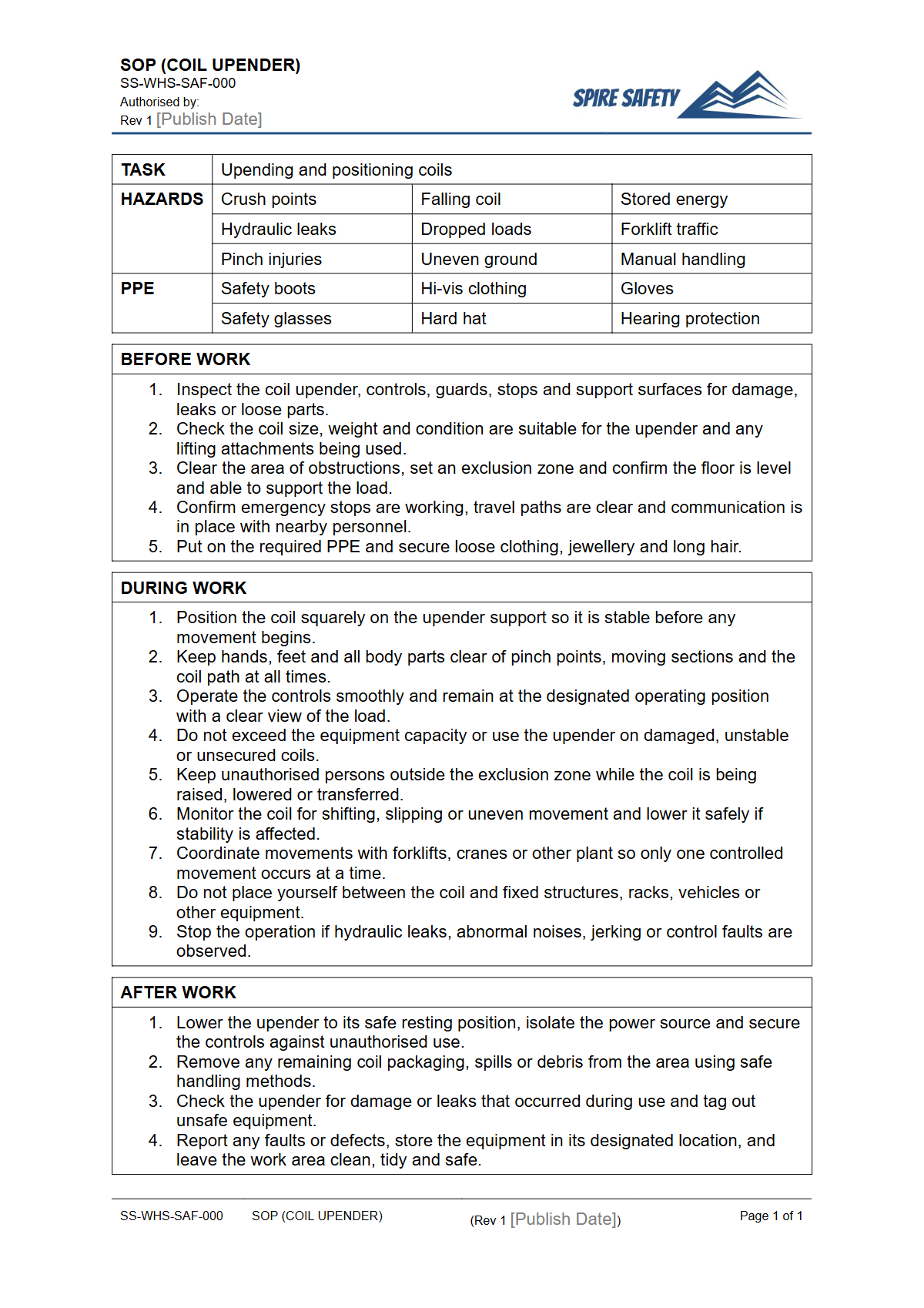
Download our free Safe Operating Procedure for coil upenders. This DOCX template helps you outline safe work steps for manufacturing and logistics.
Free Safe Operating Procedure (Coil Upender) Template
DOCX • 126 KB + PDF
Updated Oct 2026
No signup required
Purpose of the Free Safe Operating Procedure (Coil Upender) Template
This Free Safe Operating Procedure (Coil Upender) Template provides a structured framework for documenting the safe use of coil upenders (also known as coil tilters or positioners) in your workplace. Its purpose is to help you clearly define the step-by-step process for safely handling and repositioning heavy steel, aluminium, or other material coils, minimising risks to operators and personnel.
Using a standardised SOP helps ensure that all workers follow a consistent, pre-approved method, which is a cornerstone of an effective safety management system.
Coil upenders are powerful pieces of machinery that present significant hazards, including crushing, shearing, and unexpected load movement. A documented SOP is a critical administrative control measure that supports practical training and supervision.
This template is designed as a starting point, aligned with Australian WHS principles, to help your organisation meet its duty of care. Properly implemented, it forms a key part of your broader WHS management systems, demonstrating a proactive approach to risk control for high-risk plant.
Video walkthrough
How to use the Free Safe Operating Procedure (Coil Upender) Template
To effectively use this Safe Operating Procedure for a Coil Upender, you must customise it to reflect the specific equipment, environment, and processes at your site. Download the DOCX file and adapt each section by consulting with operators, supervisors, and safety personnel.
This collaborative process ensures the final document is practical, accurate, and understood by those performing the task.
Important Note:
This is a template only. It must be customised to suit the specific make and model of equipment used, the task, and your work environment.
We recommend a thorough consultation process with your team to ensure the final SOP is relevant and effective for your business.
Your customisation should include details such as the specific controls on your machine, load capacity limits, designated operating zones, and emergency procedures. The document should be reviewed and approved by a competent person before being issued. For consistency across your operations, you can adapt its structure for other plant, such as the process outlined in our Free Brake Press SOP Template.
When to use it
A Safe Operating Procedure for a coil upender should be developed before the equipment is first used and be readily available at the point of use. It is a vital tool for operator training, competency assessments, and refresher courses.
The SOP should be referenced during toolbox talks, especially when discussing material handling or changes in workflow.
It is also essential to review and potentially update the SOP after any incident or near-miss, when modifications are made to the equipment or surrounding work area, or when new types of coils or materials are introduced. Regular reviews, typically conducted annually, ensure the procedure remains relevant and effective. This proactive use helps maintain safety standards for tasks involving heavy logistics, much like the protocols required for other material handling equipment covered in our FREE Telehandler SOP Template.
Who should use it
This SOP is primarily for machine operators who are tasked with using the coil upender. They must be trained on the contents of the procedure and demonstrate competency in following it before being authorised to operate the equipment.
Supervisors and team leaders must also be familiar with the SOP to effectively oversee operations, enforce safe work practices, and lead incident investigations if required.
WHS managers and safety professionals will use this template as a foundation for developing site-specific documentation. They are responsible for ensuring the procedure integrates with the overall safety framework and that records of training and competency are maintained.
Regular checks on procedural adherence can be integrated into your safety audit schedule, a service that can be supported through professional WHS compliance auditing to verify implementation. The principles can also be applied to other fabrication equipment documented in resources like our FREE Plasma Cutter SOP Template. For more procedural documents, browse our complete free WHS resources library.
Common mistakes
Common mistakes to avoid
- Failing to properly secure the coil on the platform before initiating the tilting sequence.
- Operating the equipment in a cluttered area with insufficient clearance for the machine and load.
- Bypassing or disabling safety features like interlocking gates, light curtains, or emergency stops.
- Neglecting pre-start checks of hydraulic lines, limit switches, and mechanical components for signs of wear or damage.
Legal references
Legal considerations
The following legal requirements may be relevant to this type of work.
- Work Health and Safety Act (Harmonised) — Provides the primary duties for protecting workers and other people from work health and safety risks.
- Work Health and Safety Regulations (Harmonised) — Sets out requirements supporting the management of workplace hazards and risks.
The following codes may be relevant to this type of work.
- Managing WHS Risks Code of Practice — Provides practical guidance on identifying hazards, assessing risks and applying effective controls.
- Work Health and Safety Consultation, Cooperation and Coordination Code of Practice — Provides practical guidance on consulting workers and coordinating with other duty holders.
- Managing the Work Environment and Facilities Code of Practice — Provides practical guidance on safe work environments, workplace facilities and related controls.
Did you know
Load Stability is Key
A key function of a coil upender is to change the orientation of a heavy coil without compromising its structural integrity or the stability of the load, preventing dangerous tipping or rolling.
Hydraulic vs. Mechanical
Coil upenders can be either hydraulic or mechanical, each with different maintenance requirements and potential failure points that must be addressed in a site-specific risk assessment.
FAQ
Frequently asked questions
01What are the main hazards of using a coil upender?
02How often should an SOP for a coil upender be reviewed?
03Is specific training required to operate a coil upender?
04What Personal Protective Equipment (PPE) is typically required for operating a coil upender?
Share this resource
Free Safe Operating Procedure (Coil Upender) Template
Browse Categories
How To Use It
- 1Download and open in Word or PDF.
- 2Replace the placeholders with your business details.
- 3Get it reviewed by a WHS specialist before rollout.
Need it customised?
Our WHS consultants can adapt this template to your site, run a gap analysis, or audit what you already have in place.
Book a Free Consultation WHS consulting servicesor call 1300 156 382
Related templates
- Free Safe Operating Procedure (Coil Winder) Template
- Free Safe Operating Procedure (Coin Counter) Template
- Free Safe Operating Procedure (Cold Chain Dispatch) Template
- Free Safe Operating Procedure (Cold Chain Receiving) Template
- Free Safe Operating Procedure (Cold Cutting Pipe) Template
- Free Safe Operating Procedure (Cold Room Cleaning) Template