
Free Safe Operating Procedure (Cold Chain Receiving) Template
Manage the risks of receiving temperature-sensitive goods with our free Safe Operating Procedure (Cold Chain Receiving) Template. Download the DOCX & PDF.
Free Safe Operating Procedure (Cold Chain Receiving) Template
DOCX • 126 KB + PDF
Updated Oct 2026
No signup required
Purpose of the Free Safe Operating Procedure (Cold Chain Receiving) Template
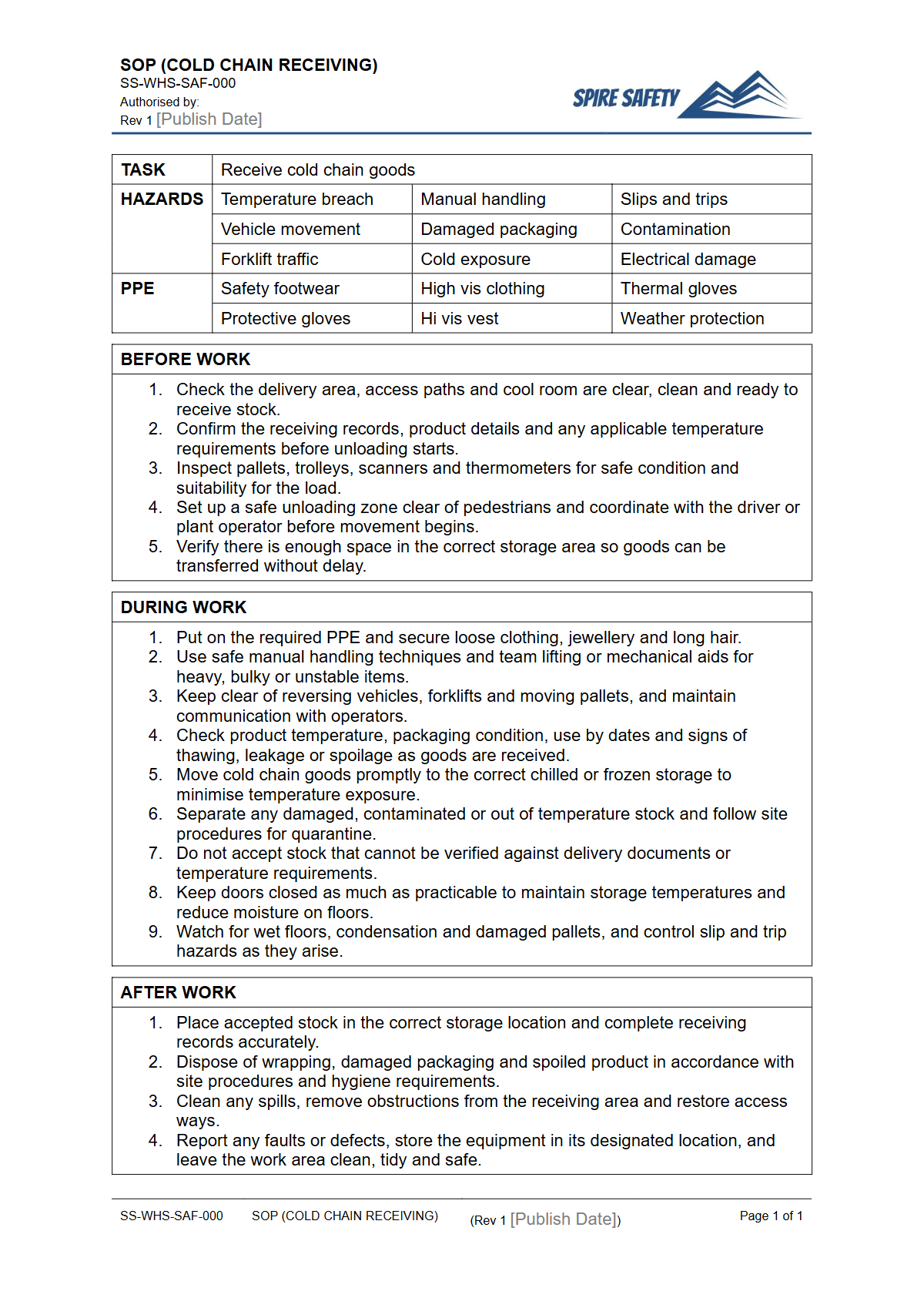
This Free Safe Operating Procedure (Cold Chain Receiving) Template provides a structured framework for outlining the steps required to safely receive, check, and store temperature-sensitive goods. Maintaining the cold chain is critical in industries like food service, pharmaceuticals, and logistics to prevent spoilage, ensure product quality, and control the risk of foodborne illness or compromised medical products.
Using this SOP helps standardise your receiving process, ensuring all team members follow a consistent, safe method for handling chilled and frozen deliveries.
A well-defined SOP is a fundamental component of a business's safety commitment. It serves as a key training document for new employees and a reference for experienced staff, reinforcing correct procedures and identifying critical control points.
This process is a core part of any robust WHS management system, demonstrating due diligence in managing foreseeable risks associated with your operations.
Video walkthrough
How to use the Free Safe Operating Procedure (Cold Chain Receiving) Template
This Safe Operating Procedure template is designed as a comprehensive starting point. After downloading the DOCX or PDF file, you must customise it to reflect the specific hazards, equipment, and environment of your workplace.
It is essential to conduct a risk assessment for your cold chain receiving tasks to identify all relevant controls.
To adapt the template:
- Insert your company name, ABN, and other relevant details.
- Review each step and modify it to match your specific receiving dock layout, the types of goods you handle, and the equipment used (e.g., infrared thermometers, probe thermometers, pallet jacks).
- Detail your specific temperature requirements for chilled and frozen goods, rejection criteria, and record-keeping processes.
- Involve your workers in the customisation process to ensure the procedure is practical and reflects how the work is actually done.
- Once finalised, use the SOP to train all relevant personnel and keep it readily accessible in the receiving area.
Important: This is a template only. We are not responsible for its customisation or implementation.
You must adapt it to your specific site conditions, legal obligations, and operational needs to ensure it is suitable for your workplace.
When to use a Cold Chain Receiving SOP
A Safe Operating Procedure for cold chain receiving should be used every time a delivery of temperature-sensitive goods arrives at your facility. This includes scheduled deliveries from regular suppliers and ad-hoc or one-off shipments.
The procedure should be initiated the moment the delivery vehicle arrives and followed through until the goods are safely stored in the appropriate cool room, freezer, or refrigerator.
Regular reviews and updates to the SOP are also necessary, especially when new equipment is introduced, processes change, or an incident occurs. Periodic checks can be incorporated into your safety audit schedule to confirm the procedure is being followed correctly.
A thorough WHS compliance audit will often review the existence and effectiveness of such critical operational documents.
Who should use this Safe Operating Procedure
This SOP should be used by all personnel involved in the receipt and handling of temperature-sensitive deliveries. This typically includes:
- Warehouse and receiving staff
- Kitchen hands and chefs
- Logistics coordinators
- Storepersons
- Any other workers responsible for checking, moving, and storing chilled or frozen products
Supervisors and managers are responsible for ensuring that staff are trained on the SOP and that its procedures are consistently followed. Effective training ensures everyone understands not just the 'how' but also the 'why' behind each step, such as the importance of temperature control for safety and quality. It also covers what to do in an emergency, which could involve anything from a major spill to a medical event requiring the use of specific equipment detailed in a defibrillator operation Safe Operating Procedure.
Furthermore, the procedure should account for all physical tasks involved, including manual handling and the use of equipment. If staff need to access items stored at height during put-away, their training should cover safe practices for equipment like ladders, as outlined in a specific step ladder Safe Operating Procedure. You can find more templates like these in our free WHS resources library to support your business's safety framework.
Common mistakes
Common mistakes to avoid
- Failing to check and record product temperatures immediately upon arrival.
- Accepting deliveries that have been left unattended on a loading dock.
- Using an uncalibrated or inaccurate thermometer for temperature checks.
- Neglecting to inspect packaging for signs of damage or thawing.
- Inadequate record-keeping, leaving no proof of due diligence.
Legal references
Legal considerations
The following legal requirements may be relevant to this type of work.
- Work Health and Safety Act (Harmonised) — Provides the primary duties for protecting workers and other people from work health and safety risks.
- Work Health and Safety Regulations (Harmonised) — Sets out requirements supporting the management of workplace hazards and risks.
The following codes may be relevant to this type of work.
- Managing WHS Risks Code of Practice — Provides practical guidance on identifying hazards, assessing risks and applying effective controls.
- Work Health and Safety Consultation, Cooperation and Coordination Code of Practice — Provides practical guidance on consulting workers and coordinating with other duty holders.
- Managing the Work Environment and Facilities Code of Practice — Provides practical guidance on safe work environments, workplace facilities and related controls.
Did you know
The Temperature Danger Zone
According to Food Standards Australia New Zealand (FSANZ), the temperature danger zone where bacteria grow most rapidly is between 5°C and 60°C. Potentially hazardous foods must be kept either below 5°C or above 60°C to remain safe.
Economic Impact
Breaks in the cold chain are a significant cause of product loss in the food and pharmaceutical industries, costing billions globally each year due to spoilage and waste.
FAQ
Frequently asked questions
01What is a cold chain receiving SOP for?
02Why is temperature control important when receiving goods?
03What key information should be in a cold chain receiving procedure?
04Who is responsible for checking temperatures of incoming deliveries?
Share this resource
Free Safe Operating Procedure (Cold Chain Receiving) Template
Browse Categories
How To Use It
- 1Download and open in Word or PDF.
- 2Replace the placeholders with your business details.
- 3Get it reviewed by a WHS specialist before rollout.
Need it customised?
Our WHS consultants can adapt this template to your site, run a gap analysis, or audit what you already have in place.
Book a Free Consultation WHS consulting servicesor call 1300 156 382
Related templates
- Free Safe Operating Procedure (Cold Cutting Pipe) Template
- Free Safe Operating Procedure (Cold Room Cleaning) Template
- Free Safe Operating Procedure (Cold Saw) Template
- Free Safe Operating Procedure (Combi Oven) Template
- Free Safe Operating Procedure (Commercial Bin Pickup) Template
- Free Safe Operating Procedure (Commercial Blender) Template