
Free Safe Operating Procedure (Commercial Bin Pickup) Template
Streamline your safety processes with our free Safe Operating Procedure (Commercial Bin Pickup) Template. Aligned with Australian WHS standards. Download now.
Free Safe Operating Procedure (Commercial Bin Pickup) Template
DOCX • 126 KB + PDF
Updated Oct 2026
No signup required
Purpose of the Free Safe Operating Procedure (Commercial Bin Pickup) Template
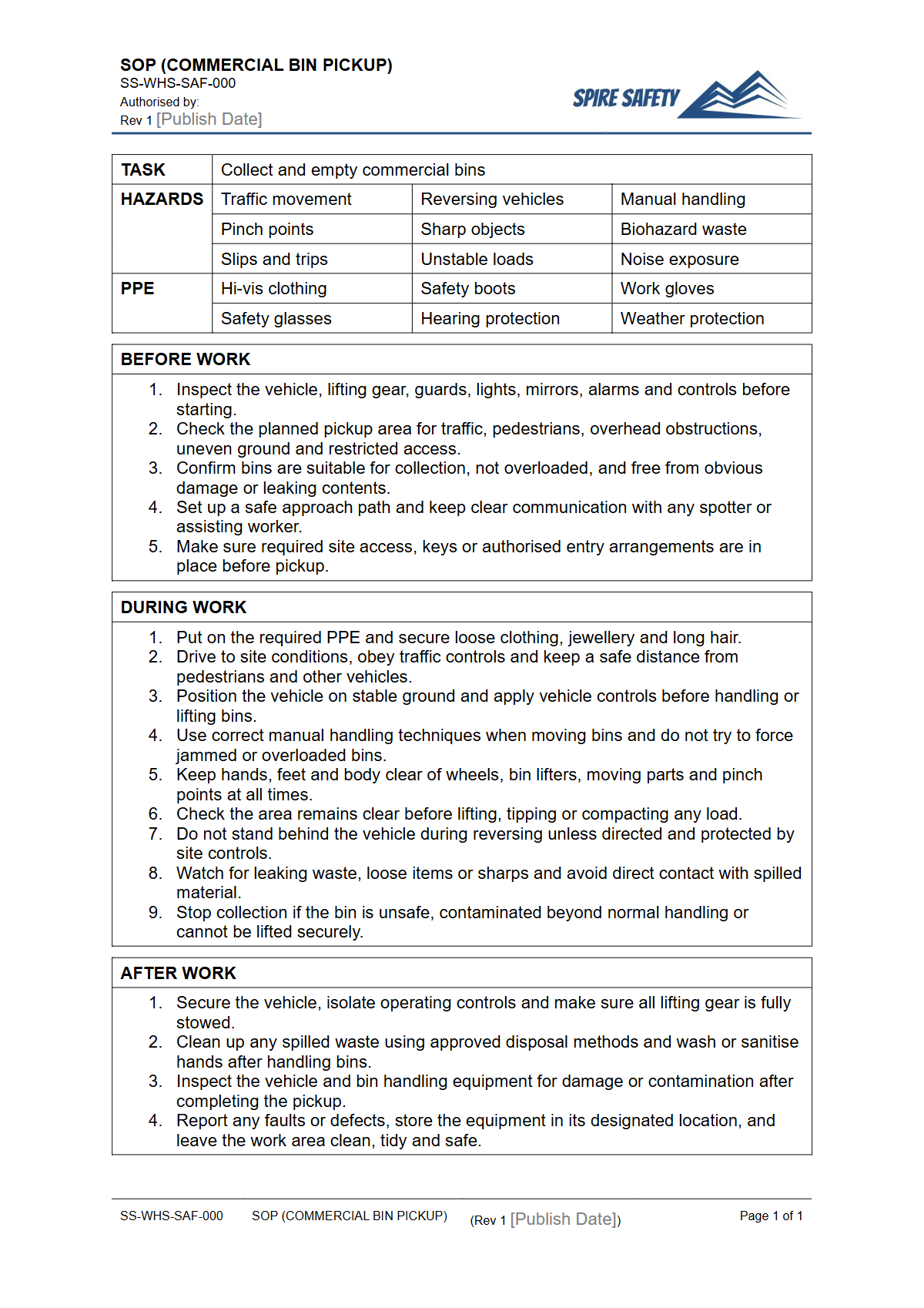
This Free Safe Operating Procedure (Commercial Bin Pickup) Template provides a structured framework for documenting the safest method to perform commercial waste collection tasks. The primary goal is to minimise the risk of injury to operators, other workers, and the public.
Commercial bin pickup involves significant hazards, including moving vehicles, hydraulic equipment, manual handling, and interaction with traffic. A documented SOP ensures that a consistent, risk-assessed process is followed every time, reducing the likelihood of incidents.
By clearly defining steps, required personal protective equipment (PPE), and emergency responses, this SOP becomes a vital tool for worker training and competency verification. It forms a cornerstone of systematic safety management, helping your organisation meet its duty of care obligations under WHS legislation.
Integrating clear operational procedures is a fundamental component of building robust WHS management systems that protect people and support compliance.
Video walkthrough
How to use the Free Safe Operating Procedure (Commercial Bin Pickup) Template
This template is provided in both DOCX and PDF formats for your convenience. The DOCX file is fully editable, allowing for comprehensive customisation to reflect the specific equipment, environment, and risks at your workplace.
It is crucial to adapt this document to your unique operational context.
To effectively use this template:
- Download the DOCX file.
- Conduct a thorough risk assessment for your specific commercial bin pickup tasks, involving the workers who perform the job.
- Modify the template content to address the identified hazards and control measures. This includes specifying the make and model of collection vehicles, types of bins handled, site-specific traffic management rules, and emergency contact details.
- Clearly outline the required pre-start checks, operational steps for lifting and emptying bins, and shutdown procedures.
- Submit the draft for review and approval according to your organisation's internal processes.
Note: We have designed this template as a comprehensive starting point. You must customise it with your site-specific information to ensure it is relevant and effective for your workplace.
A generic procedure that doesn't account for your specific machinery, like the unique risks associated with concrete placement which are addressed in our free Boom Pump SOP, will not adequately control risk.
Key Risks to Address in Your SOP
When customising your procedure, pay close attention to the primary hazards associated with commercial bin collection. These include:
- Traffic Management: Risks of collision with other vehicles, pedestrians, or cyclists. Your SOP should detail procedures for vehicle positioning, use of warning lights, and managing blind spots.
- Struck-by Hazards: The risk of workers or others being hit by the vehicle or the lifting mechanism. Procedures should enforce exclusion zones.
- Crush Injuries: Dangers associated with the compaction and lifting mechanisms of the truck. Lockout/tagout procedures for maintenance and clearing blockages are essential. Managing the risks of heavy mobile plant is a common requirement, similar to procedures outlined in a free Telehandler SOP template.
- Manual Handling: Musculoskeletal injuries from moving heavy, awkward, or overfilled bins. The SOP should specify mechanical aids and correct handling techniques.
- Environmental Hazards: Slips, trips, and falls on uneven or slippery surfaces, and risks from overhead powerlines.
Training and Implementation
A documented SOP is only effective if workers are trained on its contents. All operators, supervisors, and spotters involved in commercial bin pickup must receive training on the finalised procedure.
This training should cover all aspects of the SOP, from pre-start checks to emergency response. It's important to verify that workers are competent to operate specific machinery safely, a principle that also applies to tasks like excavation, which would be covered in a free Trencher SOP template. Keep detailed records of all training provided, including dates, attendees, and content covered.
The SOP should be readily accessible to all relevant workers during their shifts.
Review and Continuous Improvement
Safe Operating Procedures are living documents that require regular review to remain effective. Your SOP for commercial bin pickup should be reviewed periodically (e.g., annually) and also whenever there is a change in equipment or process, or after an incident or near-miss occurs.
This process of review and improvement ensures your safety documentation keeps pace with operational realities. A scheduled program of professional WHS compliance auditing can help identify gaps and opportunities for improvement in your safety systems. As part of this review, ensure emergency protocols are up-to-date, including details for first aid response and access to critical equipment as covered in a defibrillator operation procedure.
This SOP is one of many tools available to help you build a safer workplace. For more templates and guidance documents covering a wide range of tasks and equipment, explore our complete free WHS resources library.
Common mistakes
Common mistakes to avoid
- Using a generic SOP without customising it for site-specific vehicles, bins, and traffic conditions.
- Failing to conduct a thorough risk assessment before finalising the procedure.
- Neglecting to train all relevant workers and verify their understanding of the SOP.
- Not reviewing and updating the SOP after an incident, near miss, or change in operations.
Legal references
Legal considerations
The following legal requirements may be relevant to this type of work.
- Work Health and Safety Act (Harmonised) — Provides the primary duties for protecting workers and other people from work health and safety risks.
- Work Health and Safety Regulations (Harmonised) — Sets out requirements supporting the management of workplace hazards and risks.
The following codes may be relevant to this type of work.
- Managing WHS Risks Code of Practice — Provides practical guidance on identifying hazards, assessing risks and applying effective controls.
- Work Health and Safety Consultation, Cooperation and Coordination Code of Practice — Provides practical guidance on consulting workers and coordinating with other duty holders.
- Managing the Work Environment and Facilities Code of Practice — Provides practical guidance on safe work environments, workplace facilities and related controls.
Did you know
Waste Collection Risks
According to Safe Work Australia, the waste collection industry has one of the highest rates of work-related injuries and fatalities, with vehicle incidents being a leading cause.
FAQ
Frequently asked questions
01What are the main hazards involved in commercial bin pickup?
02How often should a Safe Operating Procedure for bin pickup be reviewed?
03Is a Safe Work Method Statement (SWMS) the same as an SOP?
04Who is responsible for training workers on this SOP?
Share this resource
Free Safe Operating Procedure (Commercial Bin Pickup) Template
Browse Categories
How To Use It
- 1Download and open in Word or PDF.
- 2Replace the placeholders with your business details.
- 3Get it reviewed by a WHS specialist before rollout.
Need it customised?
Our WHS consultants can adapt this template to your site, run a gap analysis, or audit what you already have in place.
Book a Free Consultation WHS consulting servicesor call 1300 156 382
Related templates
- Free Safe Operating Procedure (Commercial Blender) Template
- Free Safe Operating Procedure (Commercial Dryer) Template
- Free Safe Operating Procedure (Commercial Microwave) Template
- Free Safe Operating Procedure (Commercial Oven Operation) Template
- Free Safe Operating Procedure (Commode Brake Check) Template
- Free Safe Operating Procedure (Commode Chair Cleaning) Template