
Free Safe Operating Procedure (Commercial Dryer) Template
Download our free Safe Operating Procedure (Commercial Dryer) Template. This customisable DOCX and PDF helps Australian businesses document safe work methods.
Free Safe Operating Procedure (Commercial Dryer) Template
DOCX • 126 KB + PDF
Updated Oct 2026
No signup required
Purpose of the Free Safe Operating Procedure (Commercial Dryer) Template
Commercial dryers are powerful pieces of plant essential in many industries, from laundromats and hotels to healthcare facilities. However, they also introduce significant workplace hazards, including burns from hot surfaces, fires from lint buildup or improperly handled materials, electrical shocks, and ergonomic strains from loading and unloading.
Managing these risks requires a formal, documented process. This is the core purpose of our Free Safe Operating Procedure (Commercial Dryer) Template.
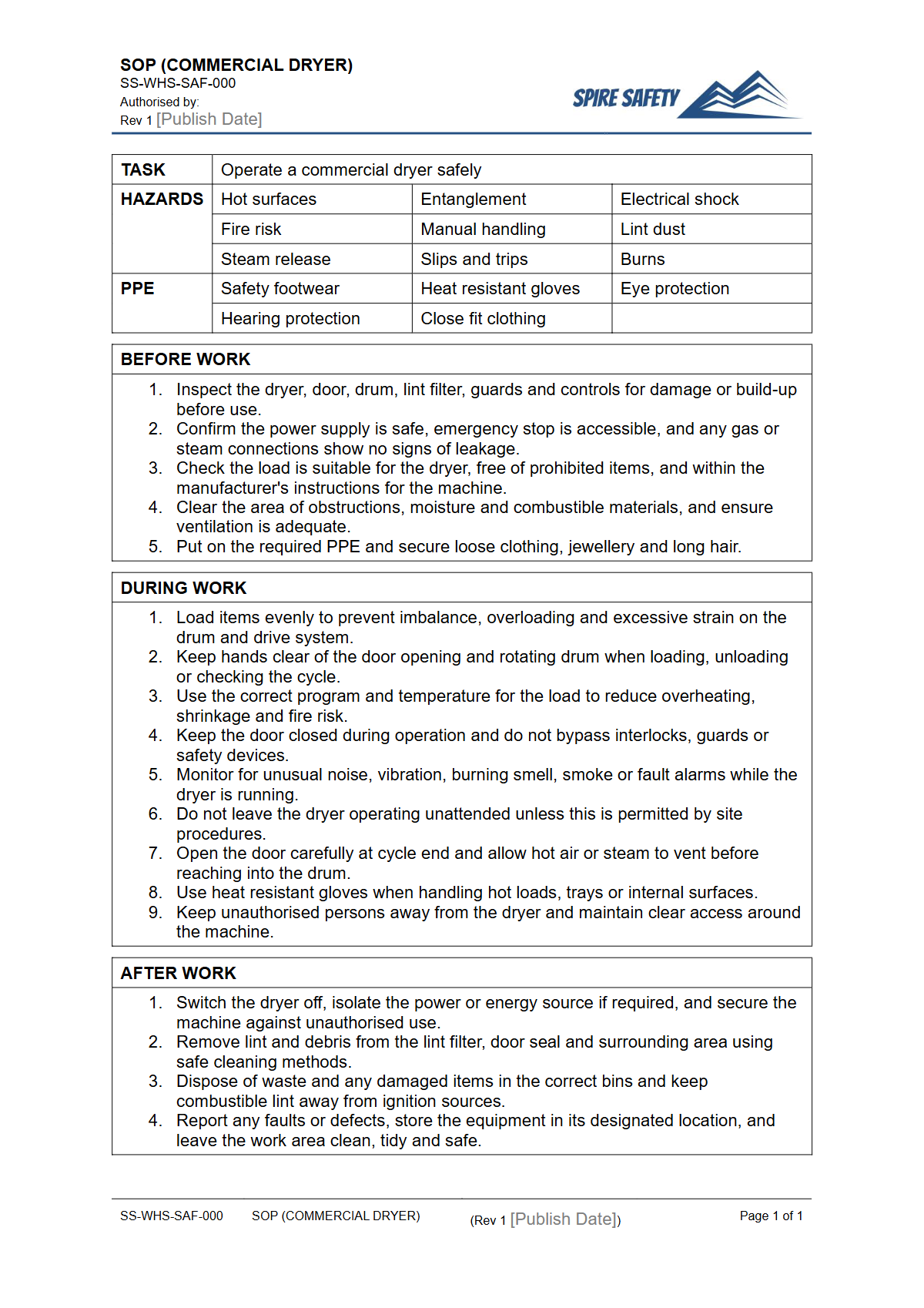
This template provides a structured framework for documenting the specific, step-by-step instructions for operating your commercial dryers safely. It is designed to be a key component of your overall WHS management systems, helping you meet your duty of care to provide a safe work environment.
A well-developed Safe Operating Procedure (SOP) formalises safe work practices, serves as a vital training tool, and establishes a clear standard for performance and supervision.
The document guides you through outlining key safety elements, including:
- Required Personal Protective Equipment (PPE).
- Pre-operational safety checks (e.g., checking lint filters, door seals, and controls).
- A logical sequence for safe operation.
- Procedures for safe shutdown and cleaning.
- Emergency response actions.
Video walkthrough
How to use the Free Safe Operating Procedure (Commercial Dryer) Template
Using this template is a straightforward process designed to give you a strong foundation for your site-specific document. The procedure is available for download as a DOCX file, which is fully editable in Microsoft Word or other compatible programs, and a PDF for easy viewing and distribution.
First, download the template and review its contents. Next, gather information about your specific commercial dryer models, the tasks your workers perform, and the findings from your risk assessments.
Involve the workers who operate the dryers in the customisation process; their hands-on experience is invaluable for creating a practical and effective SOP.
Important: This document provides a starting point aligned with Australian WHS principles. We have created it as a guide, but it is not a finished, document.
You must customise this template to reflect the specific equipment, environment, and hazards present in your workplace to ensure it is effective and supports your safety obligations.
Once customised, the SOP should be used to train all relevant personnel. Its effectiveness should be periodically reviewed as part of your standard WHS compliance auditing processes to ensure it remains current and relevant.
When to use a Safe Operating Procedure
A Safe Operating Procedure for a commercial dryer should be an active document within your workplace, not one that sits on a shelf. It is used in several key situations.
It forms the backbone of induction and training for new employees, ensuring they learn the correct, safe method from day one. It also serves as a critical reference for refresher training for existing staff.
Following a near miss or incident involving a dryer, the SOP is an essential tool for investigation to determine if procedures were followed and if they need improvement. It is also a key document to review when new dryer models are introduced, when work processes change, or when relevant WHS legislation is updated.
A robust collection of SOPs, including documents like a Safe Operating Procedure for defibrillator operation, creates a safer, more predictable work environment for everyone.
Who should use it
This SOP template is intended for a range of personnel within any organisation that uses commercial drying equipment. This includes:
- Plant Operators: The primary users who perform the day-to-day operation of the dryers.
- Supervisors and Managers: Responsible for ensuring staff are trained and adhering to the documented procedures.
- WHS/HSE Professionals: Responsible for developing, implementing, and reviewing safety systems.
- Maintenance Personnel: Who need to understand the safe shutdown and isolation procedures before conducting maintenance or repairs.
A business will often require numerous SOPs to cover its various activities and equipment. For example, a workshop or factory might also need an Air Compressor SOP to manage the risks of pressurised air systems.
Even simple tasks that support the main operation, like accessing high shelves, should be covered by a relevant Step Ladder SOP to prevent common fall-related injuries. You can find more templates like these in our free WHS resources library.
Common mistakes
Common mistakes to avoid
- Forgetting to clean the lint filter after every drying cycle, creating a major fire hazard.
- Overloading the machine, which leads to inefficient drying and can cause the motor to overheat.
- Drying items that have been contaminated with flammable substances like oils, fats, solvents, or chemicals.
- Bypassing or disabling safety features, such as door interlock switches, to speed up operations.
Legal references
Legal considerations
The following legal requirements may be relevant to this type of work.
- Work Health and Safety Act (Harmonised) — Provides the primary duties for protecting workers and other people from work health and safety risks.
- Work Health and Safety Regulations (Harmonised) — Sets out requirements supporting the management of workplace hazards and risks.
The following codes may be relevant to this type of work.
- Managing WHS Risks Code of Practice — Provides practical guidance on identifying hazards, assessing risks and applying effective controls.
- Work Health and Safety Consultation, Cooperation and Coordination Code of Practice — Provides practical guidance on consulting workers and coordinating with other duty holders.
- Managing the Work Environment and Facilities Code of Practice — Provides practical guidance on safe work environments, workplace facilities and related controls.
Did you know
Fire Risk
The US National Fire Protection Association reports that failure to clean is the leading factor contributing to clothes dryer fires in residential buildings. This risk is amplified in commercial settings due to higher usage and lint volume.
FAQ
Frequently asked questions
01What are the main hazards of a commercial dryer?
02Is a Safe Operating Procedure a legal requirement in Australia?
03How often should a commercial dryer SOP be reviewed?
04Can this template be used for a domestic dryer in a commercial setting?
Share this resource
Free Safe Operating Procedure (Commercial Dryer) Template
Browse Categories
How To Use It
- 1Download and open in Word or PDF.
- 2Replace the placeholders with your business details.
- 3Get it reviewed by a WHS specialist before rollout.
Need it customised?
Our WHS consultants can adapt this template to your site, run a gap analysis, or audit what you already have in place.
Book a Free Consultation WHS consulting servicesor call 1300 156 382
Related templates
- Free Safe Operating Procedure (Commercial Microwave) Template
- Free Safe Operating Procedure (Commercial Oven Operation) Template
- Free Safe Operating Procedure (Commode Brake Check) Template
- Free Safe Operating Procedure (Commode Chair Cleaning) Template
- Free Safe Operating Procedure (Commode Emptying) Template
- Free Safe Operating Procedure (Common Area Washdown) Template