
Free Safe Operating Procedure (Commercial Microwave) Template
Download our Free Safe Operating Procedure for a Commercial Microwave. This customisable DOCX & PDF template helps you outline safe work systems. Get yours now.
Free Safe Operating Procedure (Commercial Microwave) Template
DOCX • 126 KB + PDF
Updated Oct 2026
No signup required
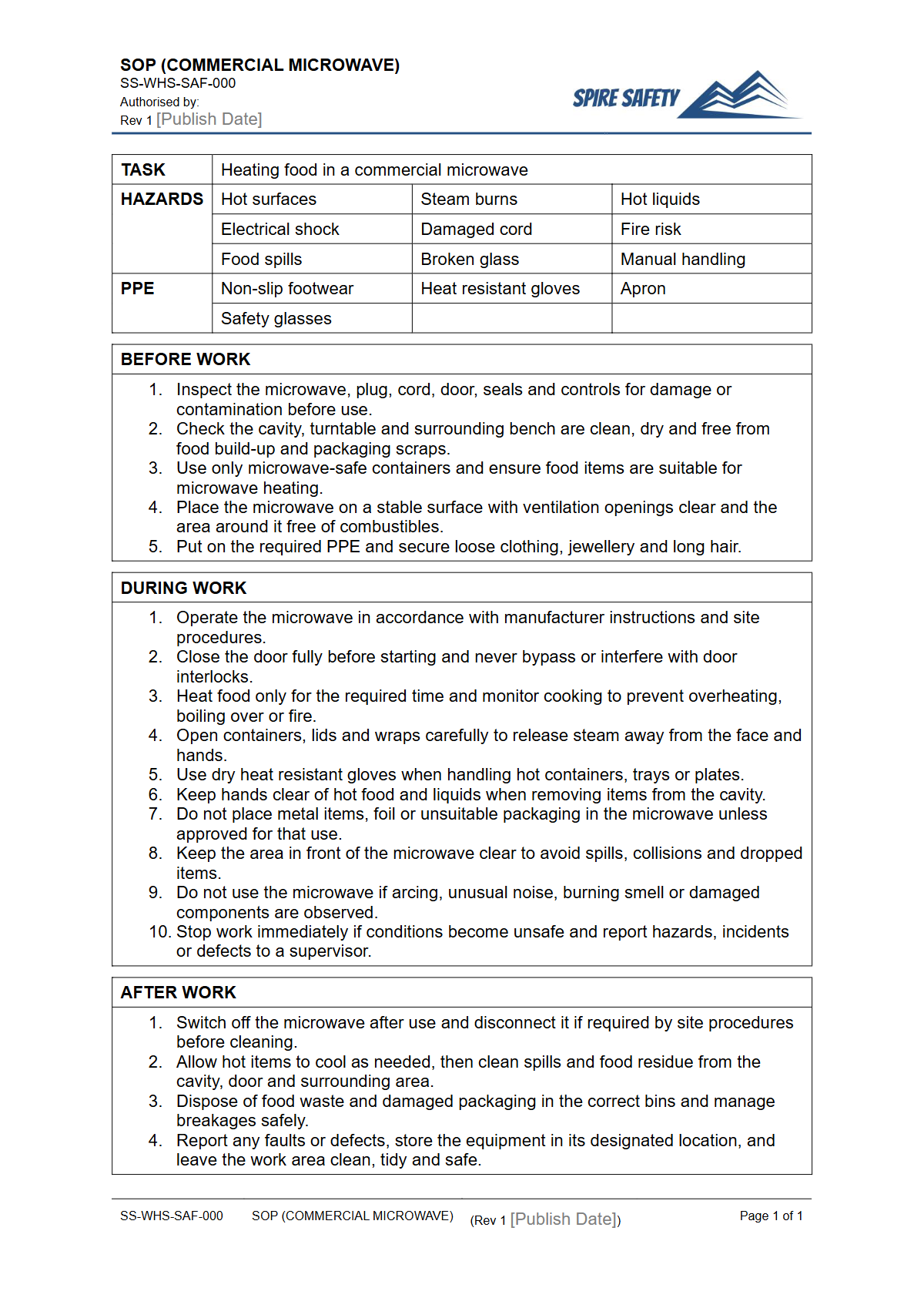
Purpose of the Free Safe Operating Procedure (Commercial Microwave) Template
Operating commercial microwaves introduces specific risks into a fast-paced kitchen environment. This Free Safe Operating Procedure (Commercial Microwave) Template provides a structured framework to document the step-by-step process for using this equipment safely.
Its primary purpose is to help Persons Conducting a Business or Undertaking (PCBUs) manage hazards and reduce the risk of injury. Key risks associated with commercial microwaves include thermal burns from hot food, liquids, and steam; electrical shock from faulty or poorly maintained units; and potential exposure to microwave radiation if door seals or interlock systems are damaged.
By clearly defining the required precautions, pre-operational checks, and correct operating steps, this SOP serves as a critical control measure. It forms an essential part of your broader WHS management systems, demonstrating a commitment to providing a safe working environment and clear instructions for your workers.
It helps ensure consistent, safe practices are followed by all staff, regardless of their experience level.
Video walkthrough
How to use the Free Safe Operating Procedure (Commercial Microwave) Template
This document is a comprehensive starting point, not a finished document. To be effective, it must be adapted to your specific workplace.
Download the template and customise it by adding details specific to your site, including the make and model of your microwave(s), the types of food and containers used, and your specific emergency procedures. Pay close attention to the sections requiring you to list Personal Protective Equipment (PPE), such as heat-resistant gloves for handling hot items.
We recommend a competent person, such as a workplace manager or safety officer, leads a consultation process with the kitchen staff who actually use the equipment. Their input is invaluable for creating a practical and effective procedure.
Once customised, the SOP should be formally approved and made readily accessible to all relevant workers. Regular reviews are also crucial, especially after a WHS compliance auditing process, if new equipment is introduced, or if an incident occurs.
When to use a Safe Operating Procedure
An SOP for a commercial microwave should be a core component of your safety framework. It is used in several key situations.
It's an essential tool for training and inducting new employees, ensuring they understand the correct procedures from day one. The SOP should also be used for regular refresher training to reinforce safe behaviour and address any bad habits that may have developed over time.
It serves as a constant point of reference for all workers, available in the work area to quickly clarify a step or safety check. Furthermore, the SOP is a vital document for investigating any incidents or near misses involving the microwave, helping to identify whether procedures were followed and if they need to be updated.
A robust set of SOPs, including a Safe Operating Procedure (Defibrillator Operation) template, demonstrates a proactive approach to emergency preparedness.
Who should use this Safe Operating Procedure
This Safe Operating Procedure is designed for any worker who operates, cleans, or supervises the use of a commercial microwave. This includes chefs, cooks, kitchen hands, apprentices, and cafe staff.
It is particularly important for businesses in the hospitality and food service sectors, such as restaurants, catering companies, hotels, pubs, and clubs. The document is also relevant for institutional settings like hospitals, aged care facilities, and school canteens where commercial-grade equipment is standard.
Supervisors and managers are responsible for ensuring the SOP is implemented, understood, and followed by their teams. They should use it as a basis for training, toolbox talks, and performance monitoring.
In many commercial kitchens, staff perform a variety of tasks, which may involve using other equipment or reaching high shelves for supplies; having documented procedures like a Step Ladder SOP ensures safety across all activities.
Explore our full free WHS resources library for more templates and guides to support your workplace safety organisation.
Common mistakes
Common mistakes to avoid
- Using non-commercial or metal containers, leading to fire or equipment damage.
- Neglecting to clean spills and food residue, which can cause uneven heating and become a fire hazard.
- Operating the microwave with a damaged door, latch, or seal, creating a potential radiation leak.
- Failing to train casual, temporary, or new staff on the specific operating procedures.
Legal references
Legal considerations
The following legal requirements may be relevant to this type of work.
- Work Health and Safety Act (Harmonised) — Provides the primary duties for protecting workers and other people from work health and safety risks.
- Work Health and Safety Regulations (Harmonised) — Sets out requirements supporting the management of workplace hazards and risks.
The following codes may be relevant to this type of work.
- Managing WHS Risks Code of Practice — Provides practical guidance on identifying hazards, assessing risks and applying effective controls.
- Work Health and Safety Consultation, Cooperation and Coordination Code of Practice — Provides practical guidance on consulting workers and coordinating with other duty holders.
- Managing the Work Environment and Facilities Code of Practice — Provides practical guidance on safe work environments, workplace facilities and related controls.
Did you know
Accidental Invention
The microwave oven was invented by accident in 1945 by Percy Spencer, an American engineer, who noticed a chocolate bar in his pocket had melted while he was working on an active radar set.
Power Difference
Commercial microwaves are significantly more powerful than domestic models, typically ranging from 1,000 to over 3,000 watts. This allows for faster cooking but also increases the severity of potential steam and burn injuries if not handled correctly.
FAQ
Frequently asked questions
01What hazards are associated with a commercial microwave?
02Is an SOP a legal requirement for a commercial microwave in Australia?
03How often should microwave SOP training be conducted?
04Can I use domestic containers in a commercial microwave?
Share this resource
Free Safe Operating Procedure (Commercial Microwave) Template
Browse Categories
How To Use It
- 1Download and open in Word or PDF.
- 2Replace the placeholders with your business details.
- 3Get it reviewed by a WHS specialist before rollout.
Need it customised?
Our WHS consultants can adapt this template to your site, run a gap analysis, or audit what you already have in place.
Book a Free Consultation WHS consulting servicesor call 1300 156 382
Related templates
- Free Safe Operating Procedure (Commercial Oven Operation) Template
- Free Safe Operating Procedure (Commode Brake Check) Template
- Free Safe Operating Procedure (Commode Chair Cleaning) Template
- Free Safe Operating Procedure (Commode Emptying) Template
- Free Safe Operating Procedure (Common Area Washdown) Template
- Free Safe Operating Procedure (Community Garden Care) Template