
Free Safe Operating Procedure (Community Garden Care) Template
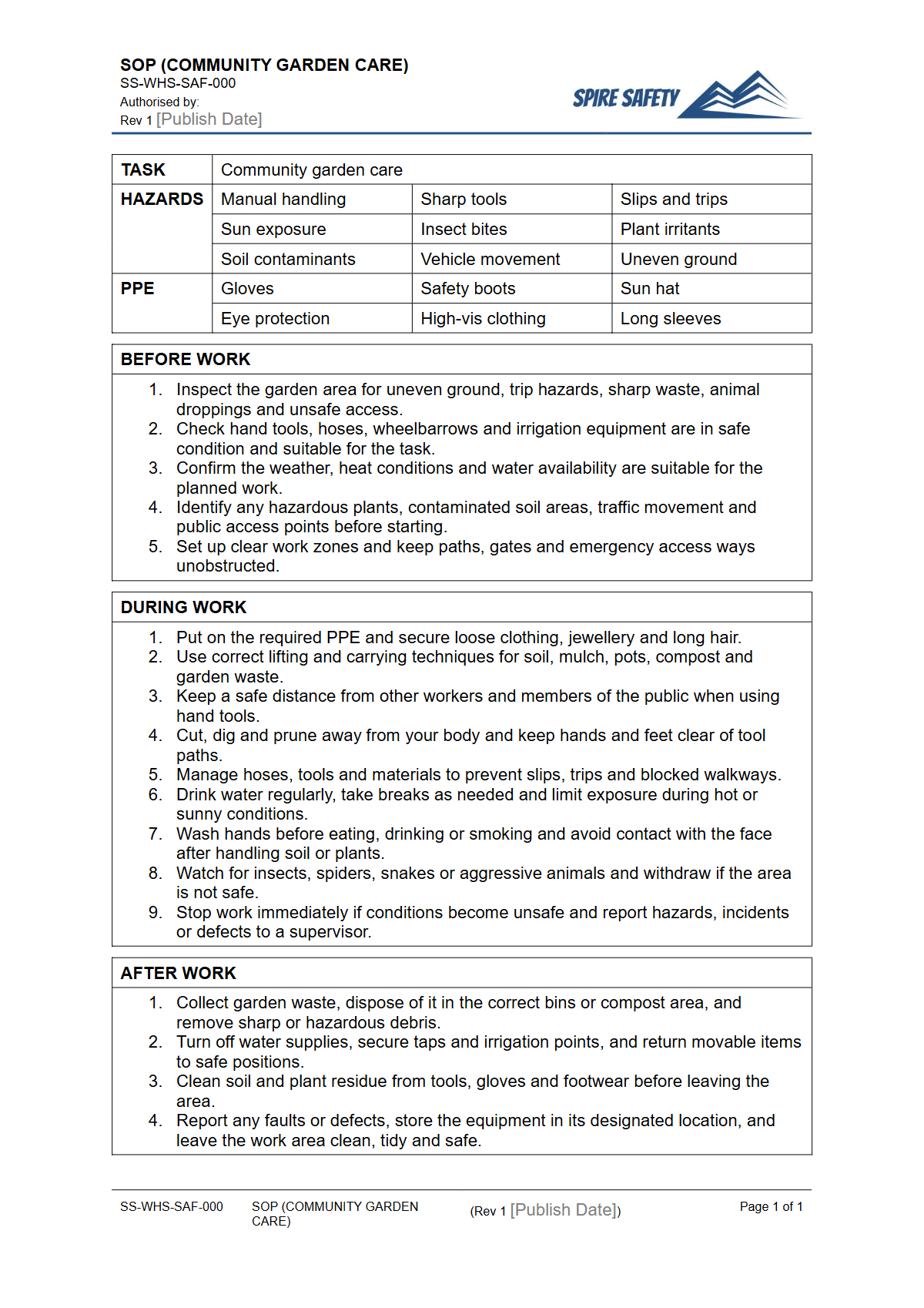
Download our free Safe Operating Procedure (Community Garden Care) template. This DOCX and PDF resource helps outline risks and controls for gardening tasks.
Free Safe Operating Procedure (Community Garden Care) Template
DOCX • 126 KB + PDF
Updated Oct 2026
No signup required
Purpose of the Free Safe Operating Procedure (Community Garden Care) Template
A Safe Operating Procedure (SOP) is a crucial document that provides step-by-step instructions on how to perform a task safely. This free Safe Operating Procedure (Community Garden Care) template is designed to help community garden coordinators, committees, and volunteers identify and manage the health and safety risks associated with garden maintenance.
It provides a structured format to document controls for hazards related to tool use, manual handling, chemical application, and general site upkeep. Having a clear SOP helps ensure everyone understands the expected safe work practices, reducing the risk of injuries.
Community gardens involve a variety of tasks, from simple weeding to operating small equipment. Documenting procedures for using tools like shovels, secateurs, lawnmowers, and even ladders is essential for preventing incidents.
For tasks involving work at height, even at a low level, having a specific procedure is vital, and our free Step Ladder SOP template can provide more detailed guidance for that specific activity.
Video walkthrough
How to use the Free Safe Operating Procedure (Community Garden Care) Template
This Safe Operating Procedure for community garden care is provided as a starting point. It is delivered in both DOCX and PDF formats for your convenience.
Download the DOCX file to edit and tailor the content to the specific equipment, environment, and personnel at your community garden. A well-customised SOP becomes an integral part of your overall safety framework, demonstrating a commitment to health and safety management.
Integrating these procedures into broader WHS management systems helps create a consistent and organised approach to safety across all your activities.
Customising Your Community Garden SOP
It is essential that you customise this template. Every community garden is unique, with different layouts, tools, and participant skill levels.
Your SOP must reflect these specific conditions to be effective. During customisation, you should:
- List all plant and equipment used on-site, including hand tools, power tools, and watering systems.
- Identify site-specific hazards such as uneven ground, trip hazards, sharp objects, water bodies, or local wildlife.
- Detail the specific chemicals used, such as fertilisers or organic pesticides, and reference their Safety Data Sheets (SDS).
- Outline your specific emergency procedures, including first aid contacts, assembly points, and the location of safety equipment. For critical medical emergencies, having a documented process is key; our Defibrillator Operation SOP provides a useful example for life-saving equipment.
- Specify the Personal Protective Equipment (PPE) required for each task, such as gloves, safety glasses, enclosed footwear, and sun protection.
Once you have tailored the document, consider engaging a professional to perform regular WHS compliance audits to ensure your procedures remain effective and aligned with current standards.
When to use it
The Community Garden Care SOP should be a living document used throughout your operations. It is not a 'set and forget' tool.
Use it during volunteer inductions to familiarise new members with safe practices from day one. It should also be a reference for toolbox talks before starting a group activity or a new project.
If your garden undertakes a significant one-off project, like installing new garden beds with specialised equipment, you may need a separate SOP, similar to our free Trencher SOP for excavation work. The SOP must also be reviewed and updated after any incident or near miss, or when new equipment or procedures are introduced.
Who should use it
This SOP should be used by anyone involved in the organisation and operation of the community garden. This includes the PCBU (Person Conducting a Business or Undertaking), which could be the committee or association managing the garden.
It is also for garden coordinators responsible for day-to-day management and, most importantly, for the volunteers and members who perform the gardening tasks. Ensuring all individuals are trained and deemed competent in the procedures outlined in the SOP is a key responsibility of the garden's management.
If you need assistance defining roles and responsibilities or implementing training programs, our WHS consulting services can provide expert guidance.
Common mistakes
Common mistakes to avoid
- Using the generic template without customising it for site-specific tools and hazards.
- Failing to train all volunteers and members on the procedures outlined in the SOP.
- Not reviewing and updating the SOP after an incident, near miss, or change in practice.
- Overlooking risks associated with hazardous manual tasks, such as lifting heavy bags or pushing wheelbarrows.
Legal references
Legal considerations
The following legal requirements may be relevant to this type of work.
- Work Health and Safety Act (Harmonised) — Provides the primary duties for protecting workers and other people from work health and safety risks.
- Work Health and Safety Regulations (Harmonised) — Sets out requirements supporting the management of workplace hazards and risks.
The following codes may be relevant to this type of work.
- Managing WHS Risks Code of Practice — Provides practical guidance on identifying hazards, assessing risks and applying effective controls.
- Work Health and Safety Consultation, Cooperation and Coordination Code of Practice — Provides practical guidance on consulting workers and coordinating with other duty holders.
- Managing the Work Environment and Facilities Code of Practice — Provides practical guidance on safe work environments, workplace facilities and related controls.
Did you know
Gardening Injuries
The Australian Institute of Health and Welfare reports that gardening is a common cause of hospitalised injuries, with falls and contact with tools or machinery being frequent mechanisms of injury.
Growth of Community Gardens
Community gardens in Australia have seen significant growth, recognised for their benefits to mental health, physical activity, and community connection, making formalised safety practices increasingly important.
FAQ
Frequently asked questions
01What tasks should be covered in a community garden SOP?
02Is an SOP legally required for a community garden in Australia?
03How often should we review our Community Garden SOP?
04Who is responsible for safety in a volunteer-run community garden?
Share this resource
Free Safe Operating Procedure (Community Garden Care) Template
Browse Categories
How To Use It
- 1Download and open in Word or PDF.
- 2Replace the placeholders with your business details.
- 3Get it reviewed by a WHS specialist before rollout.
Need it customised?
Our WHS consultants can adapt this template to your site, run a gap analysis, or audit what you already have in place.
Book a Free Consultation WHS consulting servicesor call 1300 156 382
Related templates
- Free Safe Operating Procedure (Community Hall Cleaning) Template
- Free Safe Operating Procedure (Community Outing Support) Template
- Free Safe Operating Procedure (Community Pool Setup) Template
- Free Safe Operating Procedure (Compaction Wheel) Template
- Free Safe Operating Procedure (Compost Bin Cleaning) Template
- Free Safe Operating Procedure (Compost Turning) Template