
Free Safe Operating Procedure (Community Hall Cleaning) Template
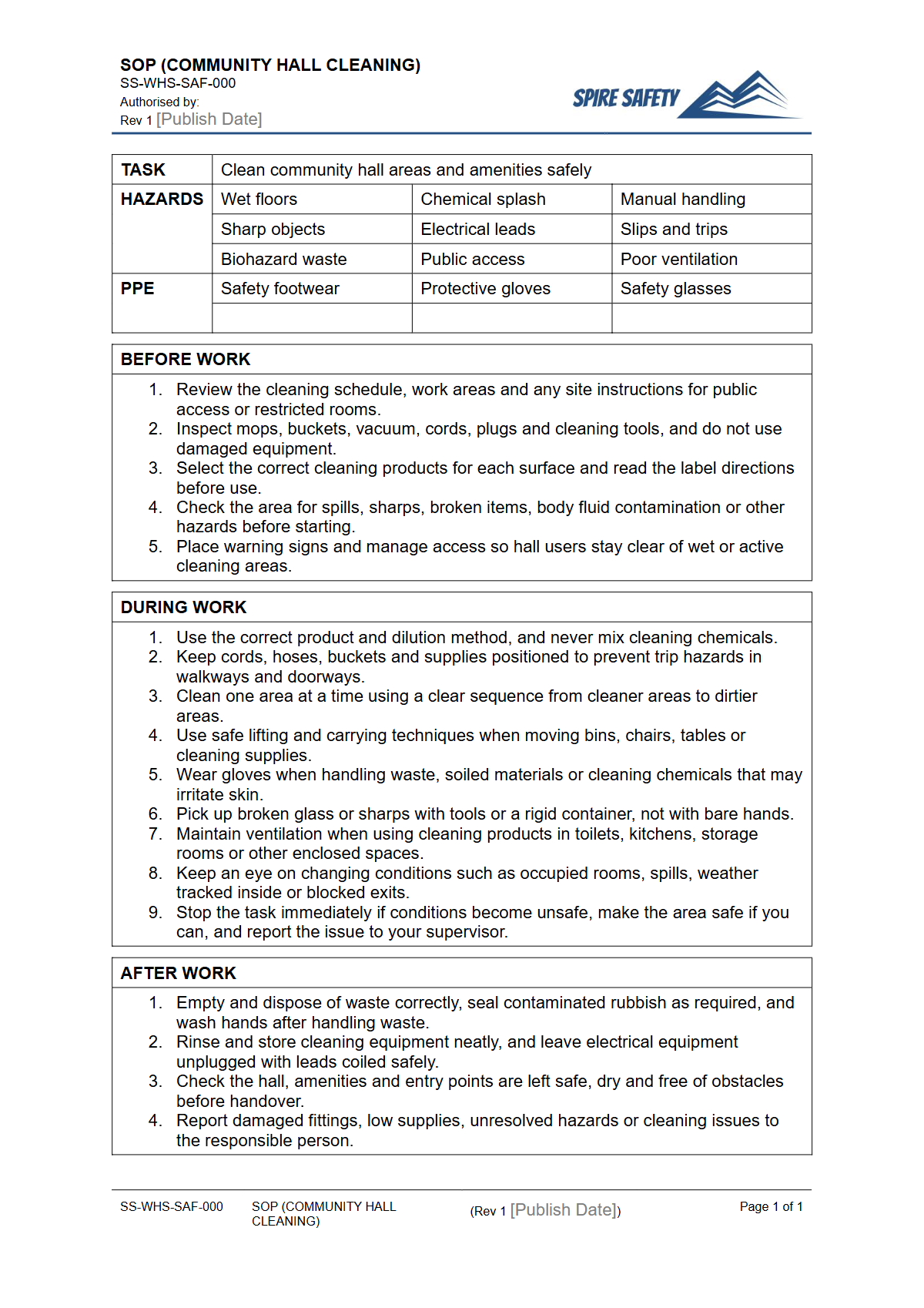
Download our free Safe Operating Procedure (Community Hall Cleaning) template. This customisable DOCX & PDF helps organisations outline safe cleaning practices.
Free Safe Operating Procedure (Community Hall Cleaning) Template
DOCX • 126 KB + PDF
Updated Oct 2026
No signup required
Purpose of the Free Safe Operating Procedure (Community Hall Cleaning) Template
This Free Safe Operating Procedure (Community Hall Cleaning) Template provides a structured framework for Persons Conducting a Business or Undertaking (PCBUs) to establish and document safe work practices for cleaning community halls and similar public venues. Cleaning tasks, while seemingly routine, present numerous hazards, including manual handling injuries, exposure to hazardous chemicals, slips, trips, and falls.
Implementing a clear SOP helps to systematically identify these risks and outline control measures to ensure the health and safety of workers, volunteers, and the public.
A well-developed SOP is a critical component of a compliant and effective safety framework. It serves as a practical tool for training, induction, and daily operational guidance.
By formalising procedures, organisations can demonstrate due diligence in managing their WHS obligations. This template is designed as a foundational document, aligned with Australian WHS principles, to help you define step-by-step instructions for tasks ranging from routine floor mopping to periodic deep cleaning, ensuring consistency and safety across all cleaning activities.
Video walkthrough
How to use the Free Safe Operating Procedure (Community Hall Cleaning) Template
To effectively use this Safe Operating Procedure for community hall cleaning, you must adapt it to the specific conditions of your venue. Start by downloading the DOCX file and conducting a thorough risk assessment of your hall, identifying all tasks and associated hazards.
This includes assessing the types of cleaning chemicals used, the equipment required (e.g., vacuums, floor polishers, ladders), and the specific layout and features of your building.
Customise the document by adding your company name, ABN, and other relevant details. Fill in the pre-start checks, operational steps, and post-task procedures with information specific to your site.
For example, detail the exact dilution ratios for your cleaning chemicals, specify the storage location for equipment, and map out routes for mopping to minimise slip hazards. It is crucial to involve the workers and volunteers who perform the cleaning tasks in this process, as their direct experience is invaluable for creating a practical and effective SOP.
This template is a starting point; we have made it for you to adapt to your specific workplace risks and legal obligations.
Once customised, the SOP should form part of your broader WHS management system. Ensure all relevant personnel are trained on the procedures and that the document is easily accessible to them. Regular reviews are essential to keep the SOP current with any changes in equipment, chemicals, or work practices.
When to use it
A Safe Operating Procedure for community hall cleaning should be used consistently for all cleaning tasks, whether they are performed daily, weekly, or periodically. It is particularly important to reference the SOP during the induction and training of new staff or volunteers to establish safe work behaviour from the outset.
It also serves as a critical reference before starting non-routine or high-risk cleaning tasks, such as working at height to clean windows or using new chemical products for the first time.
This document should be integrated into your operational planning and reviewed before any major event or change in the hall's usage that might introduce new cleaning requirements or hazards. For tasks involving specific equipment, such as ladders, the general cleaning SOP should be used in conjunction with more specific procedures, like our free Step Ladder SOP, to ensure comprehensive risk management.
Who should use it
This SOP is intended for use by anyone responsible for the safety and management of a community hall. This includes hall managers, committee members, business owners, and supervisors.
It is the primary tool for these individuals to instruct and guide employees, contractors, and volunteers who carry out cleaning duties. Everyone involved in cleaning operations, from casual staff to long-term volunteers, should be trained on and have access to the procedures outlined in the customised SOP.
Furthermore, the document is a valuable resource for those in charge of WHS compliance. Regular reviews of the SOP's implementation can be incorporated into internal safety checks or formal WHS compliance auditing programs.
This ensures that the documented procedures are being followed correctly and remain effective in controlling risks. If your organisation lacks the internal expertise to adapt this template, engaging external support through WHS consulting can provide the necessary guidance to develop a robust, site-specific document.
The SOP should also cover emergency preparedness, providing clear instructions for incidents like chemical spills or injuries. This may include referencing procedures for using onsite safety equipment, such as an AED, which is detailed in our specific defibrillator operation SOP. You can find more templates to build out your safety system in our free WHS resources library.
Common mistakes
Common mistakes to avoid
- Using a generic template without customising it for the specific hall layout and equipment.
- Failing to adequately train workers and volunteers on the procedures outlined in the SOP.
- Neglecting to include procedures for safe handling of cleaning chemicals (e.g., decanting, mixing, storage, and SDS access).
- Not scheduling regular reviews of the SOP, causing it to become outdated and ineffective.
Legal references
Legal considerations
The following legal requirements may be relevant to this type of work.
- Work Health and Safety Act (Harmonised) — Provides the primary duties for protecting workers and other people from work health and safety risks.
- Work Health and Safety Regulations (Harmonised) — Sets out requirements supporting the management of workplace hazards and risks.
The following codes may be relevant to this type of work.
- Managing WHS Risks Code of Practice — Provides practical guidance on identifying hazards, assessing risks and applying effective controls.
- Work Health and Safety Consultation, Cooperation and Coordination Code of Practice — Provides practical guidance on consulting workers and coordinating with other duty holders.
- Managing the Work Environment and Facilities Code of Practice — Provides practical guidance on safe work environments, workplace facilities and related controls.
Did you know
Slips, Trips, and Falls
According to Safe Work Australia, slips, trips, and falls are a leading cause of workplace injuries, with cleaning-related activities like mopping being a major contributor to wet and slippery surfaces.
Chemical Safety
Mixing common cleaning chemicals like bleach and ammonia-based products can create toxic chloramine gas. This gas can cause severe respiratory irritation, chest pain, and shortness of breath.
FAQ
Frequently asked questions
01What hazards should a community hall cleaning SOP cover?
02Is a Safe Operating Procedure a legal requirement for cleaning staff in Australia?
03How often should we review our community hall cleaning SOP?
04Can community volunteers be expected to follow this cleaning SOP?
Share this resource
Free Safe Operating Procedure (Community Hall Cleaning) Template
Browse Categories
How To Use It
- 1Download and open in Word or PDF.
- 2Replace the placeholders with your business details.
- 3Get it reviewed by a WHS specialist before rollout.
Need it customised?
Our WHS consultants can adapt this template to your site, run a gap analysis, or audit what you already have in place.
Book a Free Consultation WHS consulting servicesor call 1300 156 382
Related templates
- Free Safe Operating Procedure (Community Outing Support) Template
- Free Safe Operating Procedure (Community Pool Setup) Template
- Free Safe Operating Procedure (Compaction Wheel) Template
- Free Safe Operating Procedure (Compost Bin Cleaning) Template
- Free Safe Operating Procedure (Compost Turning) Template
- Free Safe Operating Procedure (Compressed Air Blowdown) Template