
Free Safe Operating Procedure (Compost Bin Cleaning) Template
Download our free Safe Operating Procedure for compost bin cleaning. This customisable DOCX & PDF template helps you outline safe work practices.
Free Safe Operating Procedure (Compost Bin Cleaning) Template
DOCX • 126 KB + PDF
Updated Oct 2026
No signup required
Purpose of the Free Safe Operating Procedure (Compost Bin Cleaning) Template
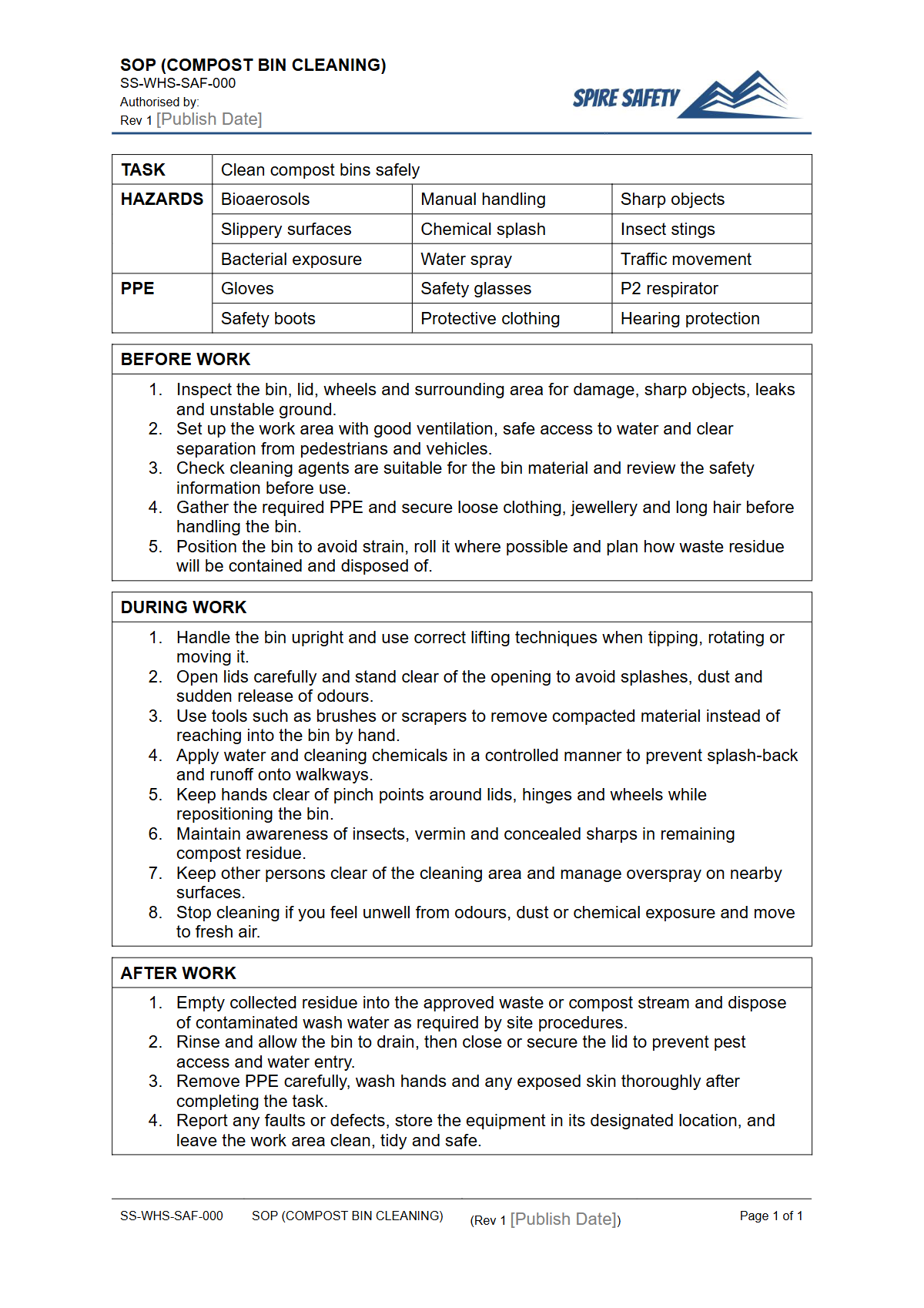
Establishing clear, documented processes is a cornerstone of an effective safety management system. This free Safe Operating Procedure (Compost Bin Cleaning) template provides a structured framework for outlining the step-by-step process required to clean commercial or industrial compost bins safely.
The primary purpose is to identify potential hazards and implement control measures to minimise the risk of injury or illness for workers undertaking this task. Properly documented procedures ensure consistency in how tasks are performed, assist in training new employees, and demonstrate a commitment to workplace health and safety. Using a standardised SOP helps integrate safety into routine operations, forming a critical part of your broader WHS management systems.
Key risks addressed in the procedure include exposure to biological hazards like bacteria and mould spores, manual handling injuries from lifting heavy components or using high-pressure hoses, slips and falls on wet surfaces, and potential chemical exposure from cleaning agents. This template guides you in detailing pre-operational checks, the specific cleaning sequence, post-cleaning checks, and emergency procedures, creating a comprehensive guide for your team.
Video walkthrough
How to use the Free Safe Operating Procedure (Compost Bin Cleaning) Template
This Safe Operating Procedure is available for immediate download in both DOCX and PDF formats. The DOCX version is fully editable, allowing you to adapt the content to the specific equipment, chemicals, and environment at your worksite.
The PDF version is useful for quick printing and distribution once you have finalised your procedure.
To use the template effectively, follow these steps:
- Download: Choose the DOCX format for customisation.
- Assess: Conduct a site-specific risk assessment for your compost bin cleaning task. Identify the specific types of bins, cleaning equipment (e.g., pressure washers, brushes), cleaning agents used, and the work environment.
- Customise: Modify the template with your site-specific details. This is not an optional step. Please note: We have provided this template as a starting point. It must be customised to reflect the unique hazards and control measures of your specific workplace and operations. Include details like the make and model of equipment, the specific Personal Protective Equipment (PPE) required, and your organisation's emergency contact information.
- Consult: Discuss the draft procedure with the workers who will be performing the task. Their direct experience is invaluable for creating a practical and effective SOP.
- Approve and Train: Once finalised, have the procedure approved by a supervisor or manager. Ensure all relevant workers are trained on the SOP before they undertake the task. If you need assistance with this process, our WHS consulting services can provide expert guidance.
When to use this Safe Operating Procedure
A Safe Operating Procedure for compost bin cleaning should be used every time the task is performed to ensure a consistent and safe approach. It is particularly important in several scenarios.
Use it for routine scheduled cleaning to maintain hygiene standards and prevent the buildup of potentially harmful pathogens. It should also be referenced during deep cleaning operations, which may involve more intensive processes or different cleaning agents.
The SOP is a vital training tool for new employees or for refresher training for existing staff, ensuring everyone understands the established safety protocols. Furthermore, if the cleaning process involves tasks like working at heights to access large bins, this document should be used in conjunction with other relevant procedures, such as a step ladder SOP.
Who should use this Safe Operating Procedure
This SOP is intended for several key roles within an organisation. Primarily, workers assigned the task of cleaning compost bins must use it as their guide to perform the job safely.
They should be thoroughly familiar with its contents and follow the steps outlined. Supervisors and team leaders are responsible for ensuring that workers follow the SOP and have received the necessary training.
They may also use the document to conduct pre-start checks or observe work practices. WHS managers and coordinators will use this procedure as part of the overall safety management system.
It serves as evidence of risk management and can be a key document reviewed during safety inspections or a WHS compliance auditing process. The document helps formalise and standardise safety expectations for everyone involved.
Common mistakes
Common mistakes to avoid
- Failing to wear appropriate PPE, especially respiratory and eye protection, leading to exposure risks.
- Using incorrect cleaning chemicals that can damage the bin or harm the composting process.
- Not assessing ergonomic risks, resulting in strains from lifting, bending, or handling high-pressure hoses.
- Neglecting to train workers on the specific, customised procedure before they undertake the task.
Legal references
Legal considerations
The following legal requirements may be relevant to this type of work.
- Work Health and Safety Act (Harmonised) — Provides the primary duties for protecting workers and other people from work health and safety risks.
- Work Health and Safety Regulations (Harmonised) — Sets out requirements supporting the management of workplace hazards and risks.
The following codes may be relevant to this type of work.
- Managing WHS Risks Code of Practice — Provides practical guidance on identifying hazards, assessing risks and applying effective controls.
- Work Health and Safety Consultation, Cooperation and Coordination Code of Practice — Provides practical guidance on consulting workers and coordinating with other duty holders.
- Managing the Work Environment and Facilities Code of Practice — Provides practical guidance on safe work environments, workplace facilities and related controls.
Did you know
Compost Heat
A well-managed compost pile can reach internal temperatures of 55–75°C. This process, known as thermophilic composting, is hot enough to kill most weed seeds and pathogens, making the final product safer to handle.
Methane Reduction
When organic waste decomposes in a landfill without oxygen, it produces methane, a greenhouse gas over 25 times more potent than carbon dioxide. Composting is an aerobic process that produces minimal methane.
FAQ
Frequently asked questions
01What are the main hazards involved in cleaning a compost bin?
02What PPE is typically required for compost bin cleaning?
03How often should a commercial compost bin be professionally cleaned?
04Can I use this template as an official document for my business?
Share this resource
Free Safe Operating Procedure (Compost Bin Cleaning) Template
Browse Categories
How To Use It
- 1Download and open in Word or PDF.
- 2Replace the placeholders with your business details.
- 3Get it reviewed by a WHS specialist before rollout.
Need it customised?
Our WHS consultants can adapt this template to your site, run a gap analysis, or audit what you already have in place.
Book a Free Consultation WHS consulting servicesor call 1300 156 382
Related templates
- Free Safe Operating Procedure (Compost Turning) Template
- Free Safe Operating Procedure (Compressed Air Blowdown) Template
- Free Safe Operating Procedure (Compressor Drain) Template
- Free Safe Operating Procedure (Compressor Filter Change) Template
- Free Safe Operating Procedure (Compressor Shutdown) Template
- Free Safe Operating Procedure (Compressor Start Up) Template