
Free Safe Operating Procedure (Compressor Drain) Template
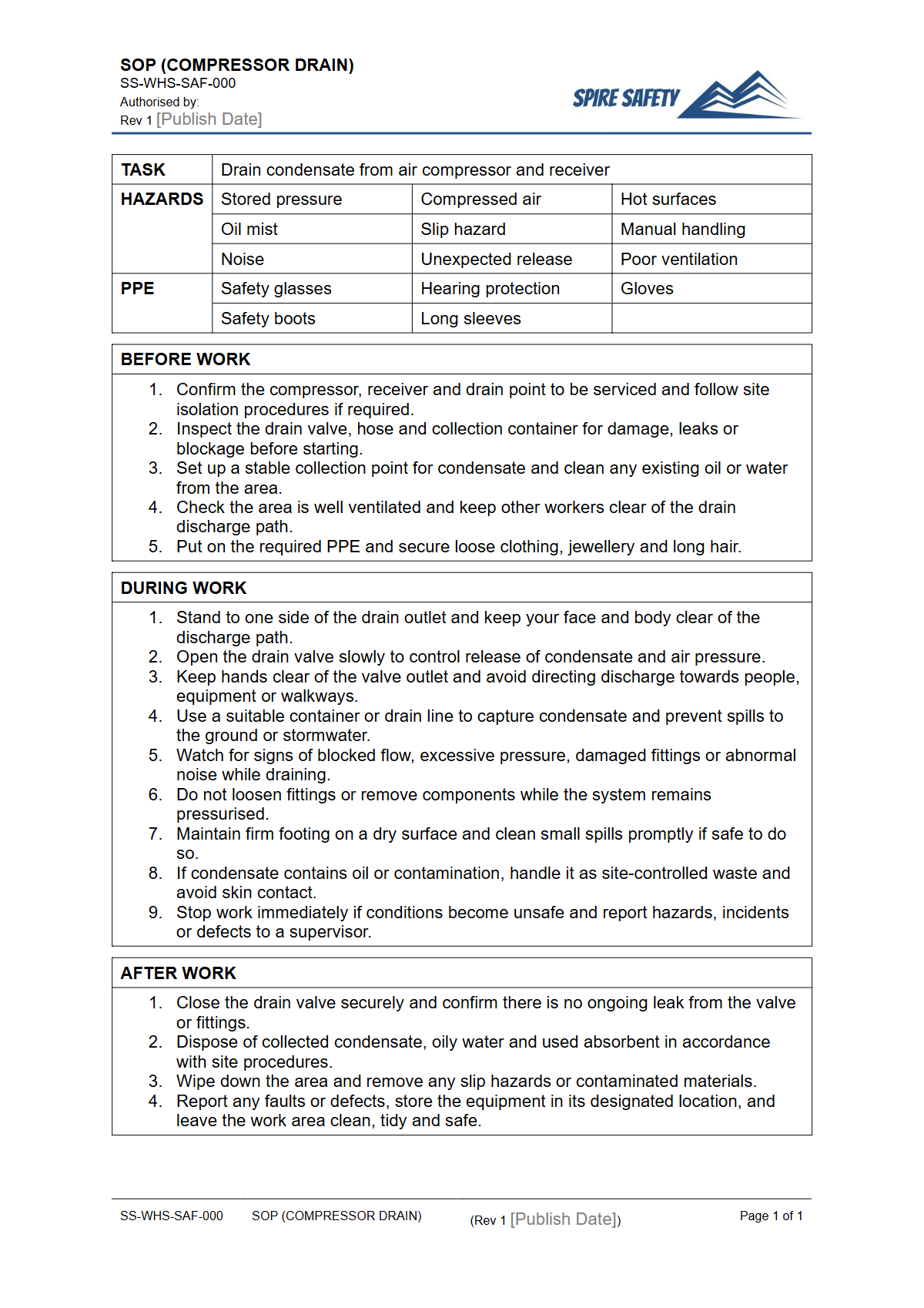
Download our free Safe Operating Procedure (Compressor Drain) template.
Free Safe Operating Procedure (Compressor Drain) Template
DOCX • 126 KB + PDF
Updated Oct 2026
No signup required
Purpose of the Free Safe Operating Procedure (Compressor Drain) Template
Draining moisture from an air compressor tank is a fundamental maintenance task crucial for both equipment longevity and workplace safety. This free Safe Operating Procedure (Compressor Drain) Template provides a structured framework for documenting the process, helping you manage risks associated with pressurised systems and equipment maintenance.
By clearly outlining the required steps, personal protective equipment (PPE), and pre-operational checks, this SOP serves as a vital tool for training personnel and ensuring consistent, safe work practices.
A well-defined SOP for draining a compressor helps prevent internal tank corrosion, which can weaken the structure and lead to catastrophic failure. It also ensures that the compressed air supplied to tools and equipment is free from excessive moisture and oil, preventing damage and improving operational efficiency.
This procedure should be integrated with your overall Free Air Compressor SOP to form a comprehensive approach to safe plant operation.
Video walkthrough
How to use the Free Safe Operating Procedure (Compressor Drain) Template
This resource is available as a fully editable DOCX file and a print-ready PDF. The template is designed as a starting point, aligned with Australian WHS principles, that you must adapt to your specific operational context.
It is not a complete, out-of-the-box solution. Effective implementation requires careful review and customisation to reflect the unique hazards and controls present in your workplace.
Important: We have developed this template as a guide. You must customise it to suit the specific equipment, environment, and work practices at your site.
Generic procedures are not sufficient to meet your WHS duties. Consider site-specific factors such as the location of the compressor, the type of drain valve (manual or automatic), and procedures for disposing of oily condensate.
Key Customisation Steps
- Equipment Details: Insert the specific make, model, and identification number of the air compressor.
- PPE Requirements: Adjust the listed PPE to match the risks identified in your own risk assessment. This typically includes safety glasses and gloves, but may require more.
- Step-by-Step Procedure: Modify the steps to accurately describe the process for your specific machine. This includes how to safely depressurise the tank before opening the drain valve.
- Emergency Response: Incorporate your site-specific emergency contacts and procedures for incidents like uncontrolled pressure release or personal injury.
Integrating specific SOPs like this into documented safety processes is a cornerstone of robust WHS management systems, demonstrating a systematic approach to risk control.
When to use it
This Safe Operating Procedure should be used every time a worker is required to drain a compressor receiver tank. The frequency of this task depends on several factors, including the compressor's usage rate, the ambient humidity, and the manufacturer's recommendations—it could be daily or weekly.
The SOP also serves as a critical training document for new employees and a reference for competency verification for existing staff. It should be reviewed regularly and updated whenever the equipment, environment, or process changes.
Regular reviews and verification of correct procedure are essential functions of workplace safety management. If your organisation lacks the internal resources to verify the effectiveness of your procedures, engaging external specialist WHS consulting can provide valuable third-party insight and support.
Who should use it
This SOP is intended for use by Persons Conducting a Business or Undertaking (PCBUs), site managers, supervisors, and, most importantly, the workers tasked with performing the maintenance. It provides managers with a tool to ensure a standardised procedure is communicated and followed.
For workers, it is a clear, step-by-step guide to performing the task safely. Only personnel who have been properly trained and deemed competent should be authorised to drain air compressors.
Documenting procedures is just one part of the safety equation; verifying that they are being followed correctly is equally important. This is often a key focus during a WHS compliance auditing process, which checks for gaps between documented systems and on-the-ground reality.
By establishing clear procedures for routine but critical tasks, you build a stronger safety culture. For more templates covering a wide range of plant and equipment, browse our complete free WHS resources library for tools that can help streamline your safety documentation.
Common mistakes
Common mistakes to avoid
- Forgetting to depressurise the tank before opening the drain valve.
- Failing to wear appropriate PPE, especially safety glasses.
- Performing the task in a poorly lit or cramped area, increasing injury risk.
- Incorrectly disposing of oily condensate, leading to environmental non-compliance.
Legal references
Legal considerations
The following legal requirements may be relevant to this type of work.
- Work Health and Safety Act (Harmonised) — Provides the primary duties for protecting workers and other people from work health and safety risks.
- Work Health and Safety Regulations (Harmonised) — Sets out requirements supporting the management of workplace hazards and risks.
The following codes may be relevant to this type of work.
- Managing WHS Risks Code of Practice — Provides practical guidance on identifying hazards, assessing risks and applying effective controls.
- Work Health and Safety Consultation, Cooperation and Coordination Code of Practice — Provides practical guidance on consulting workers and coordinating with other duty holders.
- Managing the Work Environment and Facilities Code of Practice — Provides practical guidance on safe work environments, workplace facilities and related controls.
Did you know
Water Accumulation
On a humid day, a 5-horsepower compressor running for eight hours can produce over 20 litres of water, all of which collects in the receiver tank if not drained.
Condensate Contamination
The water drained from a compressor, known as condensate, is often contaminated with oil and particulate matter. It may be classified as trade waste and require specific disposal methods to comply with environmental regulations.
FAQ
Frequently asked questions
01Why is draining a compressor important for safety?
02How often should a compressor be drained?
03What are the main hazards when draining a compressor?
04Can I use this template for any type of air compressor?
Share this resource
Free Safe Operating Procedure (Compressor Drain) Template
Browse Categories
How To Use It
- 1Download and open in Word or PDF.
- 2Replace the placeholders with your business details.
- 3Get it reviewed by a WHS specialist before rollout.
Need it customised?
Our WHS consultants can adapt this template to your site, run a gap analysis, or audit what you already have in place.
Book a Free Consultation WHS consulting servicesor call 1300 156 382
Related templates
- Free Safe Operating Procedure (Compressor Filter Change) Template
- Free Safe Operating Procedure (Compressor Shutdown) Template
- Free Safe Operating Procedure (Compressor Start Up) Template
- Free Safe Operating Procedure (Concrete Buggy) Template
- Free Safe Operating Procedure (Concrete Cover Meter) Template
- Free Safe Operating Procedure (Concrete Cube Testing) Template