
Free Safe Operating Procedure (Concrete Cover Meter) Template
Download our free Safe Operating Procedure (Concrete Cover Meter) Template. This customisable DOCX and PDF helps define safe work steps for concrete testing.
Free Safe Operating Procedure (Concrete Cover Meter) Template
DOCX • 126 KB + PDF
Updated Oct 2026
No signup required
Purpose of the Free Safe Operating Procedure (Concrete Cover Meter) Template
A concrete cover meter, or rebar locator, is a non-destructive testing device used to locate reinforcing bars (rebar) and measure the thickness of the concrete cover over them. While operating the device itself is low-risk, the tasks associated with it—such as marking out for cutting, drilling, or coring—carry significant hazards.
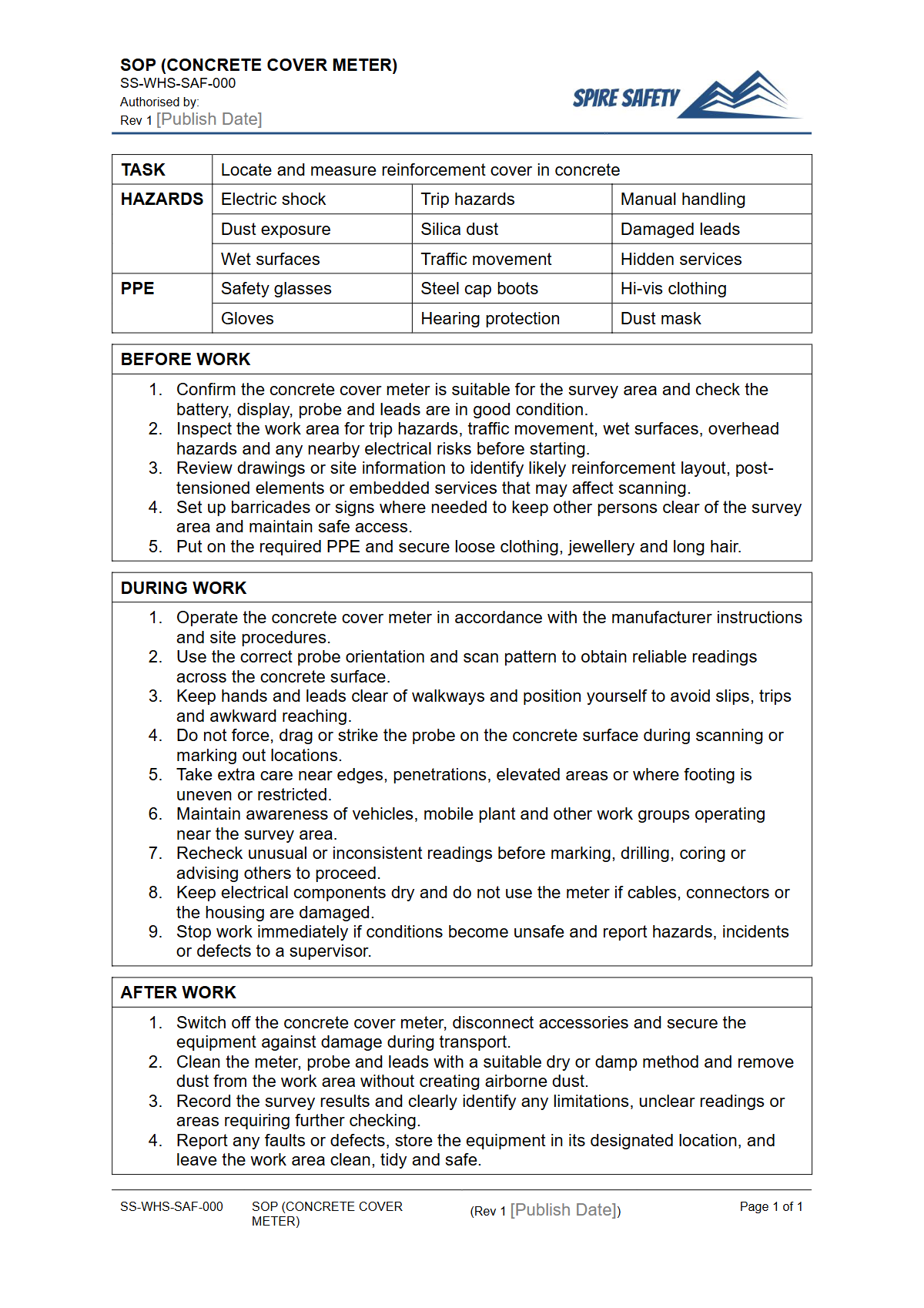
This free Safe Operating Procedure (Concrete Cover Meter) Template provides a structured starting point for documenting the required safety controls for this task.
This SOP template guides you in outlining key safety considerations, from pre-operational checks and potential hazards like electrical risks (if drilling into live conduits) and ergonomic strains, to the step-by-step process of using the equipment safely. It helps ensure that all workers follow a consistent, safe method, reducing the likelihood of incidents.
A well-defined SOP is also a critical training tool and forms part of your overall safety management system, ensuring that even emergency responses are considered, such as having a clear Safe Operating Procedure for Defibrillator Operation available on site.
Video walkthrough
How to use the Free Safe Operating Procedure (Concrete Cover Meter) Template
This template is provided in both DOCX and PDF formats to suit your organisation's needs. The DOCX file is fully editable, allowing you to tailor the content to your specific operational context.
It is designed to be a foundation, not a finished document. You must review and adapt it to reflect the specific make and model of your cover meter, the unique conditions of your worksite, and your internal safety protocols.
Important: To be effective, this Safe Operating Procedure must be customised. We have provided a comprehensive framework, but you must consult with your workers and other relevant parties to identify all specific hazards and implement controls that are relevant to your workplace.
If you require assistance in adapting this template or developing other safety documents, our specialist WHS consulting team can provide expert guidance.
Key Elements Covered in the Template
- Required PPE: Lists personal protective equipment such as safety glasses, gloves, and high-visibility clothing.
- Hazard Identification: Identifies potential risks including electrical hazards from contact with hidden services, manual handling, and environmental factors.
- Pre-Operational Checks: Includes steps for equipment inspection, battery check, and calibration to ensure accurate and safe operation.
- Step-by-Step Procedure: Outlines the sequence of actions for scanning, marking, and recording data safely.
- Post-Operational Tasks: Details procedures for cleaning, storing, and logging use of the equipment.
When to use a Concrete Cover Meter SOP
A Safe Operating Procedure for a concrete cover meter should be used as a primary reference document before any work involving the device commences. It is essential during the induction and training of new operators to ensure they understand the approved work method.
It should also be referenced during toolbox talks to refresh knowledge on safety protocols, particularly before starting work in a new or complex area. Furthermore, the SOP serves as a benchmark document during incident investigations or safety observations to assess whether correct procedures were followed. This document is a key component of your broader WHS management systems.
Who should use it
This SOP should be used by a range of personnel on a construction or engineering site. This includes:
- Equipment Operators: The primary users who must follow the procedure to perform their work safely.
- Supervisors and Site Managers: Responsible for ensuring workers are trained on and adhere to the SOP.
- WHS Advisors and Officers: Use the SOP for training development, site inspections, and risk assessments.
- Engineers and Technicians: Who rely on the accurate location of rebar for structural assessments or planning penetrations.
Using an SOP ensures that subsequent high-risk tasks, such as cutting concrete, are planned with accurate information. For such tasks, a separate procedure like a Safe Operating Procedure for a circular saw would also be required. Integrating various SOPs ensures a comprehensive approach to site safety, similar to how an SOP for a concrete boom pump governs another critical aspect of concrete-related work. These documents are often reviewed as part of formal WHS compliance auditing to verify that safe systems of work are in place and being followed.
Common mistakes
Common mistakes to avoid
- Failing to calibrate the device on a known rebar size and depth before starting work, leading to inaccurate readings.
- Ignoring the influence of congested rebar (bars spaced closely together), which can interfere with the magnetic field and cause errors.
- Not properly marking the location and orientation of detected rebar on the concrete surface for follow-up work.
- Using the template as-is without customising it for the specific site hazards, equipment model, and worker feedback.
Legal references
Legal considerations
The following legal requirements may be relevant to this type of work.
- Work Health and Safety Act (Harmonised) — Provides the primary duties for protecting workers and other people from work health and safety risks.
- Work Health and Safety Regulations (Harmonised) — Sets out requirements supporting the management of workplace hazards and risks.
The following codes may be relevant to this type of work.
- Managing WHS Risks Code of Practice — Provides practical guidance on identifying hazards, assessing risks and applying effective controls.
- Work Health and Safety Consultation, Cooperation and Coordination Code of Practice — Provides practical guidance on consulting workers and coordinating with other duty holders.
- Managing the Work Environment and Facilities Code of Practice — Provides practical guidance on safe work environments, workplace facilities and related controls.
Did you know
Magnetic Principles
Concrete cover meters work by generating a magnetic field. When the device passes over steel rebar, the metal disrupts the field, and a sensor detects this change to pinpoint the bar's location and depth.
Fire and Corrosion
Adequate concrete cover is critical for protecting rebar from corrosion and ensuring the structure's fire resistance rating. Insufficient cover is a common construction defect that these devices help identify.
FAQ
Frequently asked questions
01What is a concrete cover meter?
02Is a Safe Operating Procedure a legal requirement for a cover meter?
03How does this SOP differ from a Safe Work Method Statement (SWMS)?
04Can I use this template for any brand of concrete cover meter?
Share this resource
Free Safe Operating Procedure (Concrete Cover Meter) Template
Browse Categories
How To Use It
- 1Download and open in Word or PDF.
- 2Replace the placeholders with your business details.
- 3Get it reviewed by a WHS specialist before rollout.
Need it customised?
Our WHS consultants can adapt this template to your site, run a gap analysis, or audit what you already have in place.
Book a Free Consultation WHS consulting servicesor call 1300 156 382
Related templates
- Free Safe Operating Procedure (Concrete Cube Testing) Template
- Free Safe Operating Procedure (Concrete Dumper) Template
- Free Safe Operating Procedure (Concrete Grinder) Template
- Free Safe Operating Procedure (Concrete Hopper) Template
- Free Safe Operating Procedure (Concrete Mixer Operation) Template
- Free Safe Operating Procedure (Concrete Moisture Test) Template