
Free Safe Operating Procedure (Concrete Hopper) Template
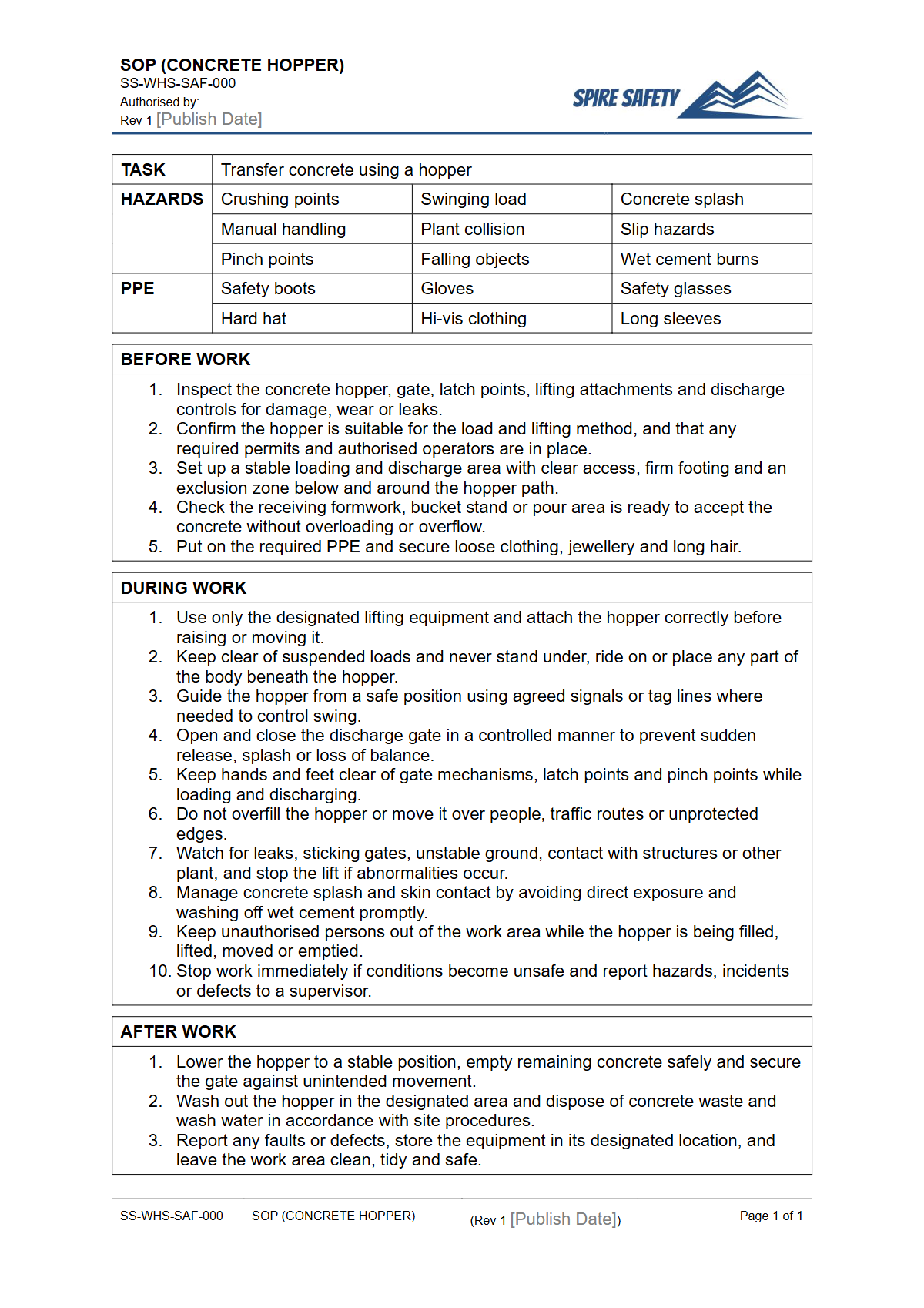
Download our free Safe Operating Procedure (Concrete Hopper) Template.
Free Safe Operating Procedure (Concrete Hopper) Template
DOCX • 126 KB + PDF
Updated Oct 2026
No signup required
Purpose of the Free Safe Operating Procedure (Concrete Hopper) Template
Operating a concrete hopper presents significant workplace health and safety risks, including entanglement in moving parts, being struck by the equipment, and exposure to hazardous substances like wet concrete and silica dust. This free Safe Operating Procedure (Concrete Hopper) Template provides a structured starting point for your business to document the required steps for the safe operation of this equipment.
It is designed to help you outline key hazards, establish risk controls, and define a clear, step-by-step process for workers to follow, aligning with Australian WHS best practices.
A documented SOP is a critical administrative control measure that supports your duty of care as a Person Conducting a Business or Undertaking (PCBU). It serves as a vital training tool and a reference for supervisors and operators, ensuring that safety protocols are consistently applied.
Using a standardised procedure helps to minimise operator error, reduce incident rates, and foster a stronger safety culture on site. For related equipment, you might also need a Safe Operating Procedure for a concrete boom pump to cover all aspects of concrete delivery.
Video walkthrough
How to use the Free Safe Operating Procedure (Concrete Hopper) Template
This document is a template and must be customised to reflect the specific equipment and conditions at your worksite. To effectively use this Safe Operating Procedure template, you should begin by conducting a thorough risk assessment of your concrete hopper and the associated tasks.
Identify the make and model of the hopper, the environment it's used in, and the specific tasks your workers perform. The content should then be adapted to include these site-specific details, such as unique environmental hazards, emergency procedures, and the specific personal protective equipment (PPE) required.
Important: We have provided this template as a guide. You must consult with your workers, supervisors, and other relevant stakeholders during the customisation process.
Their direct experience is invaluable for identifying practical hazards and effective controls. Once finalised, the SOP should be integrated into your broader safety framework.
Well-documented procedures are a cornerstone of comprehensive WHS management systems, demonstrating a systematic approach to risk management.
After customising the SOP, ensure all relevant personnel receive training on its contents. This training should cover the identified hazards, control measures, pre-start checks, shutdown procedures, and emergency responses.
Keep records of this training to demonstrate worker competency. For complex operations or if you lack in-house expertise, seeking specialist WHS consulting advice can ensure your procedures are robust and fit for purpose.
When to use a Concrete Hopper SOP
A Safe Operating Procedure for a concrete hopper should be used and readily available at all times the equipment is on site. It is most critically referenced during several key phases of work.
Before any operation begins, the SOP guides operators through mandatory pre-start checks to ensure the hopper is in safe working order, guards are in place, and emergency stops are functional. It should be a primary reference document during worker inductions and task-specific training.
The SOP should also be consulted by supervisors during routine inspections and when planning work, ensuring that the necessary safety controls are incorporated into the job plan. It is also an essential document following any incident or near miss, providing a baseline against which current work practices can be reviewed and improved.
Using this SOP consistently for all tasks involving the concrete hopper, from setup to operation and cleaning, is key to maintaining a safe system of work. The same principle applies to other plant, such as having a telehandler Safe Operating Procedure for telehandler operations.
Who should use it
This Safe Operating Procedure is intended for use by several key groups within an organisation. Primarily, equipment operators must be thoroughly trained on and follow the SOP during every task.
It provides them with clear, unambiguous instructions on how to perform their work safely. Supervisors and site managers are responsible for implementing the SOP, ensuring operators are competent, and monitoring compliance on the ground.
Project managers and safety officers should use the SOP as part of their safety planning and risk management activities. They are often responsible for the development, review, and updating of the procedure to ensure it remains current with legislation and site conditions.
Finally, PCBUs have an overarching responsibility to ensure safe systems of work are in place; this SOP is a tool that helps them meet that obligation. Verifying its implementation through regular WHS compliance auditing is a key part of WHS due diligence.
Similar documentation, such as a Dozer SOP, is essential for all other types of heavy machinery on site to ensure a consistent approach to safety.
Common mistakes
Common mistakes to avoid
- Failing to customise the template for the specific make, model, and site conditions.
- Neglecting to provide practical, hands-on training to all operators on the finalised SOP.
- Skipping mandatory pre-operational checks outlined in the procedure before starting work.
- Not enforcing the use of required personal protective equipment (PPE), such as eye protection, gloves, and respiratory protection.
Legal references
Legal considerations
The following legal requirements may be relevant to this type of work.
- Work Health and Safety Act (Harmonised) — Provides the primary duties for protecting workers and other people from work health and safety risks.
- Work Health and Safety Regulations (Harmonised) — Sets out requirements supporting the management of workplace hazards and risks.
The following codes may be relevant to this type of work.
- Managing WHS Risks Code of Practice — Provides practical guidance on identifying hazards, assessing risks and applying effective controls.
- Work Health and Safety Consultation, Cooperation and Coordination Code of Practice — Provides practical guidance on consulting workers and coordinating with other duty holders.
- Managing the Work Environment and Facilities Code of Practice — Provides practical guidance on safe work environments, workplace facilities and related controls.
Did you know
Alkaline Burns
Wet cement is highly alkaline and can cause serious chemical burns to the skin. The effects are not always immediately painful, meaning prolonged contact can lead to severe tissue damage before a worker even notices.
Entanglement Hazard
The auger or agitator inside a concrete hopper is a major entanglement hazard. Loose clothing, gloves, or tools can be caught in seconds, leading to severe or fatal injuries.
FAQ
Frequently asked questions
01What is a Safe Operating Procedure for a concrete hopper?
02Who is responsible for creating and implementing this SOP?
03Does this template cover all risks associated with concrete hoppers?
04How often should a concrete hopper SOP be reviewed?
Share this resource
Free Safe Operating Procedure (Concrete Hopper) Template
Browse Categories
How To Use It
- 1Download and open in Word or PDF.
- 2Replace the placeholders with your business details.
- 3Get it reviewed by a WHS specialist before rollout.
Need it customised?
Our WHS consultants can adapt this template to your site, run a gap analysis, or audit what you already have in place.
Book a Free Consultation WHS consulting servicesor call 1300 156 382
Related templates
- Free Safe Operating Procedure (Concrete Mixer Operation) Template
- Free Safe Operating Procedure (Concrete Moisture Test) Template
- Free Safe Operating Procedure (Concrete Pile Cutter) Template
- Free Safe Operating Procedure (Concrete Planer) Template
- Free Safe Operating Procedure (Concrete Pump Hose) Template
- Free Safe Operating Procedure (Concrete Scarifier) Template