
Free Safe Operating Procedure (Concrete Dumper) Template
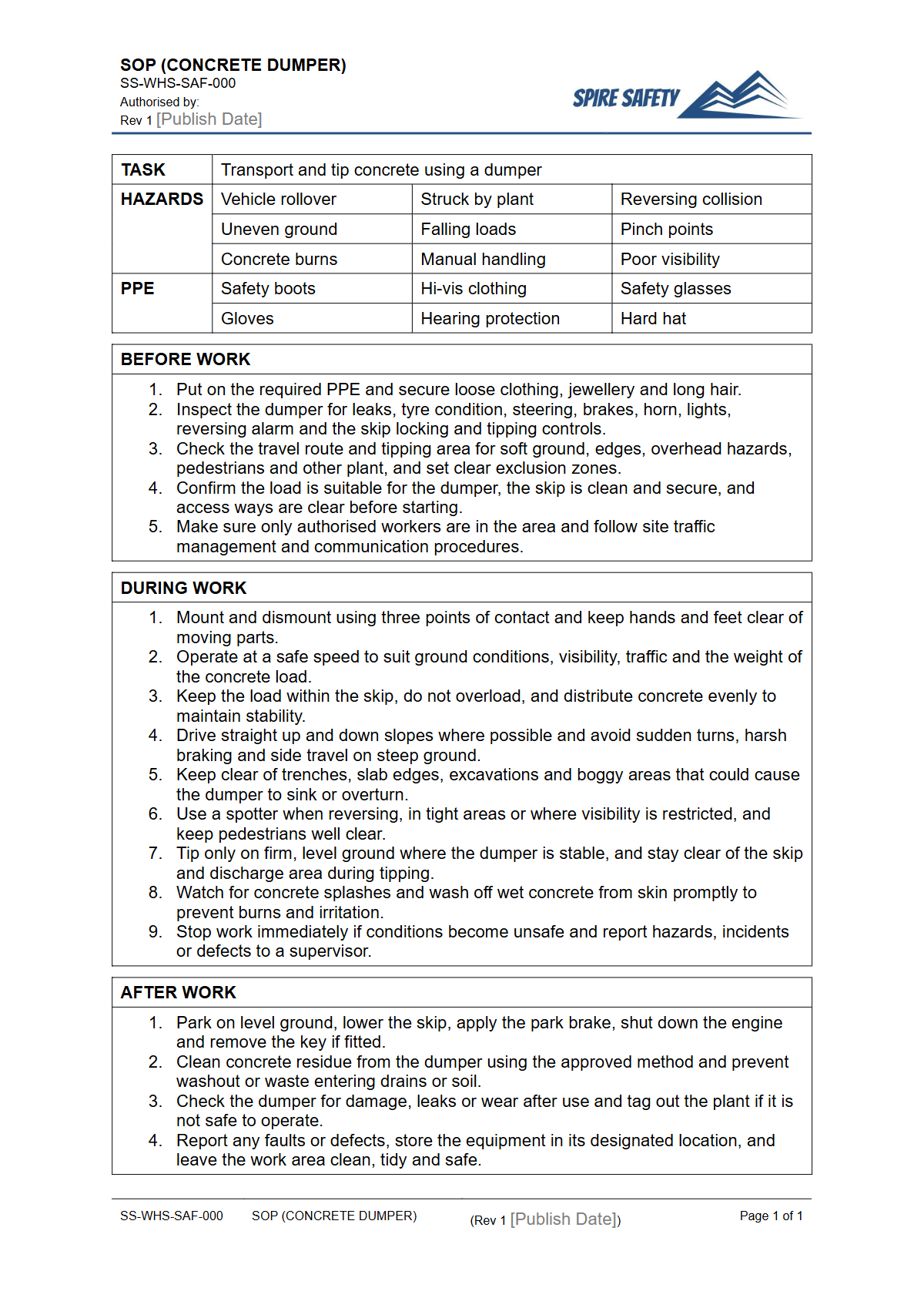
Download our free Safe Operating Procedure (SOP) template for concrete dumpers.
Free Safe Operating Procedure (Concrete Dumper) Template
DOCX • 126 KB + PDF
Updated Oct 2026
No signup required
Purpose of the Free Safe Operating Procedure (Concrete Dumper) Template
Operating a concrete dumper involves significant risks, including rollovers, collisions, and hazards associated with handling wet concrete. This Free Safe Operating Procedure (Concrete Dumper) Template provides a structured framework for documenting the safest way to perform this task.
An SOP is a critical control measure that outlines step-by-step instructions to minimise the risk of injury or incident. Implementing clear, documented procedures is a fundamental component of all effective WHS management systems, helping your organisation meet its duty of care and protect its workers.
The primary purpose of this template is to give your business a strong starting point for developing a customised procedure. It covers essential safety elements such as pre-start checks, operational steps, shutdown procedures, and emergency responses.
By standardising the process, you ensure every operator follows the same safe methodology, reducing variability and the potential for human error. A well-written SOP also serves as an invaluable tool for worker training, inductions, and competency assessments.
Video walkthrough
How to use the Free Safe Operating Procedure (Concrete Dumper) Template
This document is designed for easy customisation. After downloading the DOCX or PDF file, you must adapt it to reflect the specific circumstances of your workplace.
This includes referencing the exact make and model of the concrete dumper in use, identifying site-specific hazards (like slopes, overhead powerlines, or pedestrian traffic), and incorporating your organisation's unique safety rules and emergency contacts.
Important Note: This is a template, not a finished document. We cannot guarantee it covers every hazard unique to your site.
You must undertake a risk assessment and consult with your workers to ensure the final SOP is comprehensive and practical for your specific operations. The effectiveness of any safe work procedure depends on its relevance to the actual tasks being performed.
If you also work with other concrete placement machinery, you might find our free Boom Pump SOP template useful for standardising your documentation.
When to use a Concrete Dumper Safe Operating Procedure
A Safe Operating Procedure for a concrete dumper should be developed and implemented before any worker is permitted to operate the machinery. It is an essential document for any task classified as high-risk, which includes the operation of most mobile plant.
The SOP should be readily accessible to operators at all times, either in the plant's cabin or at the work area. Consistency in documentation is important, especially if your site uses a variety of plant such as those covered in our Telehandler SOP template.
Furthermore, the SOP should be used during initial worker training, for refresher training sessions, and when verifying operator competency. It is also a key reference document following a near miss or incident, as reviewing the procedure can help identify gaps or areas for improvement.
If your work involves other earthmoving equipment, referencing a Dozer SOP template can help maintain consistency in your documentation style.
Who should use this Safe Operating Procedure
This SOP should be used by several key groups within an organisation. Primarily, it is for the operators of the concrete dumper.
They must be trained on the procedure and are expected to follow its instructions every time they use the equipment. Supervisors and managers are also key users, as they are responsible for enforcing the procedure, ensuring workers are adequately trained, and conducting periodic checks to confirm the SOP is being followed correctly.
Workplace Health and Safety (WHS) personnel or safety advisors will use the template as a foundation for developing site-specific documents. They are often responsible for facilitating the risk assessment process and consulting with workers to ensure the final SOP is robust.
The procedure also forms a critical piece of evidence during internal and external audits, demonstrating that the business has a formal system for managing the risks associated with plant operation. Regular WHS compliance audits can verify that these procedures are being implemented effectively on site.
By standardising your safety documents, you create a more predictable and safer working environment. For more templates and safety guides, explore our complete free WHS resources library.
Common mistakes
Common mistakes to avoid
- Using a generic SOP without customising it for the specific dumper model and worksite.
- Failing to provide hands-on, practical training on the SOP for all operators.
- Neglecting to review and update the SOP after an incident, near miss, or change in work conditions.
- Skipping the pre-start inspection and operational checks detailed in the procedure.
Legal references
Legal considerations
The following legal requirements may be relevant to this type of work.
- Work Health and Safety Act (Harmonised) — Provides the primary duties for protecting workers and other people from work health and safety risks.
- Work Health and Safety Regulations (Harmonised) — Sets out requirements supporting the management of workplace hazards and risks.
The following codes may be relevant to this type of work.
- Managing WHS Risks Code of Practice — Provides practical guidance on identifying hazards, assessing risks and applying effective controls.
- Work Health and Safety Consultation, Cooperation and Coordination Code of Practice — Provides practical guidance on consulting workers and coordinating with other duty holders.
- Managing the Work Environment and Facilities Code of Practice — Provides practical guidance on safe work environments, workplace facilities and related controls.
Did you know
Rollover Risk
Concrete dumpers have a high centre of gravity, especially when loaded, making them prone to rollovers on uneven ground or steep slopes. Proper training and site assessment are critical to prevent these incidents.
Concrete Weight
A cubic metre of wet concrete can weigh approximately 2,400 kilograms. This immense weight significantly affects the dumper's stability, braking distance, and overall handling characteristics.
FAQ
Frequently asked questions
01What is a Safe Operating Procedure (SOP) for a concrete dumper?
02Is this template ready to use immediately after download?
03How often should a concrete dumper SOP be reviewed?
04Who is responsible for developing a concrete dumper SOP?
Share this resource
Free Safe Operating Procedure (Concrete Dumper) Template
Browse Categories
How To Use It
- 1Download and open in Word or PDF.
- 2Replace the placeholders with your business details.
- 3Get it reviewed by a WHS specialist before rollout.
Need it customised?
Our WHS consultants can adapt this template to your site, run a gap analysis, or audit what you already have in place.
Book a Free Consultation WHS consulting servicesor call 1300 156 382
Related templates
- Free Safe Operating Procedure (Concrete Grinder) Template
- Free Safe Operating Procedure (Concrete Hopper) Template
- Free Safe Operating Procedure (Concrete Mixer Operation) Template
- Free Safe Operating Procedure (Concrete Moisture Test) Template
- Free Safe Operating Procedure (Concrete Pile Cutter) Template
- Free Safe Operating Procedure (Concrete Planer) Template