
Free Safe Operating Procedure (Concrete Grinder) Template
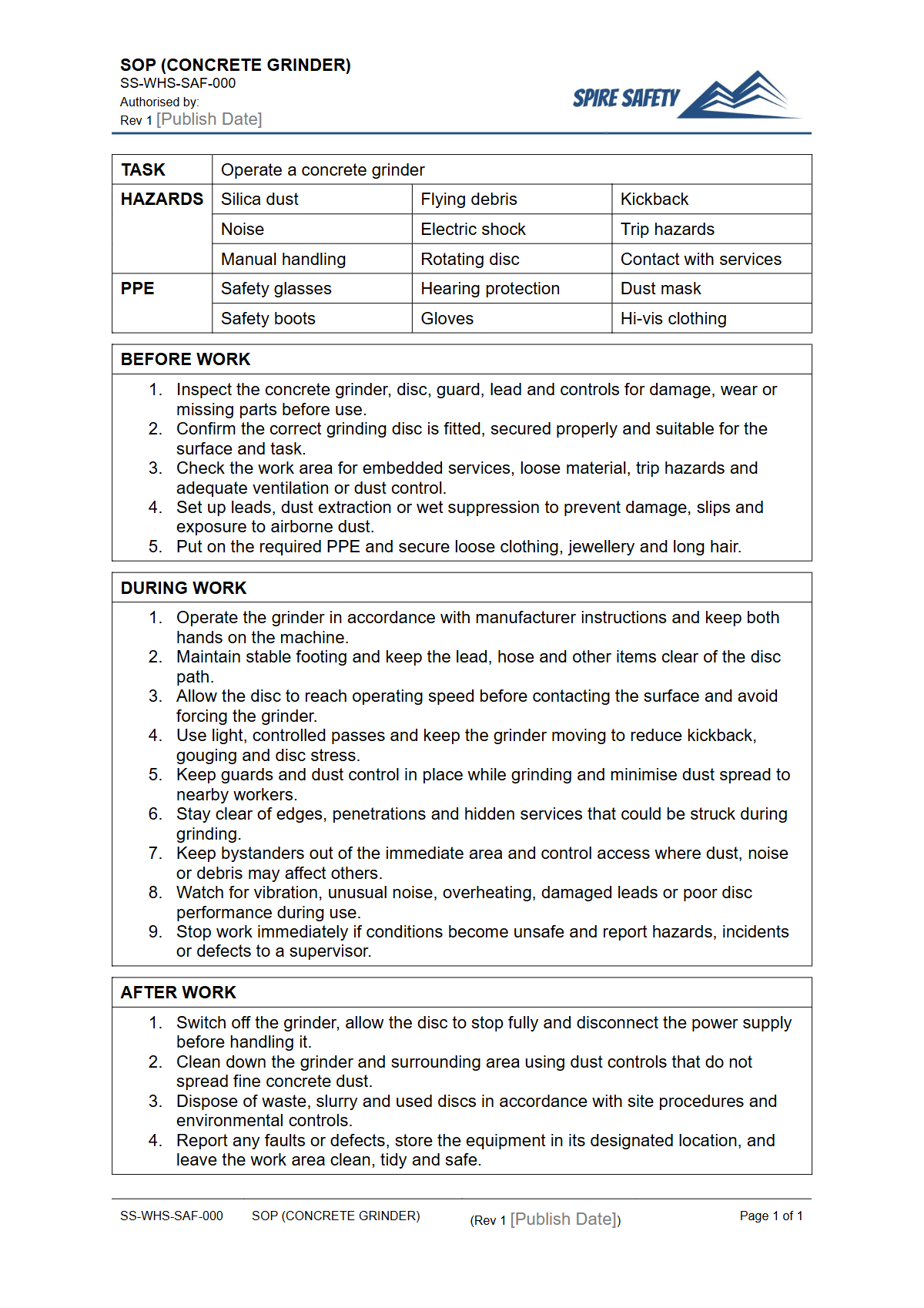
Download our free Safe Operating Procedure (Concrete Grinder) Template.
Free Safe Operating Procedure (Concrete Grinder) Template
DOCX • 126 KB + PDF
Updated Oct 2026
No signup required
Purpose of the Free Safe Operating Procedure (Concrete Grinder) Template
Operating a concrete grinder presents significant health and safety risks, including exposure to respirable crystalline silica, high noise levels, and hand-arm vibration. This Free Safe Operating Procedure (Concrete Grinder) Template provides a structured framework for businesses to document a safe system of work for this task.
By outlining hazards, control measures, and step-by-step instructions, the SOP serves as a critical tool for worker training, competency verification, and risk management. It is designed to help you meet your duty of care under Australian WHS laws by formalising the process for using concrete grinders safely and consistently.
A well-drafted SOP is a fundamental component of a safe workplace. While this document focuses on concrete grinders, the principles of documenting safe procedures apply to a wide range of equipment.
For instance, our free bench grinder SOP template addresses similar risks associated with abrasive wheels in a fixed workshop setting.
Video walkthrough
How to use the Free Safe Operating Procedure (Concrete Grinder) Template
This template is provided in both DOCX and PDF formats for your convenience. The DOCX file is fully editable, allowing you to adapt it to your specific operational needs. To effectively implement this SOP, you should:
- Download the template and add your company branding and details.
- Conduct a risk assessment for the concrete grinding tasks performed at your site.
- Populate the template with information specific to the make and model of your equipment, the work environment, and the control measures you have in place (e.g., specific dust extraction systems, required PPE).
- Consult with your workers and health and safety representatives during the drafting process to ensure the procedure is practical and reflects on-the-ground realities.
- Finalise and approve the document before communicating it to all relevant personnel.
Please note: this is a template and not a complete document. We have provided a structured starting point, but you must customise it to reflect the specific equipment, processes, and risks present in your workplace. Integrating such documents effectively is a key part of developing robust WHS management systems.
Key Hazards to Consider
When customising your concrete grinder SOP, pay close attention to the following hazards:
- Respirable Crystalline Silica (RCS): Concrete dust contains silica, which can cause incurable lung diseases like silicosis. Your SOP must detail dust control measures, such as on-tool water suppression or an M- or H-class dust extraction vacuum, along with requirements for respiratory protective equipment (RPE).
- Noise: Concrete grinders can produce noise levels well above the exposure standard, leading to permanent hearing loss. Specify the type of hearing protection required.
- Hand-Arm Vibration (HAV): Prolonged use can cause Hand-Arm Vibration Syndrome (HAVS). The SOP should note controls like limiting trigger time, using anti-vibration gloves, and maintaining the equipment.
- Projectiles: Debris, or parts from a shattered disc, can be ejected at high speed. The procedure must mandate the use of correct, undamaged discs and ensure all guards are in place.
- Electrical Hazards: Inspect all leads, plugs, and the RCD (safety switch) before use. Detail these pre-start checks in your procedure. For other high-energy tools, you might find our FREE Plasma Cutter SOP (Safe Operating Procedure) Template a useful reference.
When to use it
A Safe Operating Procedure for concrete grinders should be in place before any worker is permitted to use the equipment. It is a critical document for several key activities within your safety system.
Use it during new worker inductions, task-specific training, and as a prerequisite for competency assessments. It should also be readily available in the work area as a reference tool for operators to review before starting a job, especially for non-routine tasks.
Regular toolbox talks are a great opportunity to reinforce the key points outlined in the SOP.
The principles of documenting procedures for high-risk tools are transferable. For example, the process for using a powerful cutting tool requires a similar level of detail, as shown in our FREE Circular Saw SOP (Safe Operating Procedure) Template.
Who should use it
This SOP template is intended for use by Persons Conducting a Business or Undertaking (PCBUs), site supervisors, and WHS managers responsible for workplace safety. It provides the foundation for creating a site-specific document.
The final, customised SOP should be used by all workers who operate, supervise, or work near concrete grinding activities. Engaging operators in the development process is vital, as their practical experience is invaluable for creating an effective and workable procedure.
The finished SOPs are also key documents reviewed during formal WHS compliance auditing to verify that safe work processes are defined and implemented.
This resource is one of many documents available to help you build out your safety management system. You can explore our complete free WHS resources library for more templates and guides.
Common mistakes
Common mistakes to avoid
- Using the grinder without adequate dust extraction or water suppression controls.
- Failing to wear appropriate personal protective equipment (PPE), especially P2/N95 respiratory protection.
- Using incorrect, worn, or damaged grinding discs for the specific task or material.
- Neglecting pre-start checks of the equipment, particularly the condition of guards, handles, and electrical cords.
Legal references
Legal considerations
The following legal requirements may be relevant to this type of work.
- Work Health and Safety Act (Harmonised) — Provides the primary duties for protecting workers and other people from work health and safety risks.
- Work Health and Safety Regulations (Harmonised) — Sets out requirements supporting the management of workplace hazards and risks.
The following codes may be relevant to this type of work.
- Managing WHS Risks Code of Practice — Provides practical guidance on identifying hazards, assessing risks and applying effective controls.
- Work Health and Safety Consultation, Cooperation and Coordination Code of Practice — Provides practical guidance on consulting workers and coordinating with other duty holders.
- Managing the Work Environment and Facilities Code of Practice — Provides practical guidance on safe work environments, workplace facilities and related controls.
Did you know
Silica Dust Danger
Concrete dust can contain up to 40% crystalline silica. Heavy exposure for even a short period can lead to silicosis, an incurable and progressive lung disease.
Vibration Exposure Limits
Safe Work Australia sets exposure standards for hand-arm vibration. Continuous use of a high-vibration tool like a concrete grinder can mean an operator reaches their daily exposure limit in less than an hour.
FAQ
Frequently asked questions
01What are the main hazards of using a concrete grinder?
02Is a Safe Operating Procedure a legal requirement for concrete grinders in Australia?
03How often should a concrete grinder SOP be reviewed?
04What is the difference between an SOP and a SWMS for concrete grinding?
Share this resource
Free Safe Operating Procedure (Concrete Grinder) Template
Browse Categories
How To Use It
- 1Download and open in Word or PDF.
- 2Replace the placeholders with your business details.
- 3Get it reviewed by a WHS specialist before rollout.
Need it customised?
Our WHS consultants can adapt this template to your site, run a gap analysis, or audit what you already have in place.
Book a Free Consultation WHS consulting servicesor call 1300 156 382
Related templates
- Free Safe Operating Procedure (Concrete Hopper) Template
- Free Safe Operating Procedure (Concrete Mixer Operation) Template
- Free Safe Operating Procedure (Concrete Moisture Test) Template
- Free Safe Operating Procedure (Concrete Pile Cutter) Template
- Free Safe Operating Procedure (Concrete Planer) Template
- Free Safe Operating Procedure (Concrete Pump Hose) Template