
Free Safe Operating Procedure (Concrete Cube Testing) Template
Download our free Safe Operating Procedure (Concrete Cube Testing) template. This customisable DOCX and PDF helps formalise concrete testing safety.
Free Safe Operating Procedure (Concrete Cube Testing) Template
DOCX • 126 KB + PDF
Updated Oct 2026
No signup required
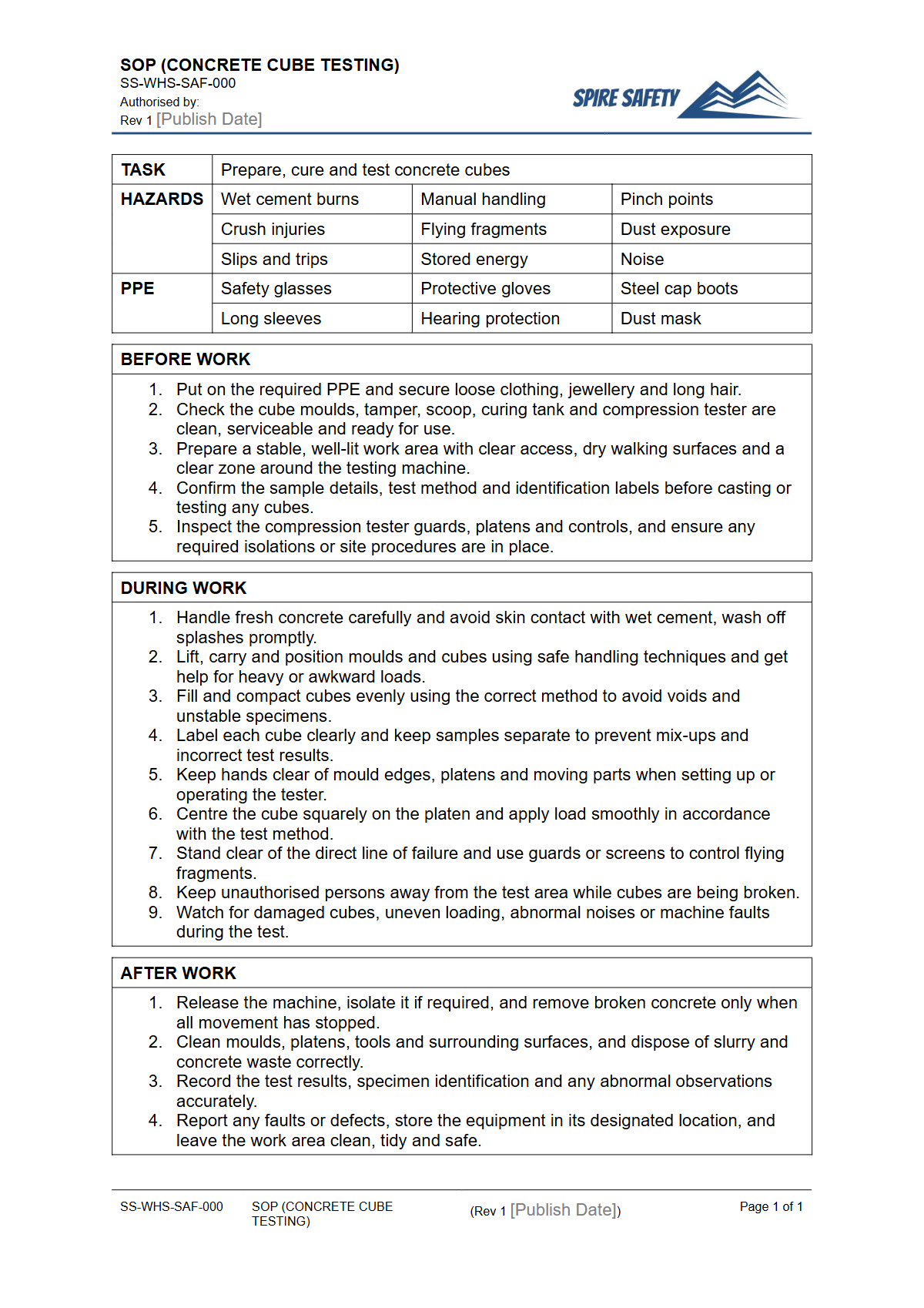
Purpose of the Free Safe Operating Procedure (Concrete Cube Testing) Template
Concrete cube testing is a critical process for verifying the compressive strength and quality of concrete used in construction projects. While routine, the task involves significant hazards, including crushing injuries from compression machines, manual handling strains, and exposure to cement dust and chemicals.
This Free Safe Operating Procedure (Concrete Cube Testing) Template provides a structured framework for documenting the required safety measures and step-by-step process for performing this task safely.
Implementing a formal SOP demonstrates a commitment to worker safety and helps meet duties under Australian WHS legislation. It serves as a vital training tool for new employees and a consistent reference for experienced operators, ensuring that safety protocols are understood and followed every time.
Documenting your safety measures is a key component of robust WHS management systems, helping to minimise risk and create a safer work environment.
Video walkthrough
How to use the Free Safe Operating Procedure (Concrete Cube Testing) Template
This document is provided in both DOCX and PDF formats for your convenience. The DOCX file is fully editable, allowing you to tailor it to the specific machinery, personnel, and environmental conditions of your workplace. To effectively implement this Safe Operating Procedure, follow these steps:
- Download: Select the DOCX version to begin customisation.
- Consult: Engage with the workers who actually perform the concrete cube testing. Their hands-on experience is invaluable for identifying specific risks and practical control measures.
- Customise: Modify the document to include details such as the make and model of your compression testing machine, specific site emergency procedures, and the types of personal protective equipment (PPE) required.
- Train: Use the finalised SOP as a basis for training all relevant personnel. Ensure every operator understands the steps and the reasoning behind them.
- Review: Schedule regular reviews of the SOP (e.g., annually, or after any incident) to ensure it remains current and effective.
A Note on Customisation
Please note: We have drafted this template to be aligned with Australian WHS practice, but it is a general document. You must customise it to reflect the specific equipment, environment, and risks in your workplace to ensure it is fit for purpose.
When to use a Concrete Cube Testing SOP
A Safe Operating Procedure for concrete cube testing should be used whenever this task is performed, whether in a dedicated laboratory or on a construction site. It should be referenced during worker inductions, pre-start meetings, and toolbox talks related to quality assurance and concrete works.
For projects involving large-scale concrete pours, this SOP complements other critical procedures, such as those outlined in our FREE Boom Pump SOP (Safe Operating Procedure) Template, creating a more comprehensive safety framework for all concrete-related activities.
Who should use this Safe Operating Procedure
This SOP is intended for use by all individuals involved in the concrete testing process. This includes:
- Laboratory Technicians: The primary operators who perform the tests.
- Site Engineers and Forepersons: Those who oversee quality control and safety on site.
- WHS Managers and Advisors: Professionals responsible for developing and implementing safety systems.
- Trainees and Apprentices: New workers who need clear, step-by-step instructions on how to perform the task safely.
Ensuring all parties understand and adhere to the SOP is fundamental to its success. For complex worksites with multiple overlapping operations, seeking external advice can help integrate various safety procedures effectively.
Our WHS consulting services can assist in developing site-wide safety solutions tailored to your specific needs.
Key Hazards in Concrete Cube Testing
Identifying potential hazards is the first step in managing risk. The process of testing concrete cubes introduces several hazards that must be controlled:
- Mechanical Hazards: The compression testing machine operates under immense force, creating a significant crushing hazard. Machine guarding and exclusion zones are critical controls.
- Manual Handling: Concrete cubes are heavy and awkward to lift and carry, posing a risk of musculoskeletal injuries.
- Chemical Hazards: Wet cement is caustic and can cause severe skin burns and irritation.
- Physical Hazards: Noise from the machine and dust (including crystalline silica) from dry concrete require controls like hearing protection and respiratory protective equipment (RPE).
Controlling these hazards requires a systematic approach. On a busy site, many tasks present similar physical risks, which is why having specific procedures like a FREE Telehandler SOP (Safe Operating Procedure) Template is just as important for managing plant as it is for managing lab equipment.
Regular WHS compliance auditing is an effective way to verify that the controls you've documented in your SOPs are being implemented correctly and are effectively mitigating risk in practice. This process helps identify gaps and drives continuous improvement in your safety management system. If you need other templates to build out your safety library, you can find more in our free WHS resources library.
Common mistakes
Common mistakes to avoid
- Failing to properly clean the platens of the compression machine and the faces of the cube, leading to inaccurate results.
- Incorrectly centering the cube in the machine, causing uneven loading and potentially damaging the equipment.
- Treating the SOP as a paperwork exercise without conducting proper consultation and training with the operators performing the task.
- Neglecting to wear appropriate PPE, particularly safety glasses to protect from flying fragments and gloves to prevent cement burns.
Legal references
Legal considerations
The following legal requirements may be relevant to this type of work.
- Work Health and Safety Act (Harmonised) — Provides the primary duties for protecting workers and other people from work health and safety risks.
- Work Health and Safety Regulations (Harmonised) — Sets out requirements supporting the management of workplace hazards and risks.
The following codes may be relevant to this type of work.
- Managing WHS Risks Code of Practice — Provides practical guidance on identifying hazards, assessing risks and applying effective controls.
- Work Health and Safety Consultation, Cooperation and Coordination Code of Practice — Provides practical guidance on consulting workers and coordinating with other duty holders.
- Managing the Work Environment and Facilities Code of Practice — Provides practical guidance on safe work environments, workplace facilities and related controls.
Did you know
It's All in the Reaction
Concrete doesn't 'dry' to gain strength; it undergoes a chemical reaction called hydration between the water and cement particles. This is why concrete cubes are cured in water to ensure the reaction proceeds correctly for maximum strength.
Strength Measurement
The compressive strength of concrete is measured in megapascals (MPa). A typical residential concrete slab might have a strength of 20-25 MPa, while high-performance concrete used in skyscrapers can exceed 100 MPa.
FAQ
Frequently asked questions
01Is a Safe Operating Procedure for concrete cube testing a legal requirement in Australia?
02What is the single biggest hazard during concrete cube testing?
03How often should a Safe Operating Procedure be reviewed?
04Can this SOP template be used for testing concrete cylinders?
Share this resource
Free Safe Operating Procedure (Concrete Cube Testing) Template
Browse Categories
How To Use It
- 1Download and open in Word or PDF.
- 2Replace the placeholders with your business details.
- 3Get it reviewed by a WHS specialist before rollout.
Need it customised?
Our WHS consultants can adapt this template to your site, run a gap analysis, or audit what you already have in place.
Book a Free Consultation WHS consulting servicesor call 1300 156 382
Related templates
- Free Safe Operating Procedure (Concrete Dumper) Template
- Free Safe Operating Procedure (Concrete Grinder) Template
- Free Safe Operating Procedure (Concrete Hopper) Template
- Free Safe Operating Procedure (Concrete Mixer Operation) Template
- Free Safe Operating Procedure (Concrete Moisture Test) Template
- Free Safe Operating Procedure (Concrete Pile Cutter) Template