
Free Safe Operating Procedure (Compressor Filter Change) Template
Download our free Safe Operating Procedure (Compressor Filter Change) template.
Free Safe Operating Procedure (Compressor Filter Change) Template
DOCX • 126 KB + PDF
Updated Oct 2026
No signup required
Purpose of the Free Safe Operating Procedure (Compressor Filter Change) Template
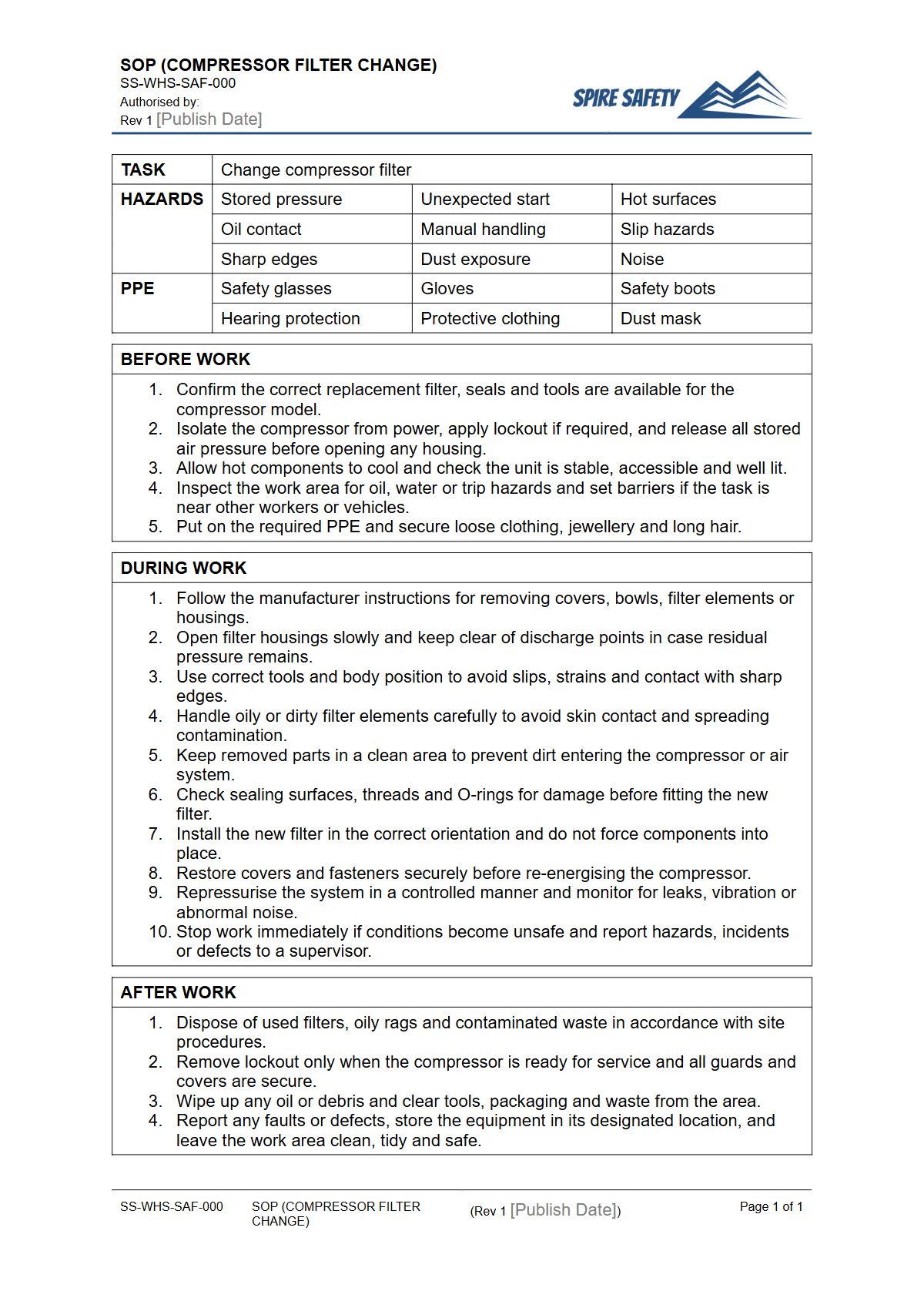
This free Safe Operating Procedure (Compressor Filter Change) template provides a structured framework for documenting the systematic process of replacing filters on air compressors. Regular filter changes are critical not only for equipment longevity and performance but also for worker safety.
A documented SOP ensures that the task is performed consistently and safely every time, addressing key hazards such as stored energy (pressurised air), manual handling, and exposure to contaminants.
Using a standardised procedure helps your organisation meet its primary duty of care under WHS legislation by providing a safe system of work. This document acts as a vital tool for training personnel and serves as a reference point for supervisors and maintenance teams.
It should form part of a broader set of procedures for plant maintenance, complementing documents like our comprehensive air compressor SOP to cover all operational aspects.
Video walkthrough
How to use the Free Safe Operating Procedure (Compressor Filter Change) Template
This template is provided as a starting point. To make it effective, you must customise it to reflect the specific equipment and environment at your workplace.
Download the DOCX file and edit the sections to include details relevant to your machinery, such as the make and model of the compressor, the specific types of air, oil, or separator filters used, and the tools required for the job. It is critical to conduct a site-specific risk assessment and incorporate your findings into the SOP.
Pay close attention to the isolation and de-pressurisation steps, as these are the most critical safety controls for this task. Once customised, the SOP should be reviewed by a competent person, such as a maintenance supervisor or WHS manager, before being approved for use.
Integrating this procedure into a robust WHS management system ensures it is properly managed, reviewed, and updated as required.
Important Customisation Note:
We have created this template to be a helpful starting point. However, every workplace is unique.
You must adapt this document by incorporating your specific site details, machinery models, and internal procedures to ensure it is relevant and effective for your operations.
When to use it
A Safe Operating Procedure for changing compressor filters should be used every time this maintenance task is performed. It is particularly important when:
- Training new or inexperienced maintenance personnel on the correct procedure.
- Scheduling routine preventive maintenance based on manufacturer recommendations or operational hours.
- As a reference for experienced workers to ensure no steps are missed.
- During incident investigations if a near-miss or injury occurs during the task.
- As a review tool for supervisors to confirm that safety standards are being followed.
While this SOP is for a routine maintenance task, other procedures are required for non-routine events. This might include emergency procedures, such as our defibrillator operation SOP, which covers a completely different risk profile but follows a similar structured approach.
Who should use it
This SOP is intended for use by individuals who are responsible for or involved in the maintenance of air compressors. This includes:
- Maintenance Technicians and Fitters: The primary users who will follow the step-by-step procedure to perform the filter change safely.
- Supervisors and Team Leaders: To oversee the work, provide guidance, and ensure the procedure is followed correctly.
- WHS Managers and Advisors: To develop, review, and integrate the SOP into the organisation's overall safety management system. They may also use it as part of a WHS compliance auditing process to verify safe work practices.
- Apprentices and Trainees: As a foundational training document under the direct supervision of a competent person.
Ensuring that all relevant personnel are trained and deemed competent in the procedure is crucial for its success. This SOP can be used to support other documents for workshop equipment, like our plasma cutter SOP, creating a consistent approach to safety across different tasks. For more templates and safety resources, browse our entire free WHS resources library.
Common mistakes
Common mistakes to avoid
- Forgetting to completely de-pressurise the system before attempting to remove the filter housing.
- Using an incorrect or non-genuine filter, which can lead to poor performance, air contamination, or equipment damage.
- Failing to clean the filter housing and check seals before installing the new filter.
- Neglecting to run the compressor and check for leaks around the new filter after the task is complete.
Legal references
Legal considerations
The following legal requirements may be relevant to this type of work.
- Work Health and Safety Act (Harmonised) — Provides the primary duties for protecting workers and other people from work health and safety risks.
- Work Health and Safety Regulations (Harmonised) — Sets out requirements supporting the management of workplace hazards and risks.
The following codes may be relevant to this type of work.
- Managing WHS Risks Code of Practice — Provides practical guidance on identifying hazards, assessing risks and applying effective controls.
- Work Health and Safety Consultation, Cooperation and Coordination Code of Practice — Provides practical guidance on consulting workers and coordinating with other duty holders.
- Managing the Work Environment and Facilities Code of Practice — Provides practical guidance on safe work environments, workplace facilities and related controls.
Did you know
Energy Consumption
A poorly maintained air compressor with clogged filters can increase energy consumption by up to 10%. Regular filter changes not only improve safety but also lead to significant energy savings.
Air Contamination
Inefficient filters can allow oil, water, and particulate contaminants into the compressed air lines, potentially damaging downstream equipment and compromising processes that rely on clean air.
FAQ
Frequently asked questions
01Why do I need a specific SOP for changing a compressor filter?
02What PPE is generally required for a compressor filter change?
03How often should compressor filters be changed?
04Can this template be used for any brand of air compressor?
Share this resource
Free Safe Operating Procedure (Compressor Filter Change) Template
Browse Categories
How To Use It
- 1Download and open in Word or PDF.
- 2Replace the placeholders with your business details.
- 3Get it reviewed by a WHS specialist before rollout.
Need it customised?
Our WHS consultants can adapt this template to your site, run a gap analysis, or audit what you already have in place.
Book a Free Consultation WHS consulting servicesor call 1300 156 382
Related templates
- Free Safe Operating Procedure (Compressor Shutdown) Template
- Free Safe Operating Procedure (Compressor Start Up) Template
- Free Safe Operating Procedure (Concrete Buggy) Template
- Free Safe Operating Procedure (Concrete Cover Meter) Template
- Free Safe Operating Procedure (Concrete Cube Testing) Template
- Free Safe Operating Procedure (Concrete Dumper) Template