
Free Safe Operating Procedure (Compressor Start Up) Template
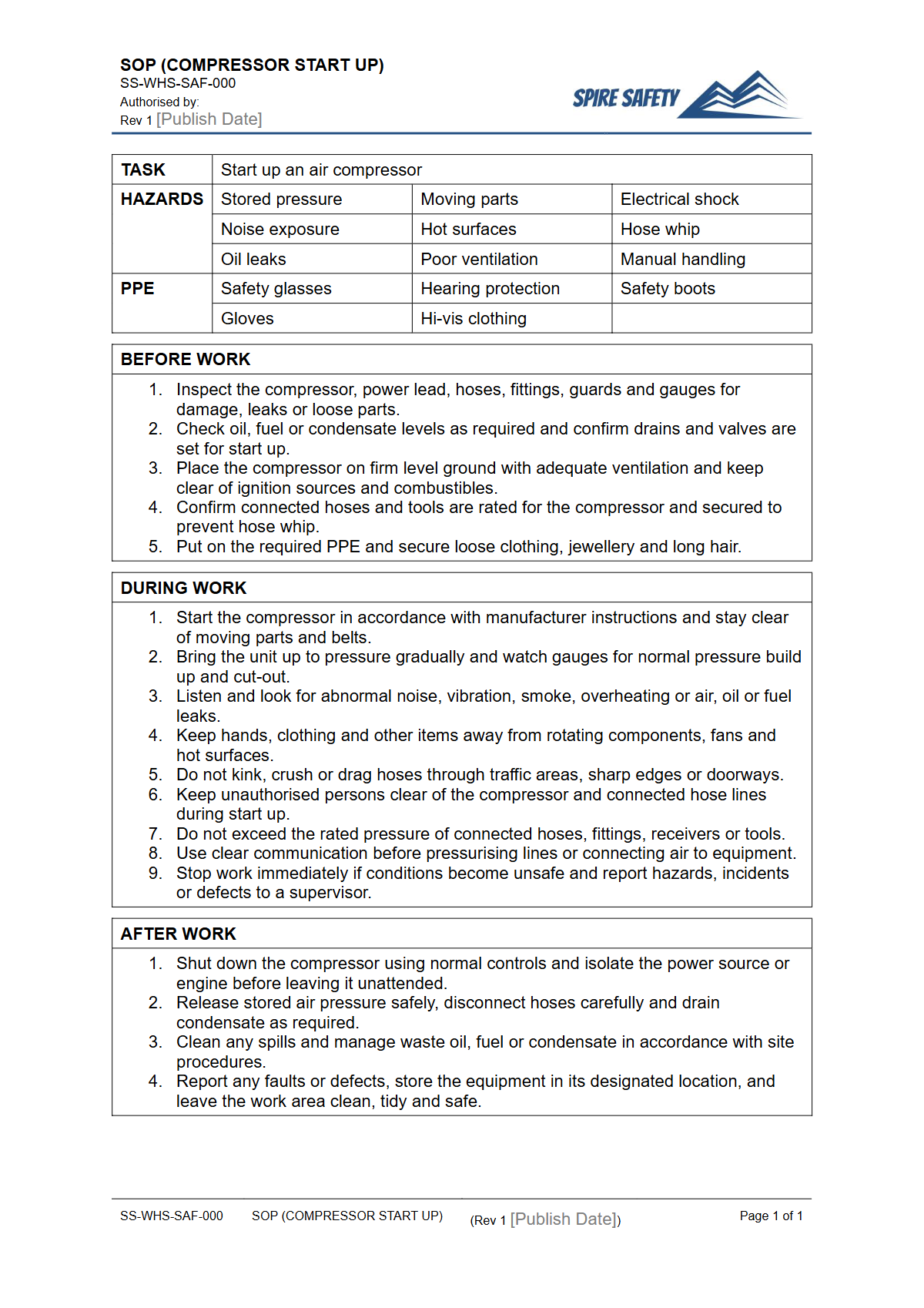
Download our Free Safe Operating Procedure (Compressor Start Up) Template.
Free Safe Operating Procedure (Compressor Start Up) Template
DOCX • 126 KB + PDF
Updated Oct 2026
No signup required
Purpose of the Free Safe Operating Procedure (Compressor Start Up) Template
Starting an air compressor involves specific steps to ensure operator safety and equipment integrity. This Free Safe Operating Procedure (Compressor Start Up) Template provides a structured framework for documenting these crucial steps.
Its primary purpose is to help Persons Conducting a Business or Undertaking (PCBUs) establish a clear, repeatable, and safe method for initiating compressor operations. Using a standardised procedure helps minimise risks associated with stored energy, electrical hazards, and mechanical failures.
This Safe Operating Procedure serves as a vital training tool for new workers and a reference for experienced operators, promoting a consistent safety culture across the worksite.
While this template focuses on the start-up sequence, a complete operational document is often required. For a more comprehensive guide covering the entire lifecycle of use, you may find our free Air Compressor SOP (Safe Operating Procedure) template a useful companion resource.
Formalising these procedures is a key step in managing plant-related risks and demonstrating due diligence under Australian WHS laws.
Video walkthrough
How to use the Free Safe Operating Procedure (Compressor Start Up) Template
This document is provided in both DOCX and PDF formats for your convenience. The DOCX file is fully editable, allowing you to tailor the content to your specific operational needs.
To use the template effectively, you should review each section and modify it to reflect the make and model of your compressor, the specific tasks performed, and the unique conditions of your workplace. It's crucial to involve workers who actually operate the equipment in the customisation process to ensure the procedure is practical and accurate.
Important: This is a template, not a finished document. We have drafted it to align with the model WHS framework, but every workplace is different.
You must customise this SOP to address the specific hazards and control measures relevant to your site, equipment, and legal obligations before use. Integrating this SOP into a broader, documented WHS management system ensures it is properly implemented, reviewed, and maintained as part of your overall safety strategy.
When customising, consider including details on specific pre-start checks, such as verifying oil levels, draining water from the receiver tank, and ensuring all guards are in place. You should also reference the manufacturer's operating manual for model-specific instructions and warnings.
For tasks that often accompany compressor use, such as welding or cutting, you may need additional documentation like a free Plasma Cutter SOP to cover all associated risks.
When to use it
A Safe Operating Procedure for compressor start-up should be used every time the equipment is initiated by an authorised operator. It is not just a document for emergencies or initial training; it forms part of the daily operational routine.
The SOP is particularly important during worker induction and onboarding, providing a clear guide on the expected safe behaviour from day one. It should also be a central document for refresher training and competency assessments.
This procedure should be readily accessible to all operators at or near the compressor's location. Regular review is also essential.
The SOP should be revisited at least annually, or whenever there is a change in equipment, processes, or after an incident or near-miss occurs. The effectiveness of your SOPs should be a key focus during any internal or external WHS compliance auditing activities.
Who should use it
This template is designed for use by a range of personnel within an organisation. WHS managers, supervisors, and team leaders will typically be responsible for customising the template and implementing it as a workplace standard.
They must ensure that the final procedure accurately reflects the risks and controls for the specific compressors on site. Developing robust safety documentation can be complex, and for organisations needing expert guidance, engaging WHS consulting services can provide clarity and support.
The primary end-users of the completed SOP are the equipment operators themselves. Every worker tasked with starting or operating a compressor must be trained on the procedure and be deemed competent before working unsupervised.
The SOP acts as their guide to performing the task safely and consistently. It is also a valuable resource for maintenance staff who may need to start the equipment for diagnostic or servicing purposes.
Beyond operational use, it's wise to integrate task-specific SOPs with broader site safety plans. This includes having clear protocols for medical emergencies, which can be supported by resources like our defibrillator operation SOP. You can find a wide range of similar documents in our free WHS resources library to help build a comprehensive safety framework for your business.
Common mistakes
Common mistakes to avoid
- Skipping pre-start checks, especially draining condensation from the receiver tank.
- Failing to verify that pressure relief valves are functional and unobstructed.
- Using a procedure for one model of compressor on a different model without customisation.
- Not wearing appropriate PPE, particularly hearing and eye protection, during operation.
Legal references
Legal considerations
The following legal requirements may be relevant to this type of work.
- Work Health and Safety Act (Harmonised) — Provides the primary duties for protecting workers and other people from work health and safety risks.
- Work Health and Safety Regulations (Harmonised) — Sets out requirements supporting the management of workplace hazards and risks.
The following codes may be relevant to this type of work.
- Managing WHS Risks Code of Practice — Provides practical guidance on identifying hazards, assessing risks and applying effective controls.
- Work Health and Safety Consultation, Cooperation and Coordination Code of Practice — Provides practical guidance on consulting workers and coordinating with other duty holders.
- Managing the Work Environment and Facilities Code of Practice — Provides practical guidance on safe work environments, workplace facilities and related controls.
Did you know
Stored Energy Hazard
Even a small air compressor stores a significant amount of pneumatic energy. A sudden, uncontrolled release from a tank or line can cause serious projectile-related injuries or property damage.
Noise Exposure
Many industrial compressors operate above 85 decibels (dB), the exposure standard at which hearing protection becomes mandatory under Australian WHS regulations to prevent noise-induced hearing loss.
FAQ
Frequently asked questions
01What should be included in a compressor start-up SOP?
02How often should a compressor start-up procedure be reviewed?
03Is a generic compressor start-up template safe to use?
04Who is responsible for enforcing the compressor start-up SOP?
Share this resource
Free Safe Operating Procedure (Compressor Start Up) Template
Browse Categories
How To Use It
- 1Download and open in Word or PDF.
- 2Replace the placeholders with your business details.
- 3Get it reviewed by a WHS specialist before rollout.
Need it customised?
Our WHS consultants can adapt this template to your site, run a gap analysis, or audit what you already have in place.
Book a Free Consultation WHS consulting servicesor call 1300 156 382
Related templates
- Free Safe Operating Procedure (Concrete Buggy) Template
- Free Safe Operating Procedure (Concrete Cover Meter) Template
- Free Safe Operating Procedure (Concrete Cube Testing) Template
- Free Safe Operating Procedure (Concrete Dumper) Template
- Free Safe Operating Procedure (Concrete Grinder) Template
- Free Safe Operating Procedure (Concrete Hopper) Template