
Free Safe Operating Procedure (Concrete Buggy) Template
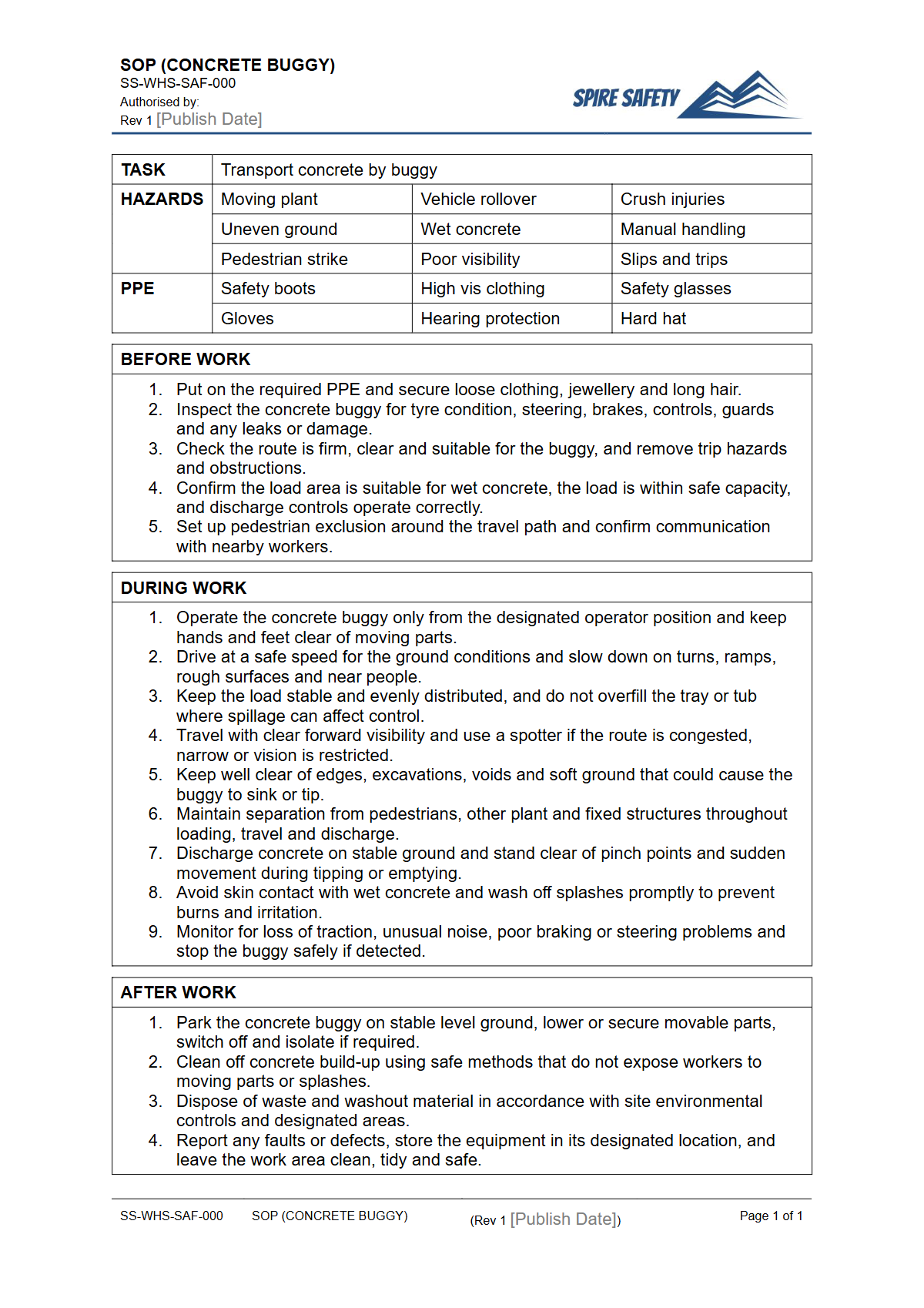
Download our free Safe Operating Procedure (Concrete Buggy) Template. This customisable DOCX & PDF provides a solid foundation for your WHS system.
Free Safe Operating Procedure (Concrete Buggy) Template
DOCX • 126 KB + PDF
Updated Oct 2026
No signup required
Purpose of the Free Safe Operating Procedure (Concrete Buggy) Template
Operating a concrete buggy, also known as a motorised wheelbarrow or power buggy, introduces significant risks on a construction site. This Free Safe Operating Procedure (Concrete Buggy) Template provides a structured framework for documenting the required steps to operate this equipment safely.
A well-developed SOP is a critical tool for managing WHS obligations, helping to control hazards such as rollovers on uneven ground, collisions with people or structures, and operator exposure to noise and vibration. By formalising your process, you create a clear, trainable, and auditable system of work that protects your workers and helps your business meet its primary duty of care.
Implementing a specific SOP for this task is a practical way to ensure safety measures are communicated effectively. It forms a core part of your broader WHS management systems, demonstrating a proactive approach to risk management for mobile plant.
Video walkthrough
How to use the Free Safe Operating Procedure (Concrete Buggy) Template
To get started, simply download the template in your preferred format (DOCX for easy editing or PDF). The document is structured with key sections that guide you through documenting your process, including pre-start checks, operational steps, and shutdown procedures.
Important: This document is a template and must be customised to your specific workplace. We have provided a comprehensive starting point, but you are responsible for ensuring the final SOP reflects the unique environment, equipment models, and control measures relevant to your site.
You must consult the manufacturer's operating manual and incorporate site-specific details, such as designated travel paths, communication protocols, and emergency response plans. The final responsibility for the SOP's accuracy and suitability rests with the Person Conducting a Business or Undertaking (PCBU).
When to use it
A Safe Operating Procedure for a concrete buggy should be an active document used in multiple scenarios. It is essential during the induction and training of new operators to ensure they understand the established safe method of work before they begin.
It should also be readily available at the worksite as a reference for operators and supervisors. Furthermore, the SOP serves as a crucial review tool following any incident or near miss, helping to identify gaps in the current process.
It's also wise to review the SOP whenever new models of buggy are introduced or when the site layout changes significantly.
Who should use it
This SOP template is designed for use by a range of personnel within an organisation. WHS managers and supervisors will use it to develop, implement, and review safety protocols.
Operators must be trained on the SOP and use it to guide their work practices. Training departments can integrate it into their competency and assessment programs.
The principles are similar for other specialised mobile plant used in construction, such as those detailed in our free Boom Pump SOP, which also involves the movement of concrete.
Key Hazards of Concrete Buggy Operation
While seemingly simple, concrete buggies present serious hazards that your SOP must address. Key risks include:
- Rollover: Operating on slopes, uneven terrain, or soft ground can lead to instability and rollover, posing a severe risk of crush injuries.
- Collisions: Poor visibility, high-traffic areas, and reversing can result in collisions with pedestrians, other vehicles, or structures.
- Musculoskeletal Disorders: Operators are exposed to whole-body vibration, which can lead to chronic injury over time. Awkward postures during operation or cleaning also contribute to this risk.
- Noise: The engine generates hazardous noise levels, requiring appropriate hearing protection.
- Falls: Operators can slip or fall when mounting or dismounting the equipment, particularly if surfaces are wet with concrete slurry or water.
Documenting controls for these hazards is fundamental, a process applicable to other equipment like that covered in our FREE Telehandler SOP Template.
Integrating the SOP into Your WHS System
An SOP is most effective when it is fully integrated into your organisation's safety culture, not just filed away. This involves ensuring all operators receive comprehensive training based on the finalised document.
Supervisors should conduct regular observations to verify that the procedures are being followed correctly. Competency should be periodically assessed and recorded.
The effectiveness of your procedures, from concrete buggies to other machinery covered by documents like our FREE Trencher SOP Template, can be formally verified during a WHS compliance audit, providing assurance that your systems are working as intended.
For more templates and safety guides, explore our complete free WHS resources library, which covers a wide range of high-risk equipment and work activities.
Common mistakes
Common mistakes to avoid
- Failing to customise the template with site-specific hazards and controls.
- Neglecting to reference the specific manufacturer's operating manual.
- Treating the SOP as a one-time document instead of a live tool for training and review.
- Forgetting to include procedures for cleaning, refuelling, and basic maintenance.
Legal references
Legal considerations
The following legal requirements may be relevant to this type of work.
- Work Health and Safety Act (Harmonised) — Provides the primary duties for protecting workers and other people from work health and safety risks.
- Work Health and Safety Regulations (Harmonised) — Sets out requirements supporting the management of workplace hazards and risks.
The following codes may be relevant to this type of work.
- Managing WHS Risks Code of Practice — Provides practical guidance on identifying hazards, assessing risks and applying effective controls.
- Work Health and Safety Consultation, Cooperation and Coordination Code of Practice — Provides practical guidance on consulting workers and coordinating with other duty holders.
- Managing the Work Environment and Facilities Code of Practice — Provides practical guidance on safe work environments, workplace facilities and related controls.
Did you know
Whole-Body Vibration
Prolonged exposure to whole-body vibration from equipment like concrete buggies is a serious hazard. It can lead to chronic back pain, musculoskeletal disorders, and other health issues.
FAQ
Frequently asked questions
01What key sections should be included in a concrete buggy SOP?
02Is a Safe Operating Procedure a legal requirement in Australia?
03How often should we review our concrete buggy SOP?
04Can this template be used for all types of concrete buggies?
Share this resource
Free Safe Operating Procedure (Concrete Buggy) Template
Browse Categories
How To Use It
- 1Download and open in Word or PDF.
- 2Replace the placeholders with your business details.
- 3Get it reviewed by a WHS specialist before rollout.
Need it customised?
Our WHS consultants can adapt this template to your site, run a gap analysis, or audit what you already have in place.
Book a Free Consultation WHS consulting servicesor call 1300 156 382
Related templates
- Free Safe Operating Procedure (Concrete Cover Meter) Template
- Free Safe Operating Procedure (Concrete Cube Testing) Template
- Free Safe Operating Procedure (Concrete Dumper) Template
- Free Safe Operating Procedure (Concrete Grinder) Template
- Free Safe Operating Procedure (Concrete Hopper) Template
- Free Safe Operating Procedure (Concrete Mixer Operation) Template