
Free Safe Operating Procedure (Compressor Shutdown) Template
Download our Free Safe Operating Procedure (Compressor Shutdown) Template.
Free Safe Operating Procedure (Compressor Shutdown) Template
DOCX • 126 KB + PDF
Updated Oct 2026
No signup required
Purpose of the Free Safe Operating Procedure (Compressor Shutdown) Template
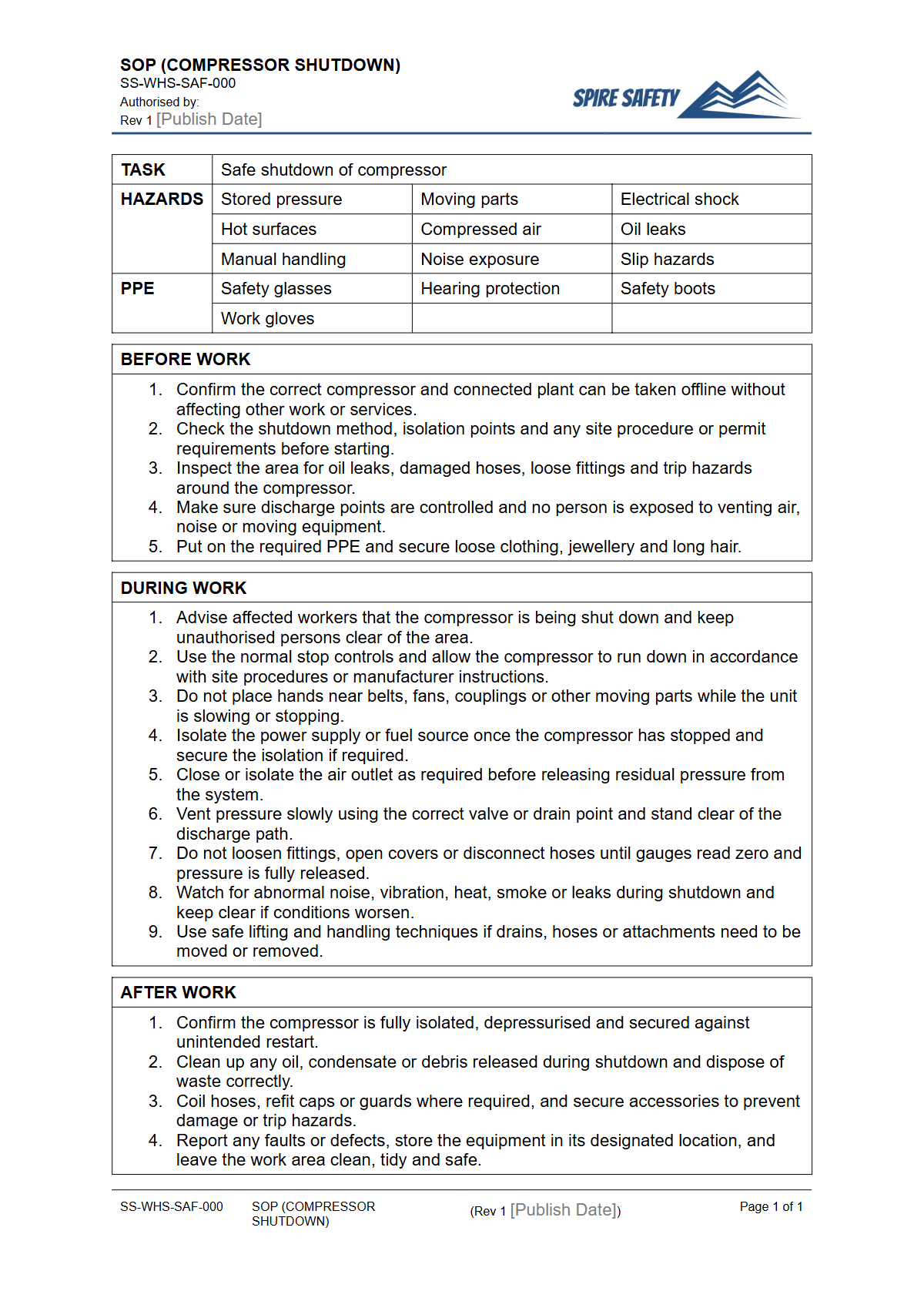
This Free Safe Operating Procedure (Compressor Shutdown) Template provides a structured framework for documenting the specific steps required to safely shut down, depressurise, and isolate industrial or commercial air compressors. A documented shutdown process is as critical as the start-up sequence, ensuring that energy sources are controlled, stored pressure is safely released, and the equipment is left in a safe state for maintenance, inspection, or extended periods of non-use.
Using this template helps organisations establish a consistent, repeatable, and safe method for taking compressors offline, reducing the risk of unexpected pressurisation, electrical hazards, or mechanical movement. It complements a general Free Air Compressor SOP (Safe Operating Procedure) Template by focusing specifically on the critical de-energisation and isolation phase.
Video walkthrough
How to use the Free Safe Operating Procedure (Compressor Shutdown) Template
To effectively use this Free Safe Operating Procedure (Compressor Shutdown) Template, start by downloading the DOCX file and opening it on your computer. The document is organised into key sections, including pre-shutdown checks, the step-by-step shutdown sequence, depressurisation, isolation (Lockout/Tagout), and post-shutdown verification.
Systematically work through each section, replacing the placeholder text with details specific to your equipment and workplace. This includes the make and model of the compressor, specific valve locations, electrical disconnect points, and any unique site hazards.
Involve competent operators and maintenance personnel in the customisation process to ensure the procedure is accurate and practical.
Important: This document is a template and must be customised to your specific workplace. We are not responsible for the outcomes of its use.
You must adapt the content to reflect the actual compressor models, energy sources, site layout, and unique risks present at your facility. Consult the manufacturer's manual and conduct a site-specific risk assessment to ensure all hazards are controlled.
Once finalised, the SOP should be used to train all relevant personnel.
When to use a Compressor Shutdown Safe Operating Procedure
A specific Safe Operating Procedure for compressor shutdown should be used in several key situations. It is mandatory before conducting any maintenance, repair, or cleaning work on the compressor or its associated components.
The procedure ensures the machine is de-energised and cannot be started accidentally. It should also be followed for planned long-term shutdowns, such as during holiday periods or plant closures, to prevent energy wastage and ensure a safe state.
Furthermore, elements of the procedure, particularly emergency stop sequences, must be clearly understood for immediate use in the event of a malfunction, equipment failure, or other workplace emergency. Having a separate, detailed shutdown SOP helps reinforce its importance as a distinct and critical safety process, rather than just the final step of a general operating procedure.
Who should use this template
This SOP template is designed for use by Persons Conducting a Business or Undertaking (PCBUs), health and safety managers, maintenance supervisors, and team leaders. Essentially, anyone with responsibility for the safety of plant and equipment in the workplace can use this document as a starting point.
It is particularly useful for those tasked with developing or refining their site's WHS management systems. The final, customised SOP should be used by trained and authorised operators, maintenance workers, and electricians who are required to interact with the compressor. Competent persons should review and approve the final document before it is formally issued and used for training.
Key Elements of a Compressor Shutdown SOP
A comprehensive compressor shutdown SOP should contain several critical elements to be effective. These include:
- Identification: Clearly state the specific plant it applies to (e.g., "Atlas Copco GA 37 VSD+ Air Compressor, Asset #C-002").
- Pre-Shutdown Checks: List any checks required before initiating the shutdown, such as ensuring production processes are complete or notifying affected personnel.
- Normal Shutdown Sequence: A step-by-step guide for a planned, non-emergency shutdown. This typically involves using the machine's control panel to stop the motor.
- Emergency Shutdown: Detail the location and method of activation for all emergency stop buttons and the actions to take immediately following an emergency stop.
- Depressurisation: Provide explicit instructions for safely venting all stored air pressure from the receiver tank and associated piping. Never assume the system is depressurised just because the motor is off.
- Energy Isolation: Outline the full Lockout/Tagout (LOTO) procedure, including the location of all electrical, pneumatic, and other energy sources and how to isolate and lock them.
- Verification: Include a step to verify that the equipment is in a zero-energy state before any work commences. This may involve attempting to start the machine or using a multimeter. This verification step is a crucial part of a robust safety system and is often reviewed during a WHS compliance auditing program.
Integrating these elements creates a robust procedure that guides workers through a safe and logical sequence. For other high-risk tasks, you may find our plasma cutter SOP template useful for structuring similar documents.
Integrating Shutdown Procedures into Broader Safety Training
A written SOP is only effective if workers are trained on its content and understand the reasoning behind each step. Training should be hands-on where possible, allowing workers to walk through the shutdown, depressurisation, and LOTO process on the actual equipment under supervision.
Training records should be maintained to demonstrate competency. The procedure should be readily accessible near the equipment for easy reference.
Regularly reviewing the SOP, especially after an incident or near miss, ensures it remains current and effective. For some critical emergency responses, you might even link this SOP to others, like your Safe Operating Procedure (Defibrillator Operation) template, as part of a broader emergency plan.
You can find many more examples in our free WHS resources library to help build out your safety systems.
Common mistakes
Common mistakes to avoid
- Assuming the system is depressurised just because the motor is off.
- Failing to perform a full Lockout/Tagout (LOTO) procedure on all energy sources.
- Not accounting for automatic restart features after a power outage.
- Using a generic manufacturer's guide without customising it for site-specific risks and isolation points.
Legal references
Legal considerations
The following legal requirements may be relevant to this type of work.
- Work Health and Safety Act (Harmonised) — Provides the primary duties for protecting workers and other people from work health and safety risks.
- Work Health and Safety Regulations (Harmonised) — Sets out requirements supporting the management of workplace hazards and risks.
The following codes may be relevant to this type of work.
- Managing WHS Risks Code of Practice — Provides practical guidance on identifying hazards, assessing risks and applying effective controls.
- Work Health and Safety Consultation, Cooperation and Coordination Code of Practice — Provides practical guidance on consulting workers and coordinating with other duty holders.
- Managing the Work Environment and Facilities Code of Practice — Provides practical guidance on safe work environments, workplace facilities and related controls.
Did you know
Stored Energy Hazard
A large industrial air receiver can store a massive amount of pneumatic energy. A catastrophic vessel failure can release this energy with the force of an explosion, capable of destroying property and causing fatal injuries.
Lockout/Tagout is Key
Lockout/Tagout (LOTO) is a non-negotiable part of a safe shutdown. It is a control measure designed to physically prevent the re-energisation of equipment while it is being serviced, protecting workers from unexpected start-ups.
FAQ
Frequently asked questions
01Why is a specific shutdown SOP needed if we already have a general compressor SOP?
02What's the difference between a normal shutdown and an emergency shutdown?
03Who is responsible for writing and approving a compressor shutdown SOP?
04How often should a compressor shutdown SOP be reviewed?
Share this resource
Free Safe Operating Procedure (Compressor Shutdown) Template
Browse Categories
How To Use It
- 1Download and open in Word or PDF.
- 2Replace the placeholders with your business details.
- 3Get it reviewed by a WHS specialist before rollout.
Need it customised?
Our WHS consultants can adapt this template to your site, run a gap analysis, or audit what you already have in place.
Book a Free Consultation WHS consulting servicesor call 1300 156 382
Related templates
- Free Safe Operating Procedure (Compressor Start Up) Template
- Free Safe Operating Procedure (Concrete Buggy) Template
- Free Safe Operating Procedure (Concrete Cover Meter) Template
- Free Safe Operating Procedure (Concrete Cube Testing) Template
- Free Safe Operating Procedure (Concrete Dumper) Template
- Free Safe Operating Procedure (Concrete Grinder) Template