
Free Safe Operating Procedure (Compost Turning) Template
Download our free Safe Operating Procedure (Compost Turning) template. This DOCX and PDF resource helps you outline safe work steps for your team.
Free Safe Operating Procedure (Compost Turning) Template
DOCX • 126 KB + PDF
Updated Oct 2026
No signup required
Purpose of the Free Safe Operating Procedure (Compost Turning) Template
Effectively managing the risks associated with turning compost requires a clear, documented process. This Free Safe Operating Procedure (Compost Turning) Template provides a structured starting point for organisations in the agriculture, waste management, and landscaping sectors to formalise their safety protocols.
A well-drafted SOP is a critical tool for ensuring tasks are performed consistently and safely, helping to minimise the risk of incidents related to machinery operation, biological hazards, and manual handling.
This template is designed to guide you in outlining the step-by-step process for safely operating compost turning equipment, such as windrow turners or front-end loaders. It serves as a key part of your risk management framework by identifying hazards and stipulating control measures.
For other heavy machinery tasks, a dedicated SOP is equally vital; our Scraper SOP template offers another example for a different type of plant.
Video walkthrough
How to use the Free Safe Operating Procedure (Compost Turning) Template
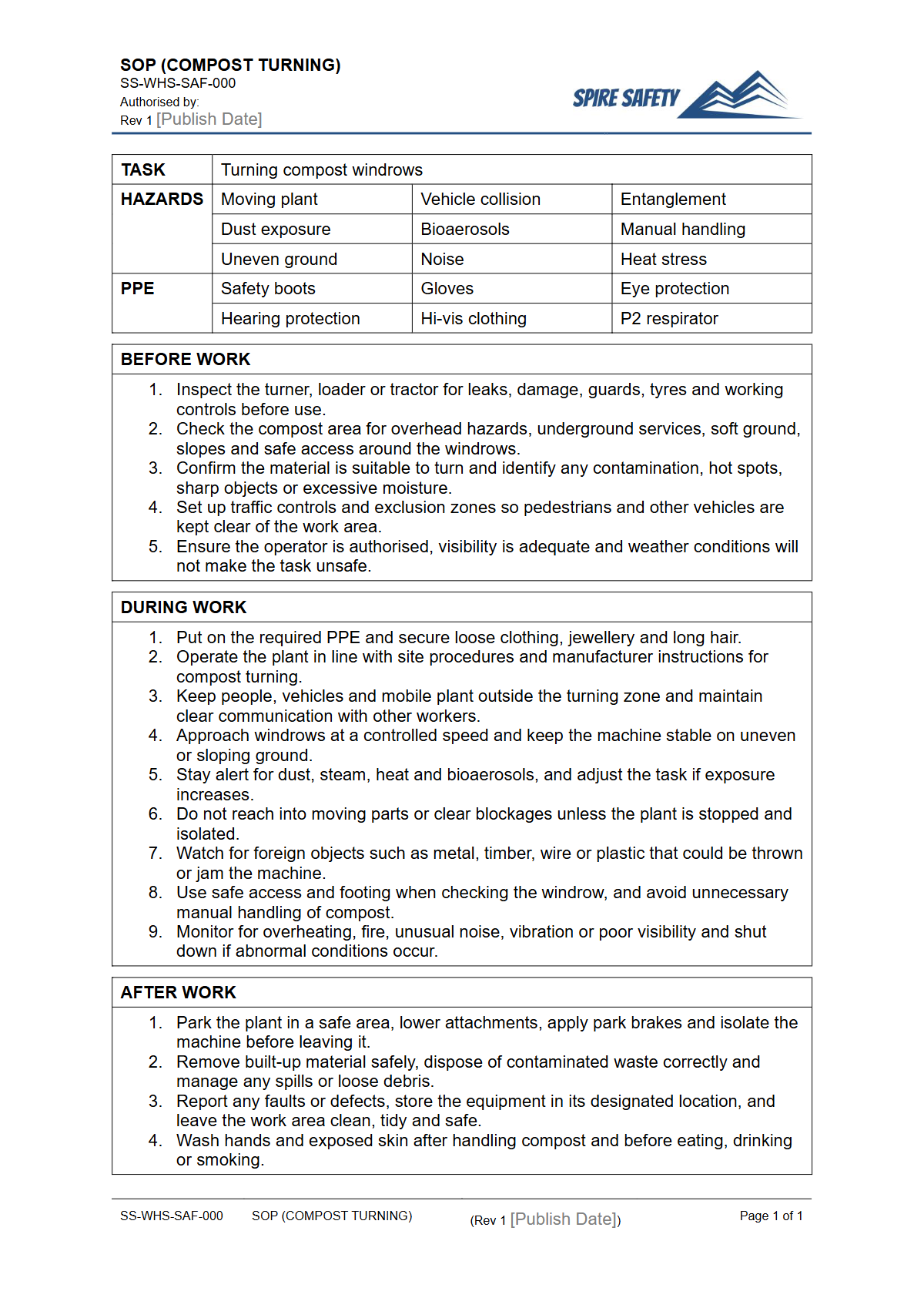
This Safe Operating Procedure is available as a fully editable DOCX file for easy customisation, as well as a print-ready PDF. To use it, download the file and systematically work through each section, adapting the content to reflect the specific machinery, site conditions, and operational procedures at your workplace.
IMPORTANT: This document is a template and must be customised to your specific operational needs. We are not liable for any incidents that may arise from its use.
You must fill in details regarding your specific machinery, site layout, emergency contacts, and the unique risks identified in your own risk assessment.
Key sections for customisation include:
- Personal Protective Equipment (PPE): Specify the exact PPE required, such as P2/P3 respirators for bioaerosols, hearing protection, safety glasses, and high-visibility clothing.
- Pre-operational Checks: List the safety and functional checks specific to your compost turning machinery.
- Step-by-Step Procedure: Detail the safe sequence of actions for the entire task, from startup to shutdown and cleaning.
- Emergency Procedures: Outline steps for machinery failure, fire, or medical emergencies.
Many facilities use versatile equipment for various material handling jobs. If a telehandler is used in your composting operations, developing a specific Telehandler SOP is a necessary complementary control.
Key Hazards in Compost Turning
Compost turning introduces a range of serious health and safety hazards that must be controlled. A comprehensive SOP helps formalise the controls for these risks.
- Mechanical Hazards: The primary risk involves machinery, including entanglement in rotating parts, being struck by the machine, or crush injuries from loaders and turners.
- Biological Hazards: Turning compost releases bioaerosols—airborne fungi, bacteria, and endotoxins—that can cause serious respiratory illnesses like Organic Dust Toxic Syndrome (ODTS) and Farmer's Lung.
- Chemical Hazards: Decomposition can release gases such as ammonia, carbon dioxide, and hydrogen sulphide, which can be hazardous in high concentrations or enclosed spaces.
- Physical Hazards: These include excessive noise from machinery, heat stress from the decomposing pile and sun exposure, and slips, trips, and falls on uneven or wet ground.
Managing these diverse hazards effectively requires more than a single document; it is a fundamental part of building and maintaining robust WHS management systems that integrate safety into every aspect of your operation.
When to use this Safe Operating Procedure
A Safe Operating Procedure for compost turning should be a living document used throughout the operational lifecycle. It is not a 'set and forget' tool. Use it:
- As the foundation for training new operators and inducting workers.
- As a reference guide for workers before starting a compost turning task.
- During routine safety observations and supervisor checks.
- As a key document when conducting a formal WHS compliance auditing process.
- When reviewing or investigating an incident or near miss to identify procedural gaps.
The principles of documenting safe work methods apply to all high-risk activities. This is just as critical for other mobile plant, as detailed in resources like our free Dozer SOP template.
Who should use it
This SOP template is intended for use by several key roles within an organisation to ensure a collaborative approach to safety:
- Managers and Supervisors: To ensure a standardised, safe procedure is established, implemented, and enforced on-site.
- Workers and Equipment Operators: As a clear guide to follow for safely performing their tasks and understanding the associated risks and controls.
- WHS/HSE Personnel and Safety Representatives: To assist in risk assessments, training development, and workplace inspections.
- Training Coordinators: To form the basis of competency-based training programs for machine operators.
By documenting and standardising your procedures, you create a safer work environment for everyone. Explore our extensive free WHS resources library for more templates and guides to support your safety goals.
Common mistakes
Common mistakes to avoid
- Using a generic template without adding site-specific machinery, personnel, and emergency details.
- Neglecting to specify appropriate PPE, especially respiratory protection for bioaerosol hazards.
- Failing to include procedures for emergency shutdown, fire response, or first aid.
- Not formally training all affected workers on the finalised SOP and documenting their competency.
Legal references
Legal considerations
The following legal requirements may be relevant to this type of work.
- Work Health and Safety Act (Harmonised) — Provides the primary duties for protecting workers and other people from work health and safety risks.
- Work Health and Safety Regulations (Harmonised) — Sets out requirements supporting the management of workplace hazards and risks.
The following codes may be relevant to this type of work.
- Managing WHS Risks Code of Practice — Provides practical guidance on identifying hazards, assessing risks and applying effective controls.
- Work Health and Safety Consultation, Cooperation and Coordination Code of Practice — Provides practical guidance on consulting workers and coordinating with other duty holders.
- Managing the Work Environment and Facilities Code of Practice — Provides practical guidance on safe work environments, workplace facilities and related controls.
Did you know
Compost Can Spontaneously Combust
If compost piles are not turned regularly, heat from microbial activity can build up to the point of spontaneous combustion. Proper turning aerates the pile and regulates its temperature, mitigating this serious fire risk.
Invisible Hazards
Bioaerosols, tiny airborne particles containing microbes from compost, are a significant respiratory hazard. Without proper PPE like P2/P3 respirators, they can cause long-term health issues for workers.
FAQ
Frequently asked questions
01What is a Safe Operating Procedure for compost turning?
02Why are bioaerosols a risk in compost turning?
03How often should a compost turning SOP be reviewed?
04Does this template cover all types of compost turning machinery?
Share this resource
Free Safe Operating Procedure (Compost Turning) Template
Browse Categories
How To Use It
- 1Download and open in Word or PDF.
- 2Replace the placeholders with your business details.
- 3Get it reviewed by a WHS specialist before rollout.
Need it customised?
Our WHS consultants can adapt this template to your site, run a gap analysis, or audit what you already have in place.
Book a Free Consultation WHS consulting servicesor call 1300 156 382
Related templates
- Free Safe Operating Procedure (Compressed Air Blowdown) Template
- Free Safe Operating Procedure (Compressor Drain) Template
- Free Safe Operating Procedure (Compressor Filter Change) Template
- Free Safe Operating Procedure (Compressor Shutdown) Template
- Free Safe Operating Procedure (Compressor Start Up) Template
- Free Safe Operating Procedure (Concrete Buggy) Template