
Free Safe Operating Procedure (Compressed Air Blowdown) Template
Download our free Safe Operating Procedure (Compressed Air Blowdown) template.
Free Safe Operating Procedure (Compressed Air Blowdown) Template
DOCX • 126 KB + PDF
Updated Oct 2026
No signup required
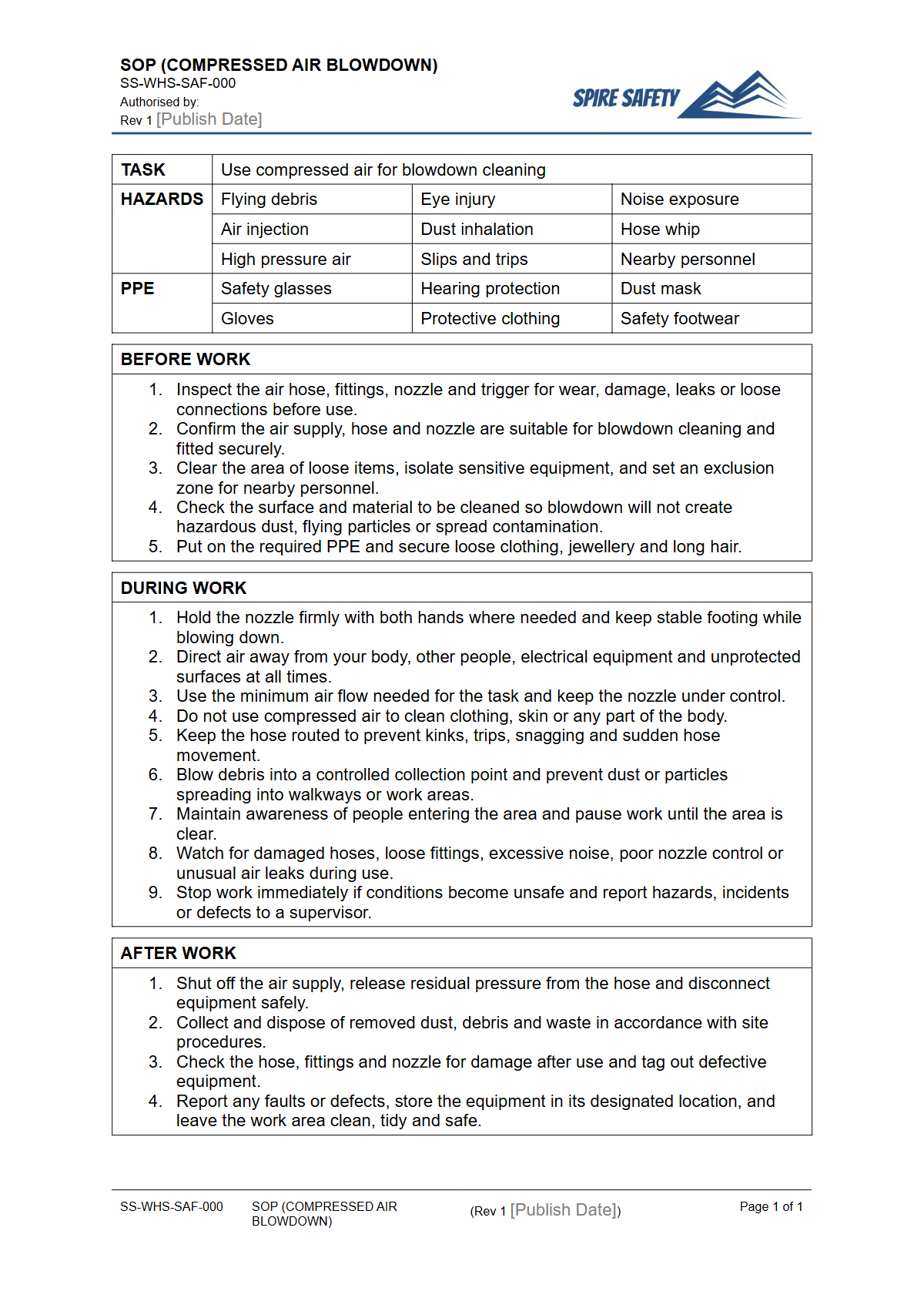
Purpose of the Free Safe Operating Procedure (Compressed Air Blowdown) Template
Spire Safety provides this Free Safe Operating Procedure (Compressed Air Blowdown) Template to help your organisation establish and document safe work methods for this common but hazardous industrial task. A well-defined SOP is a critical tool for managing the significant risks associated with high-pressure air, including injection injuries, eye damage from flying debris, and hearing loss.
This template provides a structured starting point for developing a comprehensive, site-specific procedure that guides workers to perform the task safely and consistently.
Using compressed air for cleaning or blowdown requires strict controls. The primary purpose of this SOP is to outline the required pre-operational checks, personal protective equipment (PPE), step-by-step instructions, and emergency procedures.
By formalising these steps, you create a clear standard of work, reduce the likelihood of incidents, and demonstrate a commitment to workplace safety. The procedure should be used in conjunction with a risk assessment and aligned with the operational manual for the equipment providing the compressed air. You can find a useful related resource in our free Air Compressor SOP template.
Video walkthrough
How to use the Free Safe Operating Procedure (Compressed Air Blowdown) Template
This template is available for download as a DOCX file, allowing for easy editing and customisation to suit your specific operational needs. A PDF version is also provided for straightforward printing and distribution.
It is structured to align with Australian WHS principles and provides a solid foundation for your documentation. The document includes sections for task description, risk controls, required PPE, step-by-step procedure, and training requirements.
To effectively use this resource, you must adapt its contents to reflect the unique aspects of your workplace. This includes specifying the exact make and model of equipment used, the types of materials being cleaned, and the specific environmental conditions.
Please note: This document is a template, not a finished procedure. We have created it as a framework that you must populate with your site-specific details. Effective SOPs are developed in consultation with the workers who actually perform the task. This ensures the procedure is practical, accurate, and reflects how the work is really done. Integrating procedures like this one is a key part of developing robust WHS management systems.
When to use it
A Safe Operating Procedure for compressed air blowdown should be in place and actively used before any worker is authorised to perform the task. It is a critical document for several key moments in the safety lifecycle.
It should be the primary reference material during initial worker training and induction, ensuring new team members understand the approved, safe method from day one. It also serves as an essential tool for competency assessments and refresher training.
Beyond training, the SOP should be readily accessible in the work area for operators to reference as needed. It also forms a benchmark for workplace inspections and observations.
Supervisors can use it to verify that work is being performed correctly and safely, and it serves as a critical piece of evidence during formal safety reviews or WHS compliance auditing activities.
Who should use it
This SOP is intended for multiple audiences within an organisation. WHS managers, supervisors, and team leaders will use the template as the basis for drafting, reviewing, and authorising the final, site-specific procedure.
They are responsible for ensuring the document is comprehensive, accurate, and effectively communicated to all relevant personnel.
The primary end-users of the completed SOP are the workers and operators who perform compressed air blowdown tasks. The procedure should be written in clear, simple language that is easy for them to understand and follow.
It acts as their guide to performing the job without exposing themselves or others to unnecessary risk. Similar procedural documents are vital for other workshop equipment, as seen in our FREE Plasma Cutter SOP Template, which also often involves compressed air.
For further examples, you can explore our complete free WHS resources library for a wide range of templates.
Common mistakes
Common mistakes to avoid
- Using non-safety, homemade, or modified nozzles that lack pressure relief and chip-guarding features.
- Directing the compressed air stream towards another person, even in jest.
- Failing to inspect hoses and fittings for cracks, leaks, and secure connections before use.
- Neglecting to wear appropriate PPE, especially mandatory eye protection.
Legal references
Legal considerations
The following legal requirements may be relevant to this type of work.
- Work Health and Safety Act (Harmonised) — Provides the primary duties for protecting workers and other people from work health and safety risks.
- Work Health and Safety Regulations (Harmonised) — Sets out requirements supporting the management of workplace hazards and risks.
The following codes may be relevant to this type of work.
- Managing WHS Risks Code of Practice — Provides practical guidance on identifying hazards, assessing risks and applying effective controls.
- Work Health and Safety Consultation, Cooperation and Coordination Code of Practice — Provides practical guidance on consulting workers and coordinating with other duty holders.
- Managing the Work Environment and Facilities Code of Practice — Provides practical guidance on safe work environments, workplace facilities and related controls.
Did you know
Pressure Danger
Air pressure as low as 15 PSI (103 kPa) can cause serious injury if it penetrates the skin, with the potential to rupture organs or cause a fatal air embolism.
Noise Hazard
A standard compressed air nozzle can produce noise levels well over 110 dBA, which can cause permanent hearing damage in a very short amount of time without proper hearing protection.
FAQ
Frequently asked questions
01What are the main hazards of compressed air blowdown?
02Can compressed air be used to clean dust from clothing?
03What PPE is required for compressed air blowdown tasks?
04How does a Safe Operating Procedure differ from a SWMS for this task?
Share this resource
Free Safe Operating Procedure (Compressed Air Blowdown) Template
Browse Categories
How To Use It
- 1Download and open in Word or PDF.
- 2Replace the placeholders with your business details.
- 3Get it reviewed by a WHS specialist before rollout.
Need it customised?
Our WHS consultants can adapt this template to your site, run a gap analysis, or audit what you already have in place.
Book a Free Consultation WHS consulting servicesor call 1300 156 382
Related templates
- Free Safe Operating Procedure (Compressor Drain) Template
- Free Safe Operating Procedure (Compressor Filter Change) Template
- Free Safe Operating Procedure (Compressor Shutdown) Template
- Free Safe Operating Procedure (Compressor Start Up) Template
- Free Safe Operating Procedure (Concrete Buggy) Template
- Free Safe Operating Procedure (Concrete Cover Meter) Template