
Free Safe Operating Procedure (Community Outing Support) Template
Download our free Safe Operating Procedure (Community Outing Support) template.
Free Safe Operating Procedure (Community Outing Support) Template
DOCX • 126 KB + PDF
Updated Oct 2026
No signup required
Purpose of the Free Safe Operating Procedure (Community Outing Support) Template
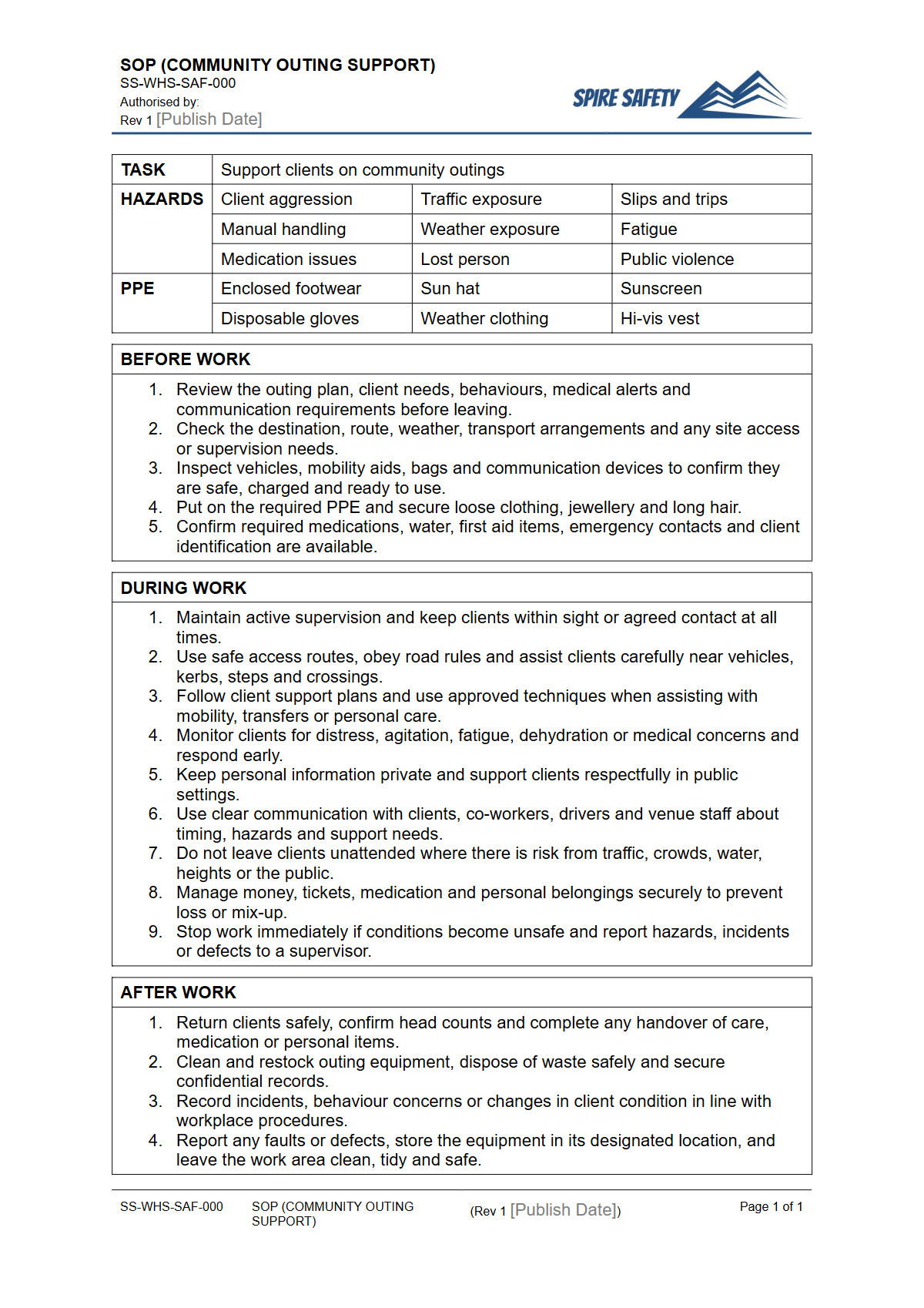
Supporting individuals in the community is a rewarding but complex task with inherent risks. This Free Safe Operating Procedure (Community Outing Support) Template provides a structured framework for organisations in sectors like aged care, disability support (including NDIS providers), and youth services to plan and execute safe community outings.
An SOP is a critical document that outlines the step-by-step process workers must follow to minimise risks to themselves, the individuals they support, and the public. It formalises risk controls and ensures a consistent, safe approach is applied across the organisation, forming a key component of robust WHS management systems.
Video walkthrough
How to use the Free Safe Operating Procedure (Community Outing Support) Template
This template is provided in both DOCX and PDF formats for your convenience. To use it effectively, download the DOCX file and adapt it to the specific context of your organisation, the clients you support, and the types of outings you conduct.
This includes adding your company branding, identifying specific hazards relevant to your locations and activities, and detailing your unique emergency procedures.
Important: This is a template only. It must be customised to your specific workplace, clients, and activities.
We are not responsible for the outcomes if you use this template without proper, site-specific customisation and risk assessment. Depending on the client's needs and the nature of the outing, you may also need to reference other specific procedures, such as an SOP for defibrillator operation if one is being taken on the trip.
Key Elements of a Community Outing SOP
A comprehensive SOP for community support outings should include several key sections to ensure all phases of the activity are covered:
- Pre-Outing Planning and Checks: This includes confirming client suitability and consent, checking weather forecasts, verifying venue accessibility, preparing necessary equipment (e.g., first aid kits, communication devices), and ensuring staff have the required training and information.
- Transport Arrangements: Detail the procedures for vehicle safety checks, securing mobility aids, driver responsibilities, and processes for boarding and disembarking clients safely.
- During the Outing: Outline responsibilities for supervision, medication management, manual handling tasks, incident response, and communication protocols between staff.
- Post-Outing Procedures: Document the process for returning the client, reporting any incidents or near misses, cleaning equipment, and providing feedback for future outings.
When to use it
A Safe Operating Procedure for community outings should be used as a primary reference document during several stages. It is essential during the planning phase of any new or recurring outing to ensure all safety aspects are considered.
It should be a core part of staff induction and ongoing training, ensuring every team member understands their responsibilities. The SOP also serves as a benchmark for safety performance reviews and can be reviewed as part of regular WHS compliance auditing to ensure it remains current and effective.
Who should use it
This SOP is designed for a range of personnel within a support service organisation. Frontline support workers and volunteers will use it as a practical guide for their day-to-day duties.
Team leaders and coordinators will use it to plan activities, supervise staff, and conduct pre-outing briefings. WHS managers and organisational leaders are responsible for developing, approving, and reviewing the SOP, ensuring it aligns with the organisation's overall safety framework. Integrating such procedures is a cornerstone of achieving high standards in safety management, often formalised through frameworks like those covered in ISO 45001 consulting.
By implementing a clear, customised SOP, your organisation demonstrates a commitment to the health and safety of both your staff and the individuals you support. This document is one of many tools that can help build a strong safety culture. For more templates and checklists, you can browse our complete free WHS resources library.
Common mistakes
Common mistakes to avoid
- Using a generic template without customising it for specific clients and outing locations.
- Failing to adequately train staff and volunteers on the SOP's procedures before an outing.
- Not including individual client needs, communication methods, or behaviour support strategies in the plan.
- Forgetting to review and update the SOP after an incident, near miss, or change in a client's condition.
Legal references
Legal considerations
The following legal requirements may be relevant to this type of work.
- Work Health and Safety Act (Harmonised) — Provides the primary duties for protecting workers and other people from work health and safety risks.
- Work Health and Safety Regulations (Harmonised) — Sets out requirements supporting the management of workplace hazards and risks.
The following codes may be relevant to this type of work.
- Managing WHS Risks Code of Practice — Provides practical guidance on identifying hazards, assessing risks and applying effective controls.
- Work Health and Safety Consultation, Cooperation and Coordination Code of Practice — Provides practical guidance on consulting workers and coordinating with other duty holders.
- Managing the Work Environment and Facilities Code of Practice — Provides practical guidance on safe work environments, workplace facilities and related controls.
Did you know
Duty of Care Extends
An organisation's legal duty of care under WHS law is not confined to its physical premises. It extends to any location where workers perform their duties, including public spaces during community outings.
Person-Centred Safety
Effective safety planning in community support is 'person-centred'. It must consider the individual's unique needs, goals, and risk factors, often documented in their behaviour support plan or care plan.
FAQ
Frequently asked questions
01What's the difference between a risk assessment and an SOP for community outings?
02Does this template cover NDIS quality and safeguarding requirements?
03How often should we review our Community Outing Support SOP?
04Can this SOP be used for all types of community outings?
Share this resource
Free Safe Operating Procedure (Community Outing Support) Template
Browse Categories
How To Use It
- 1Download and open in Word or PDF.
- 2Replace the placeholders with your business details.
- 3Get it reviewed by a WHS specialist before rollout.
Need it customised?
Our WHS consultants can adapt this template to your site, run a gap analysis, or audit what you already have in place.
Book a Free Consultation WHS consulting servicesor call 1300 156 382
Related templates
- Free Safe Operating Procedure (Community Pool Setup) Template
- Free Safe Operating Procedure (Compaction Wheel) Template
- Free Safe Operating Procedure (Compost Bin Cleaning) Template
- Free Safe Operating Procedure (Compost Turning) Template
- Free Safe Operating Procedure (Compressed Air Blowdown) Template
- Free Safe Operating Procedure (Compressor Drain) Template