
Free Safe Operating Procedure (Compaction Wheel) Template
Download our free Safe Operating Procedure (Compaction Wheel) Template.
Free Safe Operating Procedure (Compaction Wheel) Template
DOCX • 126 KB + PDF
Updated Oct 2026
No signup required
Purpose of the Free Safe Operating Procedure (Compaction Wheel) Template
Operating heavy machinery like a compaction wheel involves significant health and safety risks. This Free Safe Operating Procedure (Compaction Wheel) Template provides a structured framework for documenting the required steps to perform tasks safely.
It helps organisations formalise procedures and meet their primary duty of care under Australian WHS laws. Compaction wheels, also known as landfill or soil compactors, present hazards such as rollovers on unstable or sloped ground, collisions with other vehicles or people, and risks associated with blade or wheel attachments.
By clearly defining pre-start checks, operational steps, and emergency responses, this SOP serves as a vital tool for risk management. It acts as a guide for operators and a reference for supervisors, ensuring that safety controls are consistently applied.
Using a standardised procedure helps reduce operator error and promotes a proactive safety culture. This approach is fundamental for managing all heavy equipment on site, including tasks covered by our free Scraper SOP template.
Video walkthrough
How to use the Free Safe Operating Procedure (Compaction Wheel) Template
This document is a starting point designed for customisation. To effectively implement it, you must adapt its contents to reflect the specific conditions of your workplace.
Download the DOCX file and edit it to include details about your specific compaction wheel model, the work environment (e.g., landfill, civil construction site), and the personnel involved.
Important: This document is a template and must be customised to suit the specific equipment, environment, and tasks at your workplace. We recommend a thorough risk assessment is conducted in consultation with operators before finalising the procedure.
Consultation is a key step. Involve your operators and supervisors in the review process to ensure the procedure is practical, accurate, and reflects how the work is actually done.
Once finalised, the SOP should be integrated into your comprehensive WHS management systems, used for training, and made easily accessible to all relevant workers.
Key Elements of a Compaction Wheel SOP
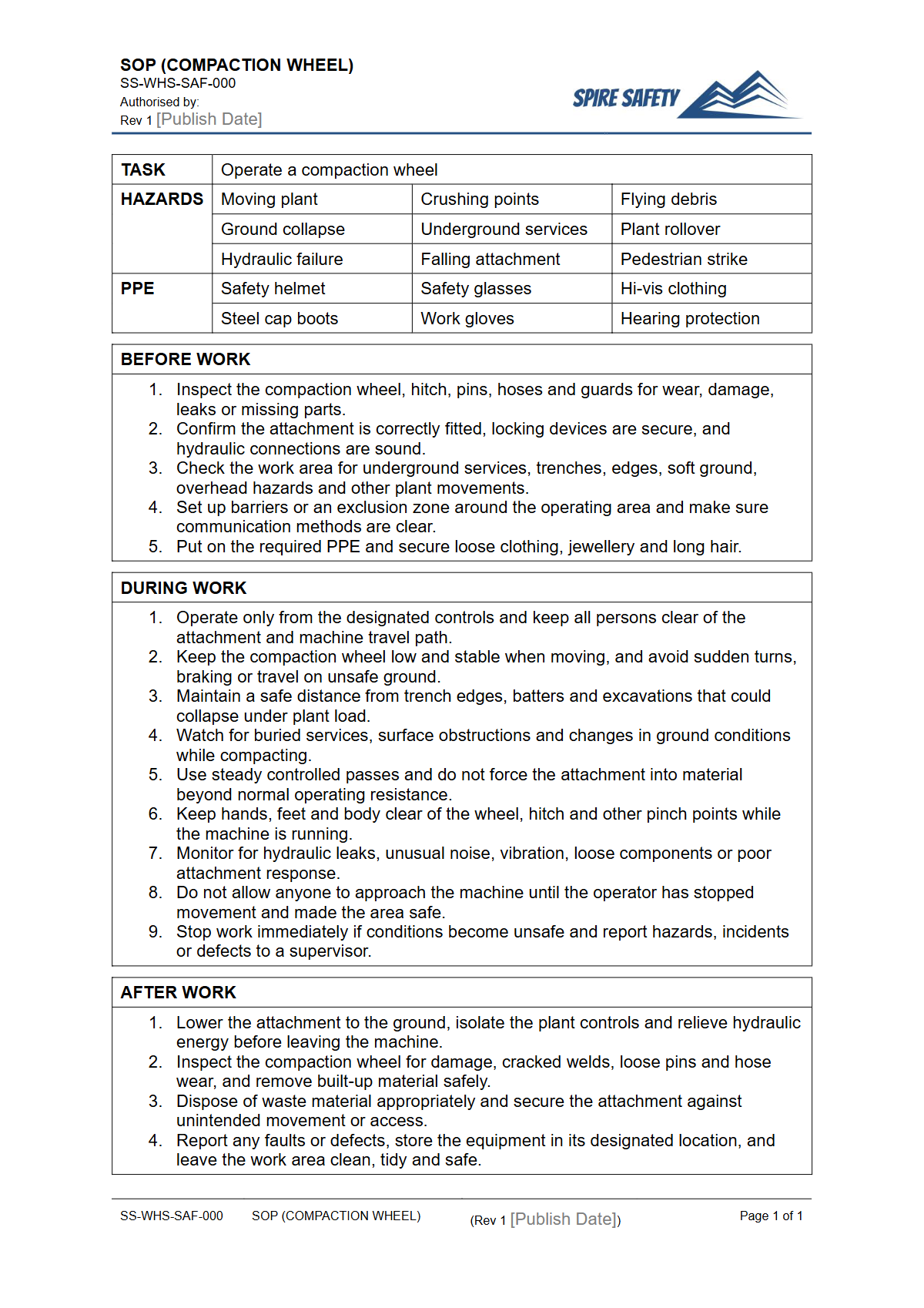
Our template is structured to cover the critical stages of operation, prompting you to detail site-specific controls. Key sections include:
- Required Personal Protective Equipment (PPE): Specifies necessary PPE such as high-visibility clothing, steel-toed boots, safety glasses, and hearing protection.
- Pre-operational Safety Checks: A checklist to ensure the machine is safe before use, covering aspects like hydraulic systems, brakes, lights, alarms, and the condition of the wheels and blade.
- Safe Operating Steps: A sequence for tasks including mounting and dismounting the machine, starting up, operating on different terrains, parking, and shutdown procedures. This methodical approach is also vital for other earthmovers, as outlined in our free Dozer SOP template.
- Emergency Procedures: Clear instructions for responding to potential emergencies like a machine rollover, fire, or hydraulic failure.
When to use it
A Safe Operating Procedure for a compaction wheel is not just a document to be filed away; it is a dynamic tool used in daily operations. It should be used during operator inductions and refresher training to establish a baseline for safe behaviour.
Supervisors can use it as a reference for pre-start meetings or toolbox talks to highlight specific risks associated with the day's tasks.
The SOP also serves as an audit tool for verifying that correct procedures are being followed on site. In the event of an incident or near-miss, it becomes a crucial document for investigation, helping to identify whether established procedures were followed and if they need revision.
It should be used alongside other key safety documents, such as our free Trencher SOP template, when multiple types of machinery are in use.
Who should use it
This SOP is intended for several key roles within an organisation to ensure a multi-layered approach to safety:
- Plant Operators: As the primary users, operators should follow the SOP as a direct guide for every task involving the compaction wheel.
- Supervisors and Site Managers: To enforce safe work practices, conduct spot-checks, and ensure operators are competent and compliant.
- WHS Managers and Advisors: To incorporate the procedure into the broader safety management system, assist with risk assessments, and use it as a benchmark for compliance audits.
- Training Personnel: To form the basis of practical training programs and competency assessments for new and existing operators.
For businesses seeking expert assistance in developing and implementing robust safety procedures across their operations, our WHS consulting services can provide tailored support. This template is a valuable instrument for improving safety outcomes on your site. For more downloadable guides and checklists, you can browse our full free WHS resources library.
Common mistakes
Common mistakes to avoid
- Using a generic SOP without customising it for the specific make, model, and site conditions.
- Failing to conduct and document thorough pre-start inspections before each use.
- Operating the machine on slopes or embankments that exceed the manufacturer's specified limits.
- Inadequate consultation with operators when drafting or reviewing the procedure, leading to impractical steps.
Legal references
Legal considerations
The following legal requirements may be relevant to this type of work.
- Work Health and Safety Act (Harmonised) — Provides the primary duties for protecting workers and other people from work health and safety risks.
- Work Health and Safety Regulations (Harmonised) — Sets out requirements supporting the management of workplace hazards and risks.
The following codes may be relevant to this type of work.
- Managing WHS Risks Code of Practice — Provides practical guidance on identifying hazards, assessing risks and applying effective controls.
- Work Health and Safety Consultation, Cooperation and Coordination Code of Practice — Provides practical guidance on consulting workers and coordinating with other duty holders.
- Managing the Work Environment and Facilities Code of Practice — Provides practical guidance on safe work environments, workplace facilities and related controls.
Did you know
Compaction Force
Modern landfill compactors can weigh over 50 tonnes and exert extreme pressure through their cleated wheels, allowing them to achieve waste densities that significantly extend the operational life of a landfill.
Rollover Risk
Due to their high centre of gravity and the unstable ground they often work on, rollovers are one of the most severe risks associated with compaction wheel operation. Most modern machines are fitted with Rollover Protective Structures (ROPS) to protect the operator.
FAQ
Frequently asked questions
01What is a compaction wheel used for?
02Why is a specific SOP needed for a compaction wheel?
03Does this compaction wheel SOP template is aligned with the model WHS framework?
04How often should a Compaction Wheel SOP be reviewed?
Share this resource
Free Safe Operating Procedure (Compaction Wheel) Template
Browse Categories
How To Use It
- 1Download and open in Word or PDF.
- 2Replace the placeholders with your business details.
- 3Get it reviewed by a WHS specialist before rollout.
Need it customised?
Our WHS consultants can adapt this template to your site, run a gap analysis, or audit what you already have in place.
Book a Free Consultation WHS consulting servicesor call 1300 156 382
Related templates
- Free Safe Operating Procedure (Compost Bin Cleaning) Template
- Free Safe Operating Procedure (Compost Turning) Template
- Free Safe Operating Procedure (Compressed Air Blowdown) Template
- Free Safe Operating Procedure (Compressor Drain) Template
- Free Safe Operating Procedure (Compressor Filter Change) Template
- Free Safe Operating Procedure (Compressor Shutdown) Template