
Free Safe Operating Procedure (Commercial Oven Operation) Template
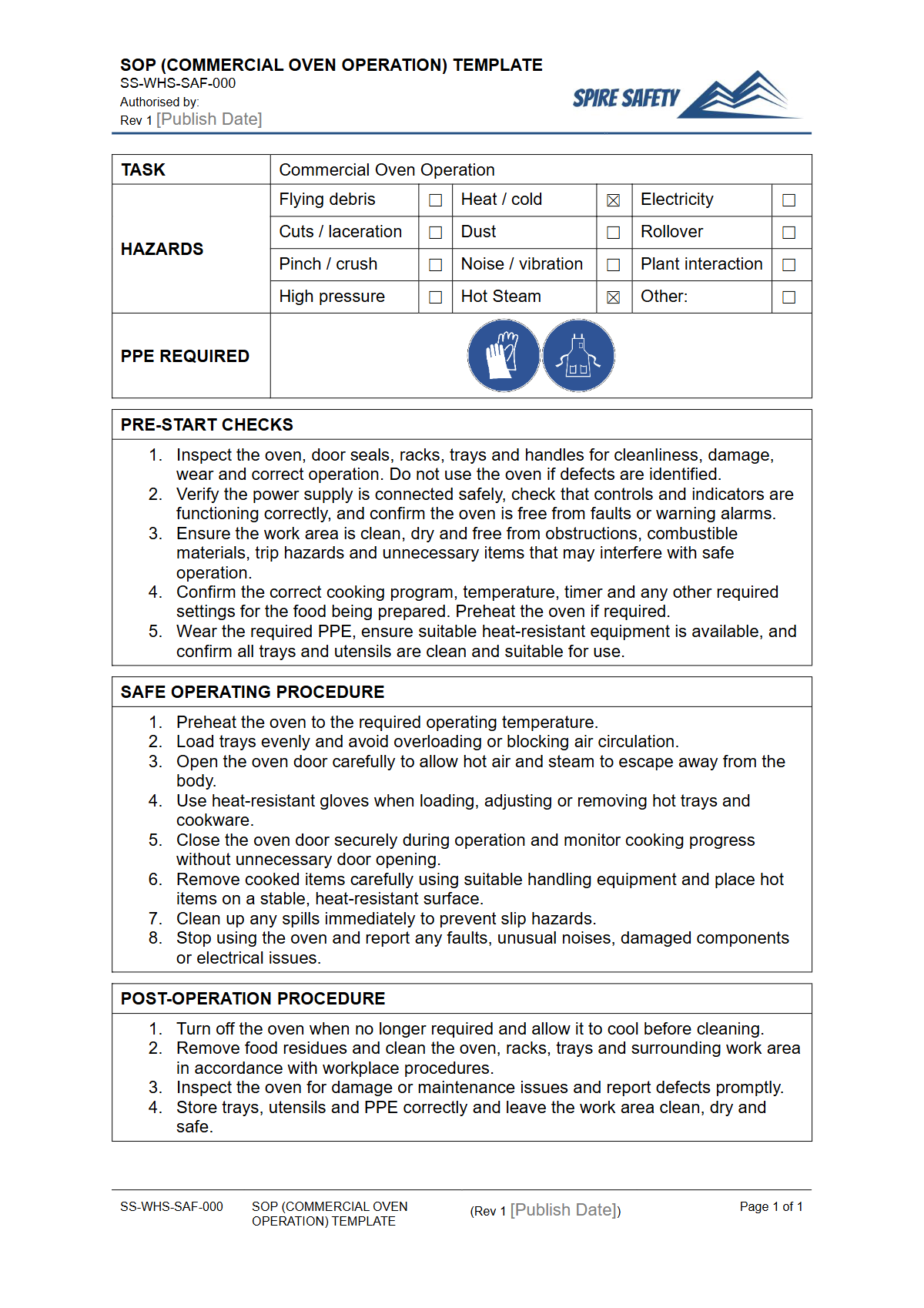
Download our Free Safe Operating Procedure (Commercial Oven Operation) Template. This user-friendly DOCX and PDF helps you formalise safety steps.
Free Safe Operating Procedure (Commercial Oven Operation) Template
DOCX • 153 KB + PDF
Updated Oct 2026
No signup required
Purpose of the Free Safe Operating Procedure (Commercial Oven Operation) Template
Operating high-temperature equipment like commercial ovens presents significant risks, including severe burns, fires, and exposure to harmful fumes. A documented Safe Operating Procedure (SOP) is a critical administrative control to manage these hazards.
This Free Safe Operating Procedure (Commercial Oven Operation) Template provides a structured framework for outlining the required steps to operate this equipment safely and consistently. Using this template helps your organisation standardise training, guide worker behaviour, and demonstrate a commitment to workplace health and safety.
Implementing formalised procedures is a fundamental component of a robust safety system. It ensures every worker, from new hires to experienced chefs, follows the same safety-verified steps, minimising the chance of accidents.
This document serves as a clear, accessible reference point, helping to embed safe work practices into your daily operations and culture. Integrating this SOP into your broader framework can significantly strengthen your approach to risk management.
Video walkthrough
How to use the Free Safe Operating Procedure (Commercial Oven Operation) Template
This Safe Operating Procedure is provided as a fully editable DOCX file, with a PDF version also available for easy printing and distribution. Your primary task is to adapt its contents to the specific context of your workplace.
A generic procedure is not sufficient for compliance or safety; it must accurately reflect your equipment and environment. Effective SOPs are practical tools, not just paperwork.
You should conduct a specific risk assessment for your commercial oven(s) before finalising this document. This involves identifying all potential hazards associated with the equipment's use at your site—from installation and pre-start checks to cleaning and maintenance.
The controls you identify in that assessment should be detailed within this SOP. Ensure you consult with the workers who actually operate the ovens; their direct experience is invaluable for creating a procedure that is both safe and practical.
IMPORTANT: Customisation Required
This document is a template and must be customised to your workplace. We have provided a structured starting point, but you are responsible for ensuring the final SOP accurately reflects your specific commercial oven model, the tasks performed, the associated risks, and the control measures your organisation has implemented.
You must add your company name, logo, and other relevant details, and review every section to ensure its applicability.
When to use a Safe Operating Procedure
A Safe Operating Procedure for commercial oven operation should be used as a primary training tool for any worker required to use the equipment. It should be a core part of their induction and any refresher training.
The SOP should also be readily accessible in the work area—either as a laminated hard copy near the oven or digitally available—for quick reference during operation. Furthermore, these procedures are essential documents during safety reviews and audits. Having documented and implemented SOPs is a key verification point during a WHS compliance audit.
Who should use this Safe Operating Procedure
This document is intended for two main groups:
- Persons Conducting a Business or Undertaking (PCBUs), Managers, and Supervisors: This group is responsible for developing, authorising, and implementing the SOP. They must ensure it is based on a thorough risk assessment, is reviewed regularly, and that workers are adequately trained in its contents. This responsibility is a key part of managing overall WHS management systems.
- Workers and Operators: This group must be trained on the SOP and follow its instructions diligently. They have a duty to take reasonable care for their own health and safety and that of others in the workplace. They should also be involved in the consultation process when the SOP is created or reviewed.
Key Elements of a Commercial Oven SOP
A comprehensive SOP for commercial ovens should cover several key stages of operation to be effective. Ensure your customised document includes:
- Pre-Operational Checks: Detail the visual inspections required before use. This includes checking for cleanliness, ensuring ventilation systems are active, inspecting gas lines or electrical cords for damage, and confirming that safety features like door seals and interlocks are functional.
- Step-by-Step Operating Instructions: Provide clear, sequential instructions for safely starting, operating, and shutting down the oven. This covers lighting procedures for gas models, setting temperatures and timers, and safe methods for loading and unloading hot trays or products using appropriate PPE.
- Cleaning and Maintenance Procedures: Outline the approved methods for routine cleaning, including which cleaning agents are permitted and the required PPE. For more complex tasks, the SOP might refer to specific maintenance personnel. The maintenance team may use other equipment, which also requires documented procedures, such as a free Air Compressor SOP (Safe Operating Procedure) Template for cleaning tasks.
- Emergency Procedures: Clearly state the immediate actions to take in case of a fire, gas leak, equipment malfunction, or medical emergency. This includes the location of fire extinguishers, emergency stops, and first aid kits.
By customising this template to include these detailed elements, you create a valuable tool that actively contributes to a safer kitchen or production environment. For workplaces with broader operational needs, you can find other procedural templates in our free WHS resources library to maintain consistency across your documentation.
Common mistakes
Common mistakes to avoid
- Using a generic, non-customised template that doesn't match the specific oven model.
- Failing to train workers on the SOP, assuming they will just read it.
- Not making the SOP easily accessible to workers in their work area.
- Forgetting to include procedures for cleaning, maintenance, and emergencies.
Legal references
Legal considerations
The following legal requirements may be relevant to this type of work.
- Work Health and Safety Act (Harmonised) — Provides the primary duties for protecting workers and other people from work health and safety risks.
- Work Health and Safety Regulations (Harmonised) — Sets out requirements supporting the management of workplace hazards and risks.
The following codes may be relevant to this type of work.
- Managing WHS Risks Code of Practice — Provides practical guidance on identifying hazards, assessing risks and applying effective controls.
- Work Health and Safety Consultation, Cooperation and Coordination Code of Practice — Provides practical guidance on consulting workers and coordinating with other duty holders.
- Managing the Work Environment and Facilities Code of Practice — Provides practical guidance on safe work environments, workplace facilities and related controls.
Did you know
Burn Severity
Contact with a surface at just 60°C can cause a serious third-degree burn in as little as five seconds. Many commercial ovens operate at temperatures well over 200°C, highlighting the critical need for caution and PPE.
FAQ
Frequently asked questions
01What should be included in a Safe Operating Procedure for a commercial oven?
02How often should our commercial oven SOP be reviewed?
03Is an SOP enough, or is hands-on training also required?
04Who is responsible for writing a Safe Operating Procedure?
Share this resource
Free Safe Operating Procedure (Commercial Oven Operation) Template
Browse Categories
How To Use It
- 1Download and open in Word or PDF.
- 2Replace the placeholders with your business details.
- 3Get it reviewed by a WHS specialist before rollout.
Need it customised?
Our WHS consultants can adapt this template to your site, run a gap analysis, or audit what you already have in place.
Book a Free Consultation WHS consulting servicesor call 1300 156 382
Related templates
- Free Safe Operating Procedure (Commode Brake Check) Template
- Free Safe Operating Procedure (Commode Chair Cleaning) Template
- Free Safe Operating Procedure (Commode Emptying) Template
- Free Safe Operating Procedure (Common Area Washdown) Template
- Free Safe Operating Procedure (Community Garden Care) Template
- Free Safe Operating Procedure (Community Hall Cleaning) Template