
Free Safe Operating Procedure (Commode Chair Cleaning) Template
Download our free SOP template for cleaning commode chairs. This DOCX & PDF helps manage infection control risks in healthcare and aged care.
Free Safe Operating Procedure (Commode Chair Cleaning) Template
DOCX • 126 KB + PDF
Updated Oct 2026
No signup required
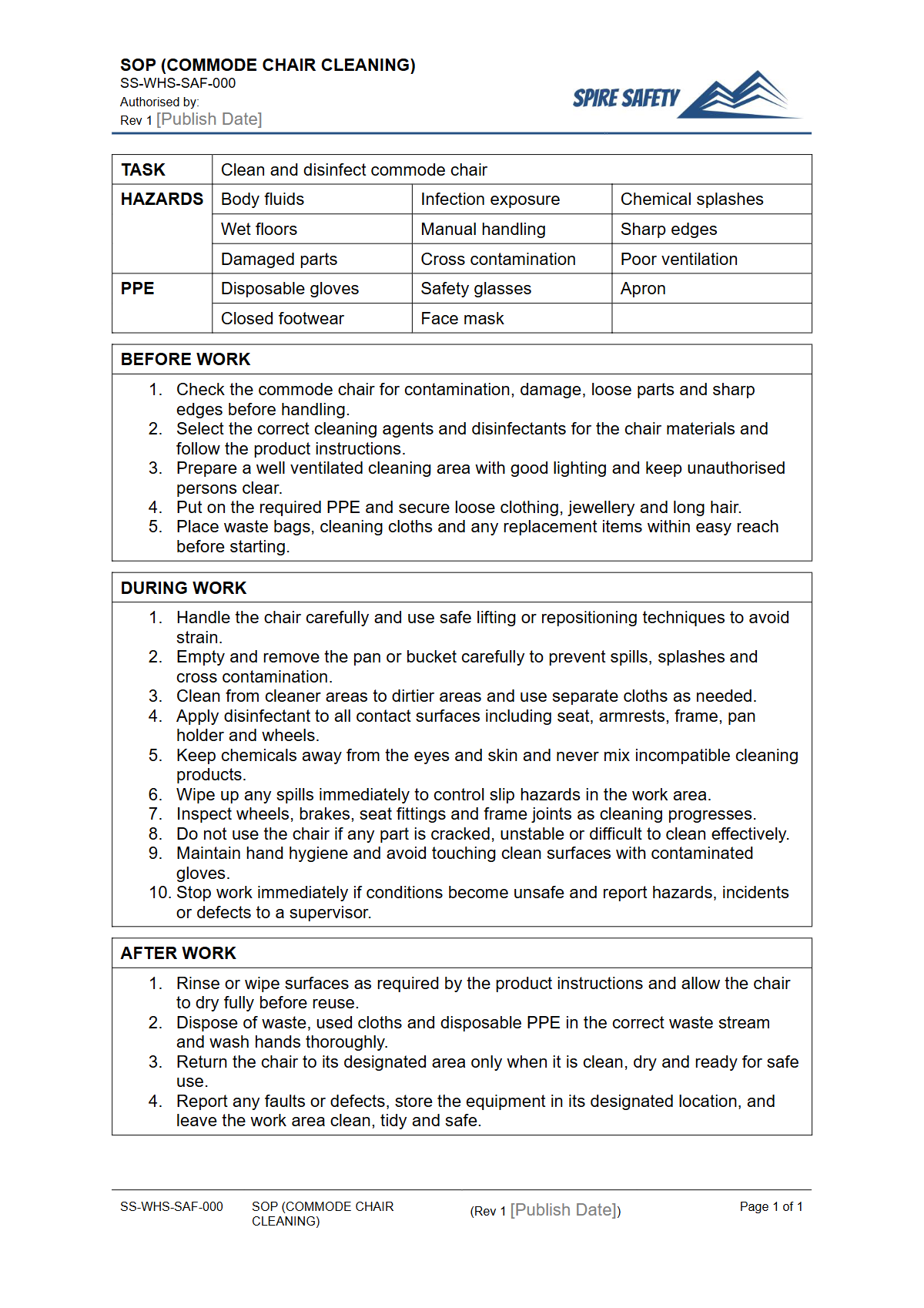
Purpose of the Free Safe Operating Procedure (Commode Chair Cleaning) Template
This Free Safe Operating Procedure (Commode Chair Cleaning) Template provides a structured framework for businesses in the healthcare, aged care, and disability support sectors. Its primary purpose is to establish a standardised, safe method for cleaning and disinfecting commode chairs, a critical task for preventing cross-contamination and the spread of infectious diseases.
By clearly outlining the required steps, personal protective equipment (PPE), and waste disposal protocols, this SOP helps protect both workers and vulnerable patients or residents from exposure to harmful biological hazards. Implementing a formal procedure promotes consistency, reduces the risk of human error, and forms a key component of a facility's overall infection control program and broader WHS management systems.
Video walkthrough
How to use the Free Safe Operating Procedure (Commode Chair Cleaning) Template
Once you download the template, it's essential to adapt it to your specific operational context. This document serves as a comprehensive starting point, aligned with Australian WHS principles, but it requires site-specific information to be fully effective.
You should conduct a consultation process with the workers who will be performing the task to ensure the procedure is practical and addresses all relevant hazards they face.
Important Note: We have provided a comprehensive framework, but you must customise this template to reflect the specific hazards, equipment, and chemicals used in your workplace. Generic procedures are not sufficient to ensure safety; they must be tailored to your unique environment and reviewed by competent persons before implementation.
While this SOP focuses on a routine cleaning task, your facility will have procedures for various activities, such as using specific medical equipment. For example, you might also need a Safe Operating Procedure for Defibrillator Operation to guide emergency response activities.
Key Components for Customisation
When adapting the template, pay close attention to several key areas to ensure the final SOP is robust and effective. These sections require specific details from your workplace to provide clear, actionable instructions for your team.
Personal Protective Equipment (PPE)
Specify the exact type of PPE required for the task. This typically includes long-cuffed disposable gloves, fluid-resistant gowns or aprons, and face protection such as safety glasses, goggles, or a full face shield to protect against splashes of contaminated water or cleaning chemicals.
Cleaning Agents and Disinfectants
List the approved cleaning agents and hospital-grade disinfectants by name. Include mandatory information on correct dilution ratios, required contact times (how long the surface must remain wet), and any specific safety precautions noted on the product's Safety Data Sheet (SDS).
Waste Management
Detail your facility's process for segregating and disposing of contaminated waste. This includes the correct use of clinical waste bags and bins, and procedures for securely closing and transporting waste to the designated collection point, minimising handling risks.
Emergency Procedures
Incorporate steps to be taken in case of an emergency, such as a large spill of contaminated material or accidental exposure to a hazardous chemical. This should include the location of spill kits, emergency showers or eyewash stations, and first aid and reporting protocols.
Beyond the primary task, workers may perform related activities that also carry risks, such as retrieving supplies from high shelves. These secondary tasks also require documented procedures, like a FREE Step Ladder SOP, to ensure safety in all aspects of the job.
Integrating the SOP with Your WHS Framework
A Safe Operating Procedure does not exist in a vacuum. It is an administrative control that stems from a thorough risk assessment of the task.
The SOP should be a core document used for worker induction, competency assessment, and regular refresher training. It's vital to schedule periodic reviews of the procedure to ensure it remains current.
Reviews should be triggered by any change in process, equipment, or chemicals, or following any reported incident or hazard. Regular reviews of your procedures are essential to maintain effectiveness, and incorporating this SOP into your scheduled WHS compliance auditing program ensures it remains current and aligned with on-the-ground practices.
Who is Responsible for this Procedure?
Clear roles and responsibilities are crucial for the successful implementation of any safety procedure. The responsibility is shared across different levels of the organisation.
- Workers: Responsible for following the SOP as trained, using the specified PPE correctly, and reporting any hazards or difficulties with the procedure to their supervisor.
- Supervisors and Managers: Responsible for providing adequate training, ensuring all necessary equipment and PPE are available and maintained, monitoring compliance with the SOP, and leading the review and update process.
- PCBU (Person Conducting a Business or Undertaking): Holds the primary duty of care under WHS law to provide and maintain safe systems of work, which includes the provision of effective and relevant SOPs. For organisations needing guidance on defining these roles and implementing effective safety systems, engaging professional WHS consulting can provide valuable clarity and expert support.
By customising and implementing this procedure, you take a proactive step towards a safer and healthier work environment for everyone. This template is just one of many tools available in our free WHS resources library to help you build a robust safety culture.
Common mistakes
Common mistakes to avoid
- Using the wrong type of disinfectant (e.g., household vs. hospital-grade) or incorrect dilution rates.
- Failing to wear appropriate PPE, especially eye protection, leading to risk of exposure from splashes.
- Not allowing for sufficient chemical contact time, wiping a surface dry before the disinfectant can work.
- Poor hand hygiene practices before donning and after doffing personal protective equipment.
Legal references
Legal considerations
The following legal requirements may be relevant to this type of work.
- Work Health and Safety Act (Harmonised) — Provides the primary duties for protecting workers and other people from work health and safety risks.
- Work Health and Safety Regulations (Harmonised) — Sets out requirements supporting the management of workplace hazards and risks.
The following codes may be relevant to this type of work.
- Managing WHS Risks Code of Practice — Provides practical guidance on identifying hazards, assessing risks and applying effective controls.
- Work Health and Safety Consultation, Cooperation and Coordination Code of Practice — Provides practical guidance on consulting workers and coordinating with other duty holders.
- Managing the Work Environment and Facilities Code of Practice — Provides practical guidance on safe work environments, workplace facilities and related controls.
Did you know
Contact Time is Critical
Most hospital-grade disinfectants require a specific 'contact time'—the surface must remain wet for several minutes to effectively kill pathogens. Wiping a surface dry immediately can render the disinfectant useless.
Invisible Hazards
Pathogens like Norovirus and C. difficile can survive on surfaces for days or even weeks, posing a significant cross-contamination risk if cleaning procedures are not followed meticulously.
FAQ
Frequently asked questions
01What is the difference between cleaning and disinfecting a commode chair?
02How often should a Safe Operating Procedure for cleaning be reviewed?
03What personal protective equipment (PPE) is essential for cleaning commodes?
04Do I need a separate SOP for each type of cleaning chemical we use?
Share this resource
Free Safe Operating Procedure (Commode Chair Cleaning) Template
Browse Categories
How To Use It
- 1Download and open in Word or PDF.
- 2Replace the placeholders with your business details.
- 3Get it reviewed by a WHS specialist before rollout.
Need it customised?
Our WHS consultants can adapt this template to your site, run a gap analysis, or audit what you already have in place.
Book a Free Consultation WHS consulting servicesor call 1300 156 382
Related templates
- Free Safe Operating Procedure (Commode Emptying) Template
- Free Safe Operating Procedure (Common Area Washdown) Template
- Free Safe Operating Procedure (Community Garden Care) Template
- Free Safe Operating Procedure (Community Hall Cleaning) Template
- Free Safe Operating Procedure (Community Outing Support) Template
- Free Safe Operating Procedure (Community Pool Setup) Template