
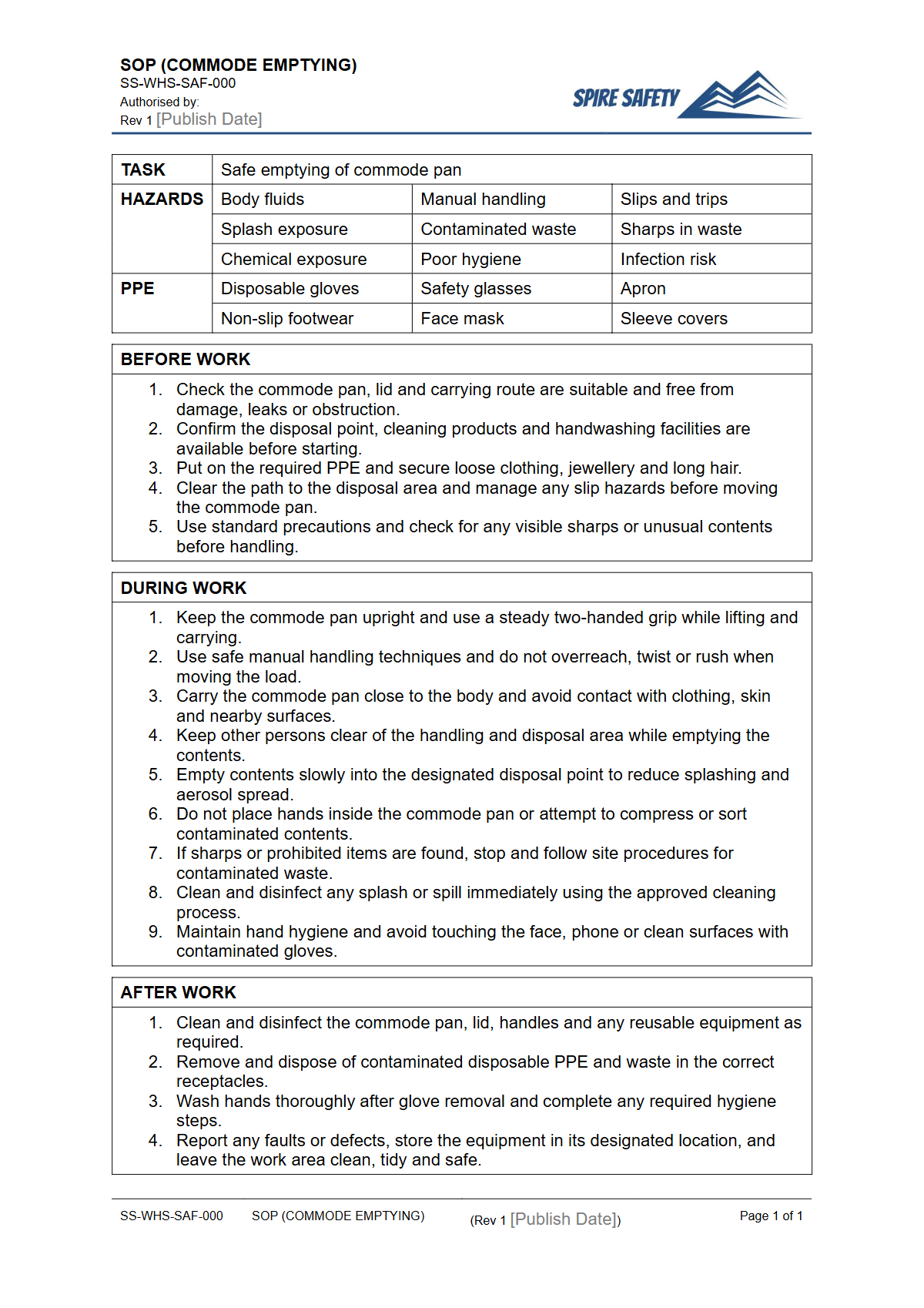
Free Safe Operating Procedure (Commode Emptying) Template
Download a free Safe Operating Procedure (Commode Emptying) template.
Free Safe Operating Procedure (Commode Emptying) Template
DOCX • 126 KB + PDF
Updated Oct 2026
No signup required
Purpose of the Free Safe Operating Procedure (Commode Emptying) Template
Emptying commodes is a routine but high-risk task in many healthcare, aged care, and disability support settings. This Free Safe Operating Procedure (Commode Emptying) Template provides a structured framework to document the safest way to perform this task.
Its primary purpose is to minimise the risk of injury and illness to workers by controlling exposure to biological hazards and addressing hazardous manual handling risks. By establishing a clear, step-by-step process, organisations can standardise practice, simplify training, and demonstrate a commitment to workplace safety.
A well-defined SOP is a critical component of a proactive safety culture. It helps ensure that every worker, regardless of experience, follows a consistent and safe method for handling infectious waste and performing awkward lifts or movements.
Implementing this procedure helps your organisation meet its duty of care under Australian WHS legislation and integrate safety protocols directly into daily workflows. It serves as a practical tool within your broader effective WHS management system, linking policy to practice.
Video walkthrough
How to use the Free Safe Operating Procedure (Commode Emptying) Template
This template is provided in both DOCX and PDF formats for your convenience. The DOCX file is fully editable, allowing you to adapt the content to the specific context of your workplace.
To correctly implement this Safe Operating Procedure, you should follow a systematic process to ensure it is relevant and effective.
Steps for Implementation:
- Download and Review: Start by downloading the template and familiarising yourself with the outlined steps.
- Consult with Workers: Engage with the care staff, nurses, and support workers who perform this task daily. Their input is invaluable for identifying practical challenges and refining the procedure to ensure it is workable.
- Customise Site-Specific Details: Modify the document to include specific details relevant to your facility. This includes the exact location of sluice rooms or designated disposal toilets, the specific types of Personal Protective Equipment (PPE) provided, and the cleaning agents used.
- Approve and Authorise: Once customised, the SOP should be formally reviewed and approved by management or the WHS committee before being issued.
- Train All Relevant Staff: Conduct training sessions to ensure all current and new employees understand and can follow the procedure correctly. Keep records of this training.
Important: This document is a template designed as a starting point. It is essential that you customise it to reflect the unique hazards and control measures of your specific work environment.
We cannot be held liable for any incidents arising from the use of this template, as its effectiveness depends entirely on its correct customisation and implementation by your organisation. If you require assistance, consider engaging professional WHS consulting services.
When to use it
A Safe Operating Procedure for commode emptying should be a readily accessible document used for several key functions. It is not a document to be filed away and forgotten.
Use it as part of the initial induction for all new care staff to establish safe work habits from day one. It should also be a central resource during regular refresher training sessions to reinforce correct practices and introduce any procedural updates.
Furthermore, this SOP should be referenced immediately following any incident or near miss involving the task. Reviewing the procedure can help identify gaps or areas for improvement in your process.
It is also a key document to have on hand during regular WHS compliance audits, as it provides clear evidence of your organisation's risk management processes for a known hazardous task.
Who should use it
This SOP is intended for a broad range of personnel within the healthcare and social assistance industry. The primary users are the frontline workers who perform the task, including Personal Care Assistants (PCAs), Assistants in Nursing (AINs), Registered and Enrolled Nurses, and disability support workers.
They will use it as a guide for safely executing their duties.
Supervisors, team leaders, and facility managers also have a critical role. They must use the SOP to train staff, monitor compliance, and conduct workplace inspections.
Work Health and Safety (WHS) managers and coordinators will use the template as a tool to formalise risk controls and integrate them into the organisation's safety framework. While this SOP is specific, it complements other procedural documents, such as our Safe Operating Procedure for Defibrillator Operation, to build a comprehensive safety system. You can explore more procedural documents in our complete library of free WHS resources.
Common mistakes
Common mistakes to avoid
- Using the template without customising it for site-specific equipment and disposal facilities.
- Failing to provide adequate training on the finalised procedure to all relevant staff.
- Neglecting to wear the correct Personal Protective Equipment (PPE) for every step of the task.
- Improper cleaning and disinfection of the commode pan after emptying.
Legal references
Legal considerations
The following legal requirements may be relevant to this type of work.
- Work Health and Safety Act (Harmonised) — Provides the primary duties for protecting workers and other people from work health and safety risks.
- Work Health and Safety Regulations (Harmonised) — Sets out requirements supporting the management of workplace hazards and risks.
The following codes may be relevant to this type of work.
- Managing WHS Risks Code of Practice — Provides practical guidance on identifying hazards, assessing risks and applying effective controls.
- Work Health and Safety Consultation, Cooperation and Coordination Code of Practice — Provides practical guidance on consulting workers and coordinating with other duty holders.
- Managing the Work Environment and Facilities Code of Practice — Provides practical guidance on safe work environments, workplace facilities and related controls.
Did you know
Manual Handling Risk
In the Australian healthcare and social assistance industry, hazardous manual tasks are a leading cause of serious workers' compensation claims, making documented procedures like SOPs crucial for injury prevention.
Hand Hygiene
According to the Australian Commission on Safety and Quality in Health Care, effective hand hygiene is the single most important strategy in preventing healthcare-associated infections (HAIs).
FAQ
Frequently asked questions
01What are the main hazards of emptying a commode?
02What PPE is required for emptying a commode?
03How does this SOP relate to infection control policies?
04Can I use this template for both hospital and home care settings?
Share this resource
Free Safe Operating Procedure (Commode Emptying) Template
Browse Categories
How To Use It
- 1Download and open in Word or PDF.
- 2Replace the placeholders with your business details.
- 3Get it reviewed by a WHS specialist before rollout.
Need it customised?
Our WHS consultants can adapt this template to your site, run a gap analysis, or audit what you already have in place.
Book a Free Consultation WHS consulting servicesor call 1300 156 382
Related templates
- Free Safe Operating Procedure (Common Area Washdown) Template
- Free Safe Operating Procedure (Community Garden Care) Template
- Free Safe Operating Procedure (Community Hall Cleaning) Template
- Free Safe Operating Procedure (Community Outing Support) Template
- Free Safe Operating Procedure (Community Pool Setup) Template
- Free Safe Operating Procedure (Compaction Wheel) Template