
Free Safe Operating Procedure (Commercial Blender) Template
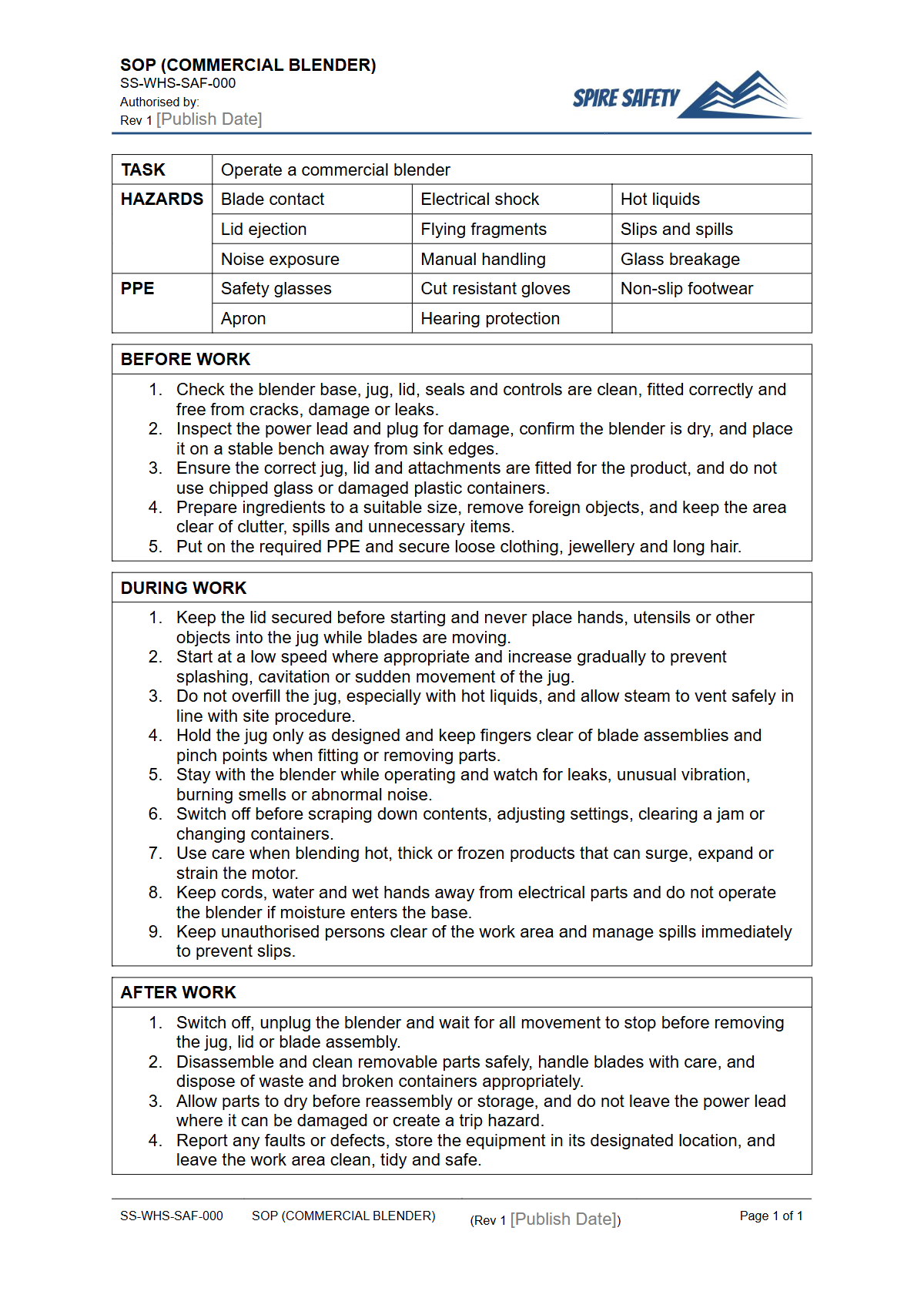
Download our free Safe Operating Procedure (SOP) for a commercial blender. This DOCX and PDF template helps you outline safe work practices in your kitchen.
Free Safe Operating Procedure (Commercial Blender) Template
DOCX • 126 KB + PDF
Updated Oct 2026
No signup required
Purpose of the Free Safe Operating Procedure (Commercial Blender) Template
This Free Safe Operating Procedure (Commercial Blender) Template provides a structured starting point for businesses to manage the health and safety risks associated with using commercial-grade blenders. Commercial blenders are powerful pieces of equipment common in cafes, restaurants, hotels, and bars, and they present significant hazards if not used correctly.
These include lacerations from sharp blades, electrical shock, entanglement of clothing or hair, and manual handling injuries. Developing a clear SOP is a critical step in fulfilling your duty of care and is a fundamental component of effective WHS management systems.
A well-drafted Safe Operating Procedure outlines step-by-step instructions for all phases of the equipment's use, from pre-operational checks and safe operation to cleaning, maintenance, and emergency shutdown. By documenting these processes, you create a clear, consistent standard for all workers, which helps reduce the likelihood of incidents, assists in providing effective training, and demonstrates proactive risk management.
What this Safe Operating Procedure Covers
Our template is designed as a comprehensive foundation, structured to align with Australian WHS practice. It prompts you to detail essential safety information, including:
- Required Personal Protective Equipment (PPE) such as cut-resistant gloves and safety glasses.
- Pre-operational safety checks, like inspecting cords, blades, and safety interlocks.
- A clear sequence of steps for safe operation.
- Procedures for safe cleaning and sanitisation, including isolating the power source.
- Emergency procedures and shutdown instructions.
Video walkthrough
How to use the Free Safe Operating Procedure (Commercial Blender) Template
Using this template is straightforward. After downloading the DOCX or PDF file, you must customise it to reflect the specific circumstances of your workplace.
Generic procedures are not sufficient for managing risk effectively. A periodic review of your documented procedures can be validated through a formal WHS compliance auditing process to ensure they are being implemented correctly on the floor.
Important: This document is a template, not a finished procedure. To be effective, you must adapt it to your specific equipment and operational context.
We have provided a framework based on common safety principles, but it is your responsibility to conduct a risk assessment for your particular commercial blender model, identify all relevant hazards, and detail the specific control measures your workplace will implement. Always consult the manufacturer’s instruction manual and integrate its recommendations into your final SOP.
When to use a Commercial Blender Safe Operating Procedure
A Safe Operating Procedure for a commercial blender should be developed and implemented before the equipment is used for the first time. It serves as a core document for various safety functions within the workplace.
Use it during the induction and training of new kitchen staff or when providing refresher training to existing employees. The SOP should be kept in a readily accessible location near the equipment, allowing workers to reference it as needed.
It also serves as a critical reference point following an incident or near-miss, helping to guide investigations and identify any gaps in your safety processes. Many kitchens also have other common equipment requiring documented procedures, such as those covered in our free Step Ladder SOP template.
Who should use this Safe Operating Procedure
This SOP is intended for use by anyone who operates, cleans, or supervises the use of a commercial blender. This includes kitchen hands, chefs, apprentices, and food and beverage attendants.
Supervisors and managers are responsible for ensuring the procedures are understood, followed, and enforced. They also play a key role in reviewing and updating the SOP.
Ultimately, the Person Conducting a Business or Undertaking (PCBU) holds the primary duty of care to provide safe systems of work, and a robust, customised SOP is a practical way to meet this obligation. This extends to ensuring staff are trained on all critical safety equipment, which might include having our Safe Operating Procedure for defibrillator operation available for emergencies.
For some maintenance or deep cleaning tasks, specific procedures like lock-out tag-out (LOTO) are vital to prevent accidental start-up. While a commercial blender typically has simple power isolation (unplugging), more complex machinery may require more detailed processes.
For example, if compressed air is used for cleaning equipment in your facility, you would also need a specific Air Compressor SOP to manage those distinct risks. You can find more templates like this across our free WHS resources library.
Common mistakes
Common mistakes to avoid
- Using the blender with a frayed cord, damaged plug, or faulty safety interlock.
- Attempting to dislodge contents with a utensil or hand while the unit is plugged in.
- Overfilling the blender jug, which can cause the lid to fail and contents to eject.
- Submerging the motor base in water during cleaning, creating a severe electrical hazard.
Legal references
Legal considerations
The following legal requirements may be relevant to this type of work.
- Work Health and Safety Act (Harmonised) — Provides the primary duties for protecting workers and other people from work health and safety risks.
- Work Health and Safety Regulations (Harmonised) — Sets out requirements supporting the management of workplace hazards and risks.
The following codes may be relevant to this type of work.
- Managing WHS Risks Code of Practice — Provides practical guidance on identifying hazards, assessing risks and applying effective controls.
- Work Health and Safety Consultation, Cooperation and Coordination Code of Practice — Provides practical guidance on consulting workers and coordinating with other duty holders.
- Managing the Work Environment and Facilities Code of Practice — Provides practical guidance on safe work environments, workplace facilities and related controls.
Did you know
A Leading Cause of Injury
The Australian Institute of Health and Welfare reports that cuts from knives and other sharp objects are one of the most common causes of injury in the hospitality industry.
Blade Speed
The blades in a high-performance commercial blender can spin at over 30,000 revolutions per minute (RPM), making contact for even a fraction of a second incredibly dangerous.
FAQ
Frequently asked questions
01What are the main hazards of a commercial blender?
02How often should an SOP for a commercial blender be reviewed?
03Is specific training required to use a commercial blender?
04Can I use a generic SOP for all blenders in my kitchen?
Share this resource
Free Safe Operating Procedure (Commercial Blender) Template
Browse Categories
How To Use It
- 1Download and open in Word or PDF.
- 2Replace the placeholders with your business details.
- 3Get it reviewed by a WHS specialist before rollout.
Need it customised?
Our WHS consultants can adapt this template to your site, run a gap analysis, or audit what you already have in place.
Book a Free Consultation WHS consulting servicesor call 1300 156 382
Related templates
- Free Safe Operating Procedure (Commercial Dryer) Template
- Free Safe Operating Procedure (Commercial Microwave) Template
- Free Safe Operating Procedure (Commercial Oven Operation) Template
- Free Safe Operating Procedure (Commode Brake Check) Template
- Free Safe Operating Procedure (Commode Chair Cleaning) Template
- Free Safe Operating Procedure (Commode Emptying) Template