
Free Safe Operating Procedure (Cold Saw) Template
Download our free Safe Operating Procedure (Cold Saw) template. This customisable DOCX & PDF provides a clear framework for safe cold saw use. Get started now.
Free Safe Operating Procedure (Cold Saw) Template
DOCX • 126 KB + PDF
Updated Oct 2026
No signup required
Purpose of the Free Safe Operating Procedure (Cold Saw) Template
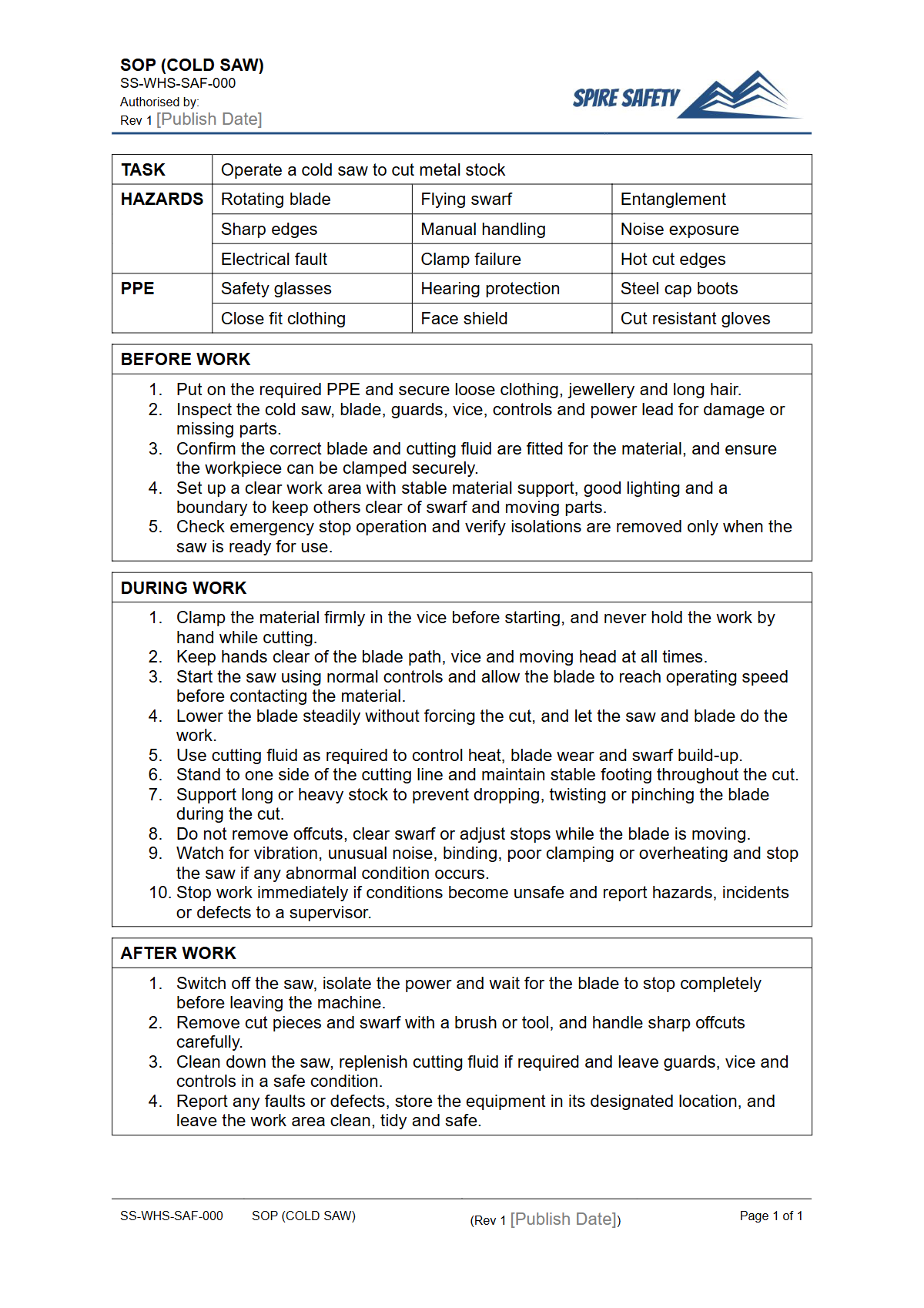
This Safe Operating Procedure (SOP) for cold saws provides a structured framework for documenting the required steps to safely operate this type of machinery. A well-drafted SOP is a fundamental tool in managing workplace risks, ensuring consistent and safe work practices among all operators.
By outlining pre-start checks, operational steps, and shutdown procedures, this template helps your organisation meet its primary duty of care under Australian WHS legislation. It serves as a critical reference for worker training, competency assessments, and incident investigations.
Implementing a standardised procedure minimises the risk of injuries associated with cold saws, such as severe cuts, eye injuries from metal swarf, or entanglement in moving parts. An SOP is a critical component of your overall WHS management system, demonstrating a proactive approach to health and safety.
Video walkthrough
How to use the Free Safe Operating Procedure (Cold Saw) Template
Our free download provides a comprehensive starting point, but it is not a finished document. To be effective, it must be customised to your specific workplace.
Download the DOCX file and adapt it to reflect the make and model of your cold saw, the types of materials being cut, and the unique environmental factors of your workshop. Involve experienced operators and supervisors in the customisation process to ensure the procedure is practical and accurately reflects best practices on your site.
Important Note: We have provided a solid foundation aligned with Australian WHS principles. However, you must conduct your own risk assessment and adapt this template to ensure all identified hazards and control measures specific to your operations are included.
The final document should be reviewed, approved by management, and made readily accessible to all relevant personnel.
When to use a Cold Saw SOP
A Safe Operating Procedure for a cold saw should be developed before the equipment is first used in the workplace and integrated into your safety processes. It is a living document that serves multiple functions throughout the equipment's lifecycle.
It should be the primary training document for new operators and used for regular refresher training for existing staff. Supervisors can use the SOP as a checklist for monitoring safe work practices and conducting informal safety observations.
The SOP should also be reviewed and updated periodically, especially after an incident or near-miss, when a new model of cold saw is introduced, or when the process or materials change. This ensures it remains relevant and effective.
For many businesses, machine-specific procedures are a key focus of routine WHS compliance auditing to verify that controls are implemented and understood by workers.
Who should use it
This Safe Operating Procedure should be used by a range of personnel within your organisation. This includes:
- Operators: The primary users who must follow the procedure step-by-step to perform their work safely.
- Supervisors and Line Managers: Responsible for ensuring operators are trained on the SOP and adhere to it during daily operations. They use it as a tool for enforcement and coaching.
- WHS/HSE Professionals: Responsible for developing, reviewing, and managing the document as part of the broader safety management system.
- Maintenance Personnel: May refer to the SOP for lockout/tagout procedures and other safety requirements before conducting maintenance or repairs.
- Trainers and Assessors: Use the SOP as the basis for developing training programs and verifying the competency of operators.
Key Elements of a Cold Saw SOP
A robust cold saw SOP contains several critical sections, all of which are included in this template. These include a clear outline of required Personal Protective Equipment (PPE), such as safety glasses, hearing protection, and appropriate gloves.
It details pre-operational safety checks, like inspecting the blade for damage, ensuring guards are in place and functional, and checking the coolant system. This process is just as important for other cutting equipment, as detailed in our FREE Circular Saw SOP Template.
The procedure outlines the step-by-step process for safe operation, covering how to correctly clamp the workpiece, set the cutting speed, and manage the cutting process to avoid blade binding. Finally, it specifies post-operational tasks, including cleaning the machine, disposing of swarf safely, and storing the equipment correctly. This structured approach helps manage risks for many types of heavy machinery, much like the process outlined in our free brake press SOP.
Common Hazards and Control Measures
Operating a cold saw presents several significant hazards that this SOP helps to control. The primary hazard is contact with the moving blade, which can cause severe lacerations or amputation.
Key controls include fixed guarding, proper operator training, and maintaining a safe distance. Other hazards include projectiles, such as sharp metal swarf or offcuts, which are controlled with guarding and mandatory eye protection.
Entanglement is another risk, where loose clothing, hair, or jewellery can be caught in rotating parts. This is managed through strict dress codes and operator awareness.
Electrical hazards from the power supply and ergonomic risks from manual handling of heavy materials are also important considerations. In workshops that use other fabrication equipment, it's vital to have specific procedures for each; for example, you may also require a free plasma cutter SOP template to manage different but related risks.
You can find more templates like this in our free WHS resources library to build out your safety documentation.
Common mistakes
Common mistakes to avoid
- Using a dull, damaged, or incorrect type of blade for the material being cut.
- Failing to securely clamp the workpiece, leading to vibration, poor cut quality, or blade damage.
- Bypassing or removing safety guards, particularly the self-closing blade guard.
- Applying excessive force during the cut instead of letting the machine do the work, causing the blade to bind or stall.
Legal references
Legal considerations
The following legal requirements may be relevant to this type of work.
- Work Health and Safety Act (Harmonised) — Provides the primary duties for protecting workers and other people from work health and safety risks.
- Work Health and Safety Regulations (Harmonised) — Sets out requirements supporting the management of workplace hazards and risks.
The following codes may be relevant to this type of work.
- Managing WHS Risks Code of Practice — Provides practical guidance on identifying hazards, assessing risks and applying effective controls.
- Work Health and Safety Consultation, Cooperation and Coordination Code of Practice — Provides practical guidance on consulting workers and coordinating with other duty holders.
- Managing the Work Environment and Facilities Code of Practice — Provides practical guidance on safe work environments, workplace facilities and related controls.
Did you know
Cool and Clean
The term "cold saw" comes from its cutting process. Unlike abrasive saws, it uses a coolant system and a slow-turning, toothed blade to transfer heat away from the workpiece and into the chips, leaving the cut material cool to the touch.
Blade Speed is Key
The rotational speed of a cold saw blade is significantly slower than other saws, typically running between 25 and 120 RPM. This low speed, combined with high torque, allows the blade's teeth to cleanly mill through the metal rather than abrading it.
FAQ
Frequently asked questions
01What PPE is required for operating a cold saw?
02How often should a Safe Operating Procedure for a cold saw be reviewed?
03Can a trainee operate a cold saw?
04What is the difference between a cold saw and an abrasive saw?
Share this resource
Free Safe Operating Procedure (Cold Saw) Template
Browse Categories
How To Use It
- 1Download and open in Word or PDF.
- 2Replace the placeholders with your business details.
- 3Get it reviewed by a WHS specialist before rollout.
Need it customised?
Our WHS consultants can adapt this template to your site, run a gap analysis, or audit what you already have in place.
Book a Free Consultation WHS consulting servicesor call 1300 156 382
Related templates
- Free Safe Operating Procedure (Combi Oven) Template
- Free Safe Operating Procedure (Commercial Bin Pickup) Template
- Free Safe Operating Procedure (Commercial Blender) Template
- Free Safe Operating Procedure (Commercial Dryer) Template
- Free Safe Operating Procedure (Commercial Microwave) Template
- Free Safe Operating Procedure (Commercial Oven Operation) Template