
Free Safe Operating Procedure (Combi Oven) Template
Download our free Safe Operating Procedure (Combi Oven) Template. This customisable DOCX and PDF helps define safe work practices for commercial kitchens.
Free Safe Operating Procedure (Combi Oven) Template
DOCX • 126 KB + PDF
Updated Oct 2026
No signup required
Purpose of the Free Safe Operating Procedure (Combi Oven) Template
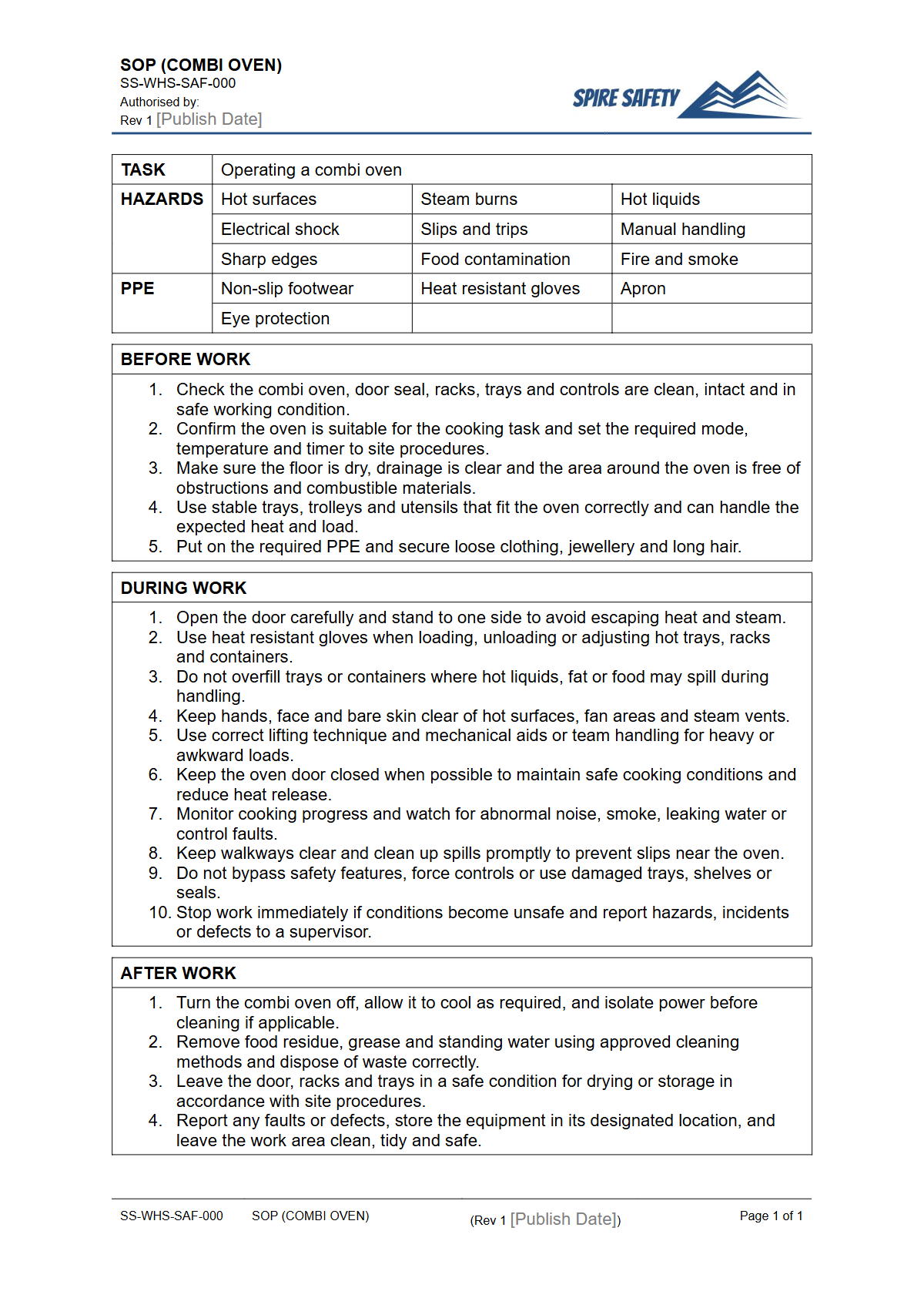
Operating a commercial combi oven involves significant risks, including severe burns from hot surfaces and steam, musculoskeletal injuries from manual handling, and chemical exposure during cleaning. This Free Safe Operating Procedure (Combi Oven) Template provides a structured starting point for developing a workplace-specific document that outlines the safest way to perform this common kitchen task.
By clearly defining steps for pre-operational checks, operation, cleaning, and shutdown, a well-developed SOP helps your business meet its duty of care and reduces the risk of injury to workers.
A robust SOP is a fundamental component of a holistic safety framework. It serves as a practical tool for risk control and demonstrates a commitment to operational safety, forming a critical part of your overall WHS management systems. This document is designed to be adapted to your specific equipment and operational context, helping to formalise safe work practices and provide a clear reference for training and supervision.
Video walkthrough
How to use the Free Safe Operating Procedure (Combi Oven) Template
This template is provided in both DOCX and PDF formats for your convenience. The DOCX file is fully editable, allowing you to tailor the content to the specific make and model of combi oven used in your commercial kitchen, as well as your unique site conditions and cleaning protocols.
It includes sections for detailing required Personal Protective Equipment (PPE), emergency procedures, and step-by-step instructions for each phase of operation.
Important: This document is a template, not a finished procedure. To be effective, you must customise it.
We strongly recommend consulting with the kitchen staff who operate the equipment, referring to the manufacturer's user manual, and reviewing your chemical safety data sheets (SDS) to ensure the final SOP is comprehensive and relevant to your workplace. Integrating feedback from workers is a vital part of the consultation process and leads to more practical and effective safety outcomes.
When to use this Safe Operating Procedure
A Safe Operating Procedure for a combi oven should be a living document integrated into your daily operations. It is not a 'set and forget' tool.
Its primary use is during the induction and training of new kitchen staff, apprentices, and anyone required to operate or clean the equipment. It should also be used for regular refresher training to prevent complacency and reinforce safe work habits.
The SOP should be readily accessible near the equipment for quick reference. Furthermore, it is a crucial document to review during incident investigations or when conducting routine safety inspections.
Regular reviews, as part of a scheduled WHS compliance auditing program, ensure the procedure remains current and effective, especially if the equipment, chemicals, or work environment changes.
Who should use this Combi Oven SOP
This SOP is intended for all personnel involved with the combi oven. This includes:
- Chefs and Cooks: For day-to-day operation, including pre-start checks and standard cooking cycles.
- Kitchen Hands and Apprentices: As a primary training and reference tool to build safe work habits from the start.
- Cleaning Staff: To follow correct procedures for shutdown, isolation, and handling of cleaning chemicals.
- Supervisors and Managers: To enforce the procedure, conduct training, and supports your compliance efforts within their teams.
Every worker has a responsibility to follow established safety procedures. Using this SOP consistently helps everyone understand the risks and the controls put in place to manage them.
Consistency is also key for other tasks in a busy environment, which is why having procedures for all equipment, such as our FREE Step Ladder SOP Template for accessing high storage, is essential for comprehensive kitchen safety.
Key Elements of a Combi Oven SOP
Our template is structured to guide you through the critical safety elements aligned with Australian WHS practice. Key sections you will need to customise include:
- Required PPE: Specifies the personal protective equipment necessary to protect against burns, splashes, and chemical contact, such as heat-resistant gloves, eye protection, and aprons.
- Pre-Operational Checks: A checklist of safety-critical items to inspect before use, like checking door seals, ensuring clear ventilation, and confirming the area is free of slip hazards.
- Step-by-Step Operating Guide: A logical sequence of actions for safely loading, programming, and unloading the oven.
- Cleaning and Shutdown Procedures: Detailed instructions for powering down, isolating energy sources if required, and safely using approved cleaning chemicals.
- Emergency Procedures: Clear steps to take in case of a fire, burn, or chemical exposure incident.
For more specific safety documents, such as a procedure for responding to medical emergencies, you might find our Free Safe Operating Procedure (Defibrillator Operation) Template a useful reference. Building a complete suite of documents ensures all aspects of workplace safety are addressed. You can explore our entire free WHS resources library for more templates to support your safety management system.
Common mistakes
Common mistakes to avoid
- Failing to customise the template with manufacturer-specific instructions.
- Not involving experienced kitchen staff in the drafting and review process.
- Neglecting to train all relevant workers on the finalised SOP.
- Storing the SOP in an office instead of making it easily accessible near the equipment.
Legal references
Legal considerations
The following legal requirements may be relevant to this type of work.
- Work Health and Safety Act (Harmonised) — Provides the primary duties for protecting workers and other people from work health and safety risks.
- Work Health and Safety Regulations (Harmonised) — Sets out requirements supporting the management of workplace hazards and risks.
The following codes may be relevant to this type of work.
- Managing WHS Risks Code of Practice — Provides practical guidance on identifying hazards, assessing risks and applying effective controls.
- Work Health and Safety Consultation, Cooperation and Coordination Code of Practice — Provides practical guidance on consulting workers and coordinating with other duty holders.
- Managing the Work Environment and Facilities Code of Practice — Provides practical guidance on safe work environments, workplace facilities and related controls.
Did you know
Kitchen Hot Spots
According to Safe Work Australia, burns and scalds are a leading cause of injury in the hospitality industry, with hot cooking oil, water, and contact with ovens being common sources.
Combination Cooking
Combination ovens were invented in the late 1960s to overcome the limitations of conventional ovens. By combining steam and convection heat, they can cook food faster and more evenly while retaining moisture.
FAQ
Frequently asked questions
01What are the main hazards of using a combi oven?
02Is a Safe Operating Procedure a legal requirement in Australia?
03How often should an SOP for a combi oven be reviewed?
04Can this template be used for any brand of combi oven?
Share this resource
Free Safe Operating Procedure (Combi Oven) Template
Browse Categories
How To Use It
- 1Download and open in Word or PDF.
- 2Replace the placeholders with your business details.
- 3Get it reviewed by a WHS specialist before rollout.
Need it customised?
Our WHS consultants can adapt this template to your site, run a gap analysis, or audit what you already have in place.
Book a Free Consultation WHS consulting servicesor call 1300 156 382
Related templates
- Free Safe Operating Procedure (Commercial Bin Pickup) Template
- Free Safe Operating Procedure (Commercial Blender) Template
- Free Safe Operating Procedure (Commercial Dryer) Template
- Free Safe Operating Procedure (Commercial Microwave) Template
- Free Safe Operating Procedure (Commercial Oven Operation) Template
- Free Safe Operating Procedure (Commode Brake Check) Template