
Free Safe Operating Procedure (Cold Room Cleaning) Template
Download our free Safe Operating Procedure (Cold Room Cleaning) Template.
Free Safe Operating Procedure (Cold Room Cleaning) Template
DOCX • 126 KB + PDF
Updated Oct 2026
No signup required
Purpose of the Free Safe Operating Procedure (Cold Room Cleaning) Template
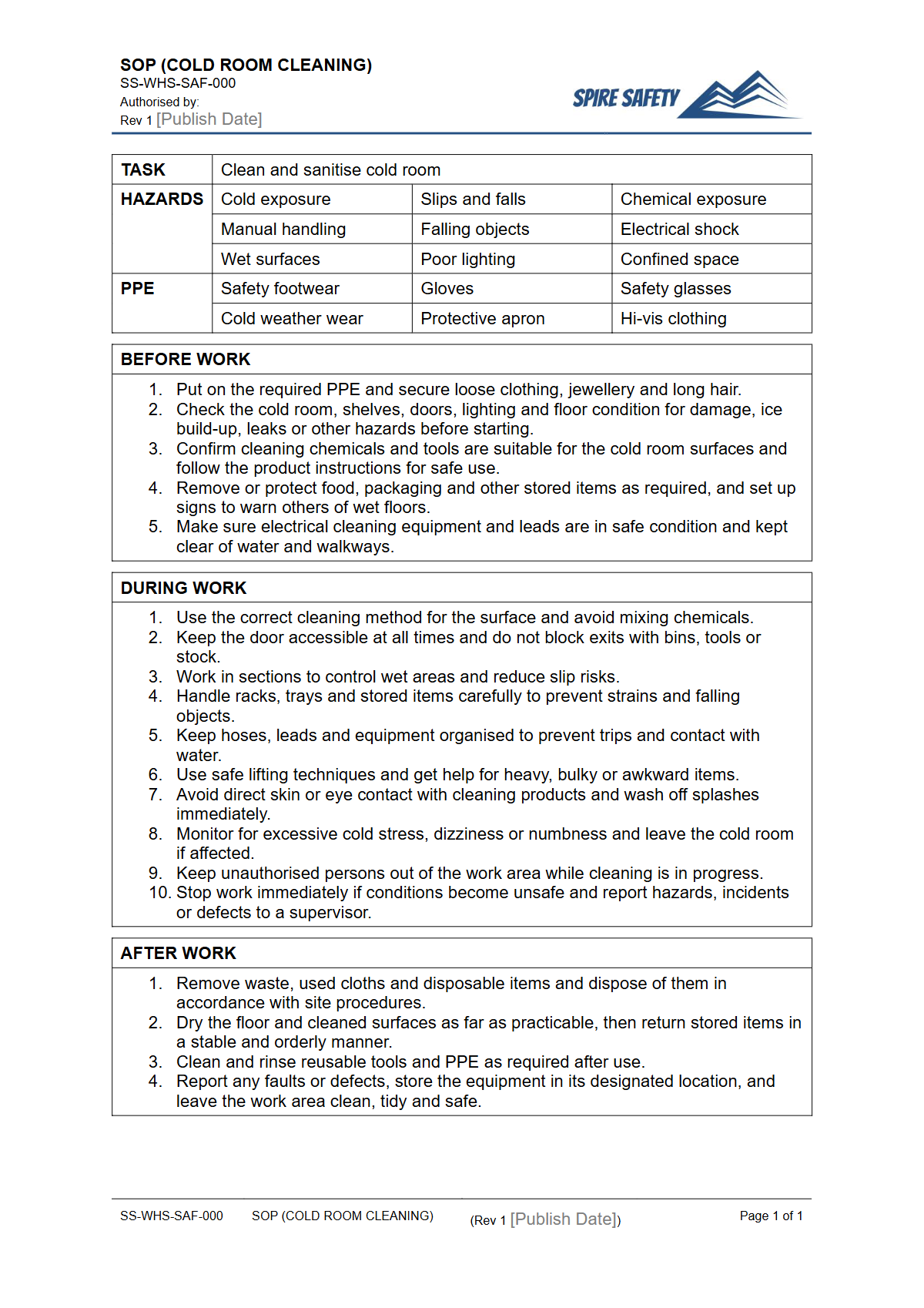
This Free Safe Operating Procedure (Cold Room Cleaning) Template provides a structured framework for businesses to document the specific steps and safety controls required for cleaning cold storage environments. Cleaning cold rooms presents unique hazards, including slips and falls on wet or icy surfaces, thermal stress from exposure to cold, manual handling injuries, and potential exposure to cleaning chemicals.
Using a standardised SOP helps to ensure these risks are systematically identified and controlled.
A well-developed SOP is a cornerstone of effective WHS management systems, serving as a critical training tool for workers and a clear record of your organisation's commitment to providing a safe system of work. It formalises expectations, promotes consistent and safe work practices, and assists in meeting your WHS duties.
Video walkthrough
How to use the Free Safe Operating Procedure (Cold Room Cleaning) Template
This resource is provided as a fully editable DOCX file, with a PDF version also available for easy printing and distribution. To use the template, download the file and systematically work through each section, adding details specific to your workplace.
This includes identifying the exact personal protective equipment (PPE) required, listing the specific cleaning chemicals used (and referencing their Safety Data Sheets), and detailing the step-by-step process from pre-start checks to post-cleaning lockdown.
You should involve workers who perform the cleaning tasks in the development and review of the SOP. Their direct experience is invaluable for creating a practical and effective procedure.
If you are unsure about any aspect of risk management or procedure development, our WHS consulting services can provide expert guidance.
Important Customisation Note
This document is a template and not a complete Safe Operating Procedure. It must be customised to align with the unique risks of your workplace.
You must consult with your team to identify hazards and implement control measures specific to your equipment, chemicals, and environment. Spire Safety does not warrant that this template is suitable for your specific circumstances.
When to use this Safe Operating Procedure
An SOP for cold room cleaning should be used as the primary reference document for the task. It should be readily accessible to all workers involved in the cleaning process. Key times to use this SOP include:
- Worker Training: For inducting new employees or training workers assigned to cleaning duties for the first time.
- Pre-Task Briefings: As a tool for supervisors to review hazards and controls with the team before work begins.
- Refresher Training: For periodic reviews to ensure work practices have not deviated from the established safe procedure.
- Incident Investigations: As a baseline to determine if established procedures were followed during a near miss or incident.
For tasks that involve working at height, such as cleaning high shelving, it should be used in conjunction with a specific step ladder SOP.
Who should use this Safe Operating Procedure
This template is designed for use by any person responsible for workplace safety and operational procedures. This includes:
- WHS Managers and Safety Officers: To develop and integrate into the broader safety management system.
- Operations and Facility Managers: To ensure cleaning standards are met without compromising worker safety.
- Supervisors and Team Leaders: To train their teams and oversee the safe execution of cleaning tasks. This process is similar to creating procedures for other equipment, such as our air compressor SOP template.
The final SOP document should be used by all workers who perform, supervise, or manage cold room cleaning activities. A comprehensive safety plan should also include emergency response planning, including procedures for defibrillator operation in case of a medical emergency.
Explore our complete free WHS resources library for more templates to support your safety management system.
Common mistakes
Common mistakes to avoid
- Using incorrect cleaning chemicals that can damage surfaces or react dangerously.
- Failing to erect warning signs and allowing foot traffic before floors are completely dry.
- Not properly isolating electrical equipment and power outlets from water during cleaning.
- Neglecting to train workers on the symptoms of cold stress and the importance of scheduled warm-up breaks.
Legal references
Legal considerations
The following legal requirements may be relevant to this type of work.
- Work Health and Safety Act (Harmonised) — Provides the primary duties for protecting workers and other people from work health and safety risks.
- Work Health and Safety Regulations (Harmonised) — Sets out requirements supporting the management of workplace hazards and risks.
The following codes may be relevant to this type of work.
- Managing WHS Risks Code of Practice — Provides practical guidance on identifying hazards, assessing risks and applying effective controls.
- Work Health and Safety Consultation, Cooperation and Coordination Code of Practice — Provides practical guidance on consulting workers and coordinating with other duty holders.
- Managing the Work Environment and Facilities Code of Practice — Provides practical guidance on safe work environments, workplace facilities and related controls.
Did you know
Slips, Trips and Falls
Slips, trips and falls are a leading cause of workplace injury in Australia, accounting for a significant portion of serious workers' compensation claims. Wet and icy surfaces in cold rooms are a major contributor to this risk.
Cold Stress
Working in a cold environment causes the body to lose heat faster than it can be produced. Prolonged exposure can lead to serious health problems like hypothermia, where core body temperature drops to a dangerous level.
FAQ
Frequently asked questions
01What are the main hazards when cleaning a cold room?
02Is a Safe Operating Procedure legally required for cold room cleaning?
03How often should an SOP for cold room cleaning be reviewed?
04What PPE is generally needed for cleaning a cold room?
Share this resource
Free Safe Operating Procedure (Cold Room Cleaning) Template
Browse Categories
How To Use It
- 1Download and open in Word or PDF.
- 2Replace the placeholders with your business details.
- 3Get it reviewed by a WHS specialist before rollout.
Need it customised?
Our WHS consultants can adapt this template to your site, run a gap analysis, or audit what you already have in place.
Book a Free Consultation WHS consulting servicesor call 1300 156 382
Related templates
- Free Safe Operating Procedure (Cold Saw) Template
- Free Safe Operating Procedure (Combi Oven) Template
- Free Safe Operating Procedure (Commercial Bin Pickup) Template
- Free Safe Operating Procedure (Commercial Blender) Template
- Free Safe Operating Procedure (Commercial Dryer) Template
- Free Safe Operating Procedure (Commercial Microwave) Template