
Free Safe Operating Procedure (Coil Winder) Template
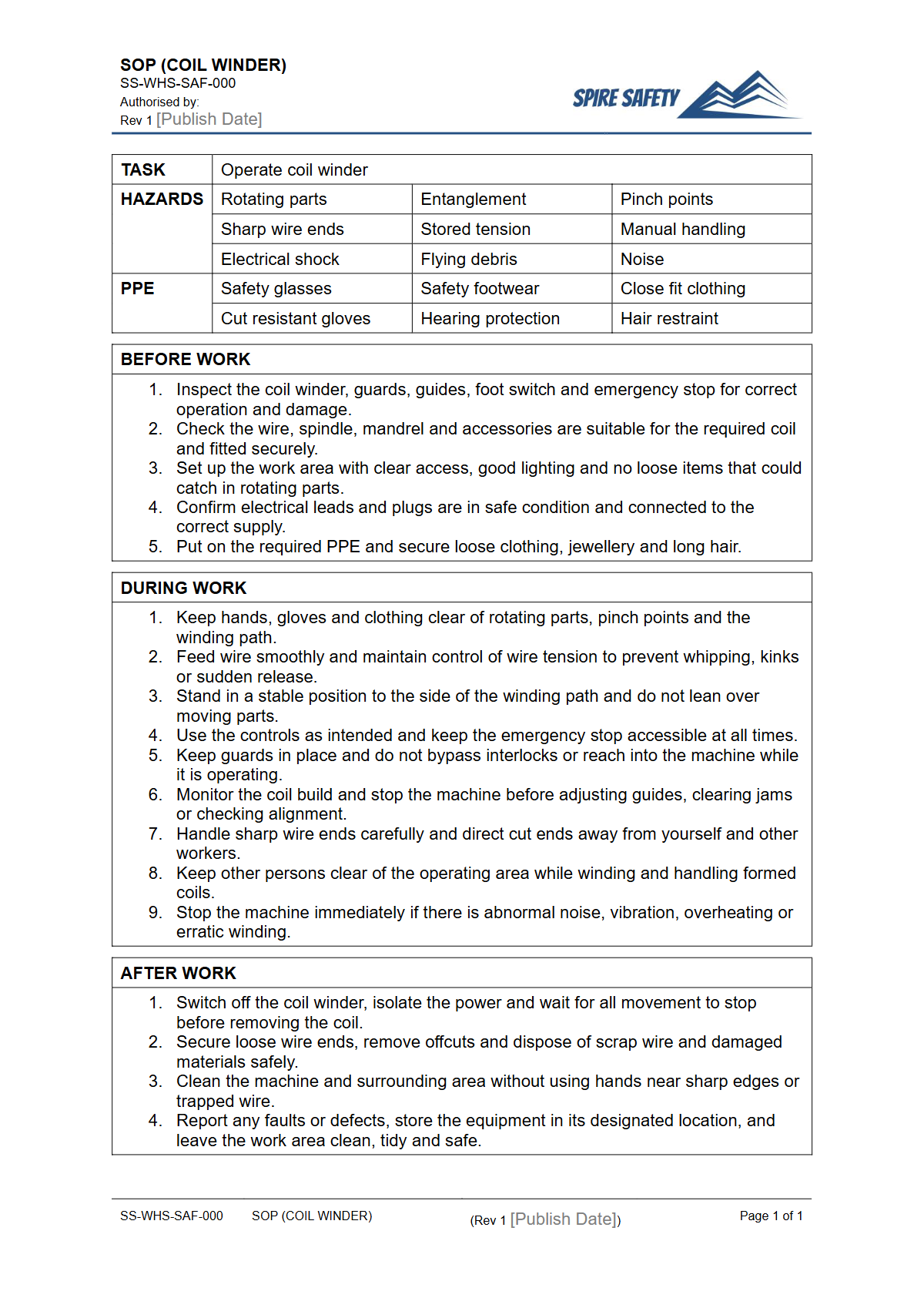
Download our free Safe Operating Procedure (Coil Winder) Template to help manage risks associated with winding machinery.
Free Safe Operating Procedure (Coil Winder) Template
DOCX • 126 KB + PDF
Updated Oct 2026
No signup required
Purpose of the Free Safe Operating Procedure (Coil Winder) Template
Operating a coil winder presents significant workplace health and safety risks, including entanglement, crushing, and electrical hazards. This Free Safe Operating Procedure (Coil Winder) Template provides a structured framework for documenting the required steps to operate this machinery safely.
A well-drafted Safe Operating Procedure (SOP) is a key administrative control measure, forming an essential part of your risk management process. It helps ensure all operators understand the hazards, risk controls, and emergency procedures associated with the task.
This template is designed as a starting point, aligned with Australian WHS principles. It guides you in outlining pre-start checks, operational steps, cleaning, and maintenance protocols specific to the coil winders used in your organisation.
Properly implemented, an SOP can significantly reduce the likelihood of incidents and injuries. For other common workshop equipment, you might also need a plasma cutter SOP to ensure consistent safety standards.
Video walkthrough
How to use the Free Safe Operating Procedure (Coil Winder) Template
This template is provided in both DOCX and PDF formats for your convenience. The DOCX file is fully editable, allowing you to tailor the content to the specific make and model of coil winder at your site, as well as your unique operational environment and company policies.
It is crucial to replace the placeholder text with detailed, site-specific information.
To effectively use this resource:
- Consult with Operators: Involve experienced operators and supervisors in the drafting process. Their practical knowledge is invaluable for identifying all relevant steps and hazards.
- Conduct a Risk Assessment: Ensure a thorough risk assessment has been completed for the task. The SOP should reflect the control measures identified in that assessment.
- Add Specific Details: Include machine-specific details such as model numbers, locations of emergency stops, required personal protective equipment (PPE), and isolation points.
- Review and Approve: Have the completed SOP reviewed and approved by a competent person, such as a manager or WHS advisor, before implementation.
- Train All Users: Ensure every operator receives training on the contents of the final SOP. Keep records of this training.
Important: This is a template, not a finished document. We have developed it as a guide, but you must customise it to reflect the specific equipment and processes in your workplace to ensure it is effective. Integrating these procedures is a critical component of developing robust WHS management systems.
When to use it
A Safe Operating Procedure for a coil winder should be used consistently as a reference tool to promote safe work practices. It is not a document to be filed away and forgotten. Key times to use the SOP include:
- Operator Training and Induction: Use it as a foundational document when training new operators or inducting workers into a new area.
- Pre-Operational Checks: The SOP should outline the daily pre-start checks required before the machine is used.
- Refresher Training: It serves as an excellent tool for periodic refresher training to prevent complacency and reinforce correct procedures.
- Incident Investigations: Following an incident or near-miss, the SOP should be reviewed to determine if the procedure was followed and if it needs revision.
- Audits and Inspections: The SOP is a key piece of evidence during safety inspections and is a document that will be scrutinised during a WHS compliance audit.
Who should use it
This SOP template is designed for use by any person or organisation responsible for workplace safety where coil winders are operated. This includes:
- Persons Conducting a Business or Undertaking (PCBUs): To meet their primary duty of care to provide safe systems of work.
- Managers and Supervisors: To train workers and supervise the safe operation of machinery.
- WHS Professionals: To develop and implement safety documentation as part of the overall safety management system.
- Operators: As a practical, step-by-step guide to follow during their day-to-day tasks.
By standardising procedures, you create a consistent safety benchmark for all workers. This same principle applies to other heavy machinery; for example, our Free Brake Press SOP Template can help formalise safety for another key piece of fabrication equipment.
Consistency across all plant and equipment documentation strengthens your safety culture. You can find more templates like this in our free WHS resources library.
Common mistakes
Common mistakes to avoid
- Failing to conduct and document pre-start safety checks before each use.
- Neglecting to isolate the machine from all energy sources (Lockout/Tagout) before cleaning or maintenance.
- Wearing loose clothing, long hair untied, or jewellery that can become entangled in moving parts.
- Operating the machine with guards removed, damaged, or disabled.
Legal references
Legal considerations
The following legal requirements may be relevant to this type of work.
- Work Health and Safety Act (Harmonised) — Provides the primary duties for protecting workers and other people from work health and safety risks.
- Work Health and Safety Regulations (Harmonised) — Sets out requirements supporting the management of workplace hazards and risks.
The following codes may be relevant to this type of work.
- Managing WHS Risks Code of Practice — Provides practical guidance on identifying hazards, assessing risks and applying effective controls.
- Work Health and Safety Consultation, Cooperation and Coordination Code of Practice — Provides practical guidance on consulting workers and coordinating with other duty holders.
- Managing the Work Environment and Facilities Code of Practice — Provides practical guidance on safe work environments, workplace facilities and related controls.
Did you know
The Danger of Entanglement
Entanglement in machinery is a leading cause of serious injury in manufacturing. A rotating shaft can catch clothing or hair in less than a second, making machine guarding and safe work procedures critically important.
Lockout/Tagout (LOTO)
A formal Lockout/Tagout procedure, which should be detailed in your SOP, is the most reliable way to ensure a machine is de-energised during maintenance, preventing unexpected start-ups and protecting workers from harm.
FAQ
Frequently asked questions
01What are the main hazards of operating a coil winder?
02Is training required before using a coil winder?
03How often should a Safe Operating Procedure for a coil winder be reviewed?
04Can a generic SOP be used for all coil winders?
Share this resource
Free Safe Operating Procedure (Coil Winder) Template
Browse Categories
How To Use It
- 1Download and open in Word or PDF.
- 2Replace the placeholders with your business details.
- 3Get it reviewed by a WHS specialist before rollout.
Need it customised?
Our WHS consultants can adapt this template to your site, run a gap analysis, or audit what you already have in place.
Book a Free Consultation WHS consulting servicesor call 1300 156 382
Related templates
- Free Safe Operating Procedure (Coin Counter) Template
- Free Safe Operating Procedure (Cold Chain Dispatch) Template
- Free Safe Operating Procedure (Cold Chain Receiving) Template
- Free Safe Operating Procedure (Cold Cutting Pipe) Template
- Free Safe Operating Procedure (Cold Room Cleaning) Template
- Free Safe Operating Procedure (Cold Saw) Template