
Free Safe Operating Procedure (Coin Counter) Template
Download our free Safe Operating Procedure (Coin Counter) Template.
Free Safe Operating Procedure (Coin Counter) Template
DOCX • 126 KB + PDF
Updated Oct 2026
No signup required
Purpose of the Free Safe Operating Procedure (Coin Counter) Template
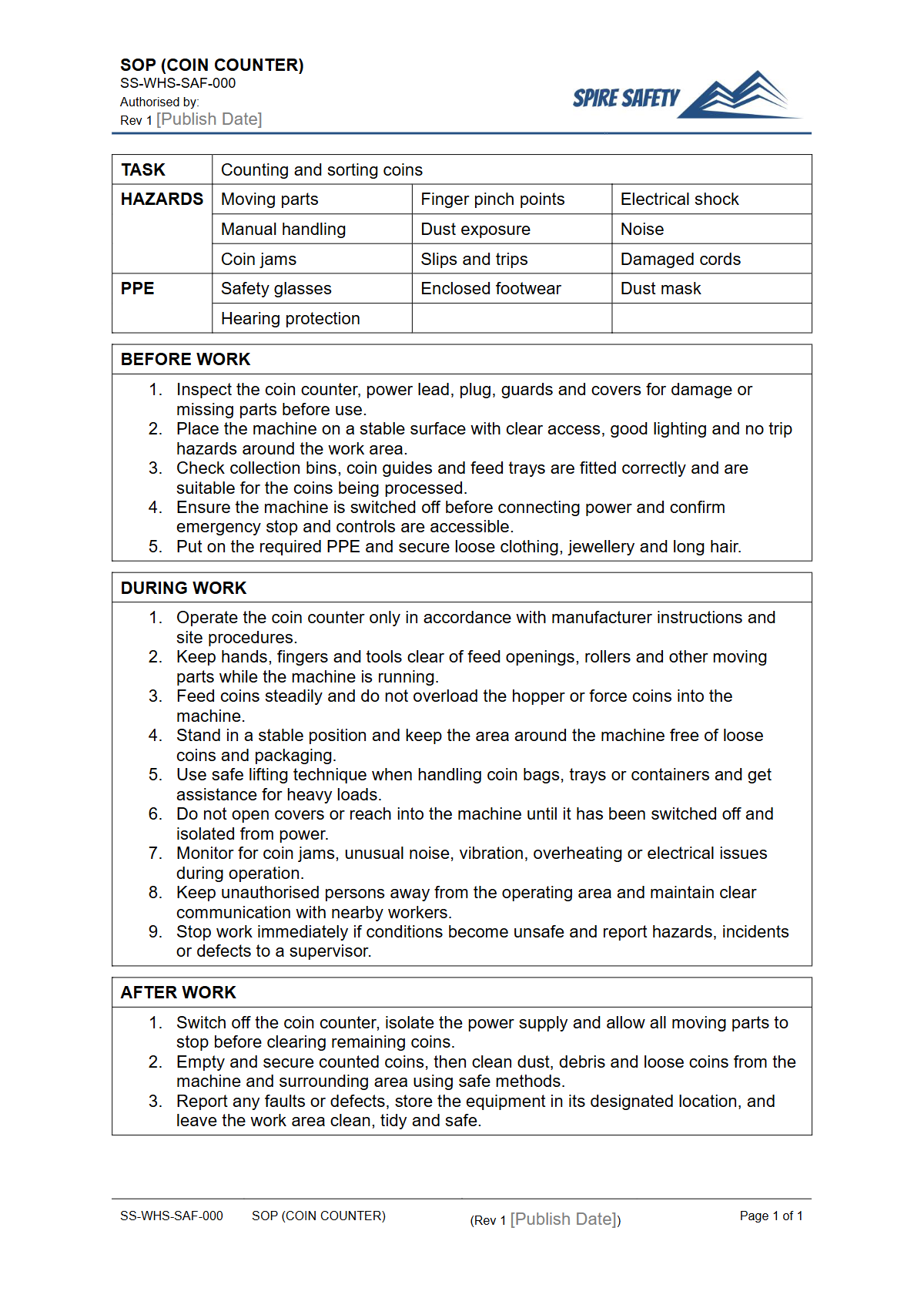
Effectively manage the risks associated with coin counting machines in your workplace with our Free Safe Operating Procedure (Coin Counter) Template. This downloadable document provides a structured format to outline safe work practices, helping you meet your WHS obligations. Designed for Australian businesses, this template helps formalise procedures for tasks like pre-operational checks, jam clearing, and routine maintenance, minimising the risk of injury to your staff.
Using a clear SOP ensures that all workers follow a consistent, safe method every time they use the equipment.
A documented procedure is a fundamental part of managing workplace safety. It serves as a training tool for new employees and a reference for experienced operators, ensuring everyone understands the hazards and control measures.
This SOP template guides you in addressing risks such as electrical shock, entanglement in moving parts, manual handling injuries from lifting coin bags, and ergonomic strains from repetitive tasks.
Video walkthrough
How to use the Free Safe Operating Procedure (Coin Counter) Template
This resource is available in both DOCX and PDF formats for your convenience. The DOCX file is fully editable, allowing you to tailor it to your specific operational needs.
The template is structured to cover key safety areas, including required personal protective equipment (PPE), pre-start checks, step-by-step operating instructions, and procedures for cleaning and maintenance.
Important: This document is a template, not a finished product. You must customise it to reflect the specific model of coin counter used in your business, your unique work environment, and the tasks your workers perform.
We have provided a comprehensive framework, but it is your responsibility as the PCBU (Person Conducting a Business or Undertaking) to conduct a thorough risk assessment and populate the SOP with site-specific details to ensure it is effective.
Key Hazards and Control Measures
While often seen as simple office equipment, coin counters present several hazards that must be managed. This SOP prompts you to consider controls for common risks:
- Electrical Hazards: Ensure the machine is properly tested and tagged, and that staff know to disconnect power before any maintenance or clearing of jams.
- Moving Parts: The internal sorting mechanism can pose an entanglement or crushing risk. The SOP should detail lockout/tagout procedures for clearing blockages safely.
- Manual Handling: Full coin hoppers and bags can be heavy and awkward. Your procedure should specify safe lifting techniques and weight limits, or the use of mechanical aids where necessary.
- Ergonomics: Repetitive loading and unloading can lead to musculoskeletal disorders. Consider workstation design, task rotation, and regular breaks.
- Hygiene and Dust: Coins can be dirty and create dust. Your SOP should outline requirements for hand washing and, if identified in your risk assessment, the use of gloves or dust masks.
Proper documentation of these hazards is a key step in developing robust WHS management systems that protect your people and your business.
Integrating this SOP into Your Safety System
A Safe Operating Procedure is most effective when it is part of a broader safety framework. This means not just writing the document, but also implementing it.
Ensure all relevant workers are trained on the SOP's contents and that their understanding is verified. Keep records of this training.
The SOP should be readily accessible to workers near the coin counter. For a complete safety system, you may also need procedures for other common workplace equipment, such as our FREE Step Ladder SOP Template, which addresses risks associated with simple access tasks.
Regularly review the SOP—at least annually, or whenever there is a change in equipment, procedures, or after an incident. An independent review during a formal WHS compliance auditing process can help identify any gaps between the documented procedure and actual work practices.
Who Should Use this SOP?
This Safe Operating Procedure is designed for any business where coin counters are used. This includes a wide range of industries such as retail, banking, hospitality, gaming and casinos, transport, and vending machine operators. It is a valuable tool for:
- Business Owners and Managers: To fulfil their duty of care and establish formal safety protocols.
- WHS/HSE Professionals: To standardise procedures and integrate them into the overall safety management system.
- Team Leaders and Supervisors: To train staff and supervise the safe operation of the equipment.
By establishing clear guidelines, you create a safer and more organised work environment. A well-prepared workplace is also equipped for emergencies, which can involve having other critical procedures in place, like a Safe Operating Procedure for Defibrillator Operation.
This template is one of many resources we offer to help Australian businesses improve their safety practices. For more templates and checklists, explore our complete free WHS resources library.
Common mistakes
Common mistakes to avoid
- Failing to disconnect the machine from its power source before attempting to clear a coin jam.
- Underestimating the weight of full coin bags, leading to manual handling injuries.
- Using a generic SOP without customising it for the specific machine model and work environment.
- Forgetting to train new or casual staff on the safe operating procedure before they use the machine.
Legal references
Legal considerations
The following legal requirements may be relevant to this type of work.
- Work Health and Safety Act (Harmonised) — Provides the primary duties for protecting workers and other people from work health and safety risks.
- Work Health and Safety Regulations (Harmonised) — Sets out requirements supporting the management of workplace hazards and risks.
The following codes may be relevant to this type of work.
- Managing WHS Risks Code of Practice — Provides practical guidance on identifying hazards, assessing risks and applying effective controls.
- Work Health and Safety Consultation, Cooperation and Coordination Code of Practice — Provides practical guidance on consulting workers and coordinating with other duty holders.
- Managing the Work Environment and Facilities Code of Practice — Provides practical guidance on safe work environments, workplace facilities and related controls.
Did you know
Hidden Contaminants
Studies have shown that coins can carry a wide variety of bacteria and trace amounts of heavy metals. Regular hand washing after handling large volumes of cash is a simple but critical hygiene control measure.
Ergonomic Impact
The repetitive motions of scooping and pouring coins, combined with prolonged standing or awkward postures, are a leading cause of musculoskeletal disorders (MSDs) for cash-handling employees.
FAQ
Frequently asked questions
01What is a Safe Operating Procedure (SOP)?
02Are coin counters a significant workplace hazard?
03Do I need a separate SOP for each model of coin counter?
04How often should I review my coin counter SOP?
Share this resource
Free Safe Operating Procedure (Coin Counter) Template
Browse Categories
How To Use It
- 1Download and open in Word or PDF.
- 2Replace the placeholders with your business details.
- 3Get it reviewed by a WHS specialist before rollout.
Need it customised?
Our WHS consultants can adapt this template to your site, run a gap analysis, or audit what you already have in place.
Book a Free Consultation WHS consulting servicesor call 1300 156 382
Related templates
- Free Safe Operating Procedure (Cold Chain Dispatch) Template
- Free Safe Operating Procedure (Cold Chain Receiving) Template
- Free Safe Operating Procedure (Cold Cutting Pipe) Template
- Free Safe Operating Procedure (Cold Room Cleaning) Template
- Free Safe Operating Procedure (Cold Saw) Template
- Free Safe Operating Procedure (Combi Oven) Template