
Free Safe Operating Procedure (Coil Slitter) Template
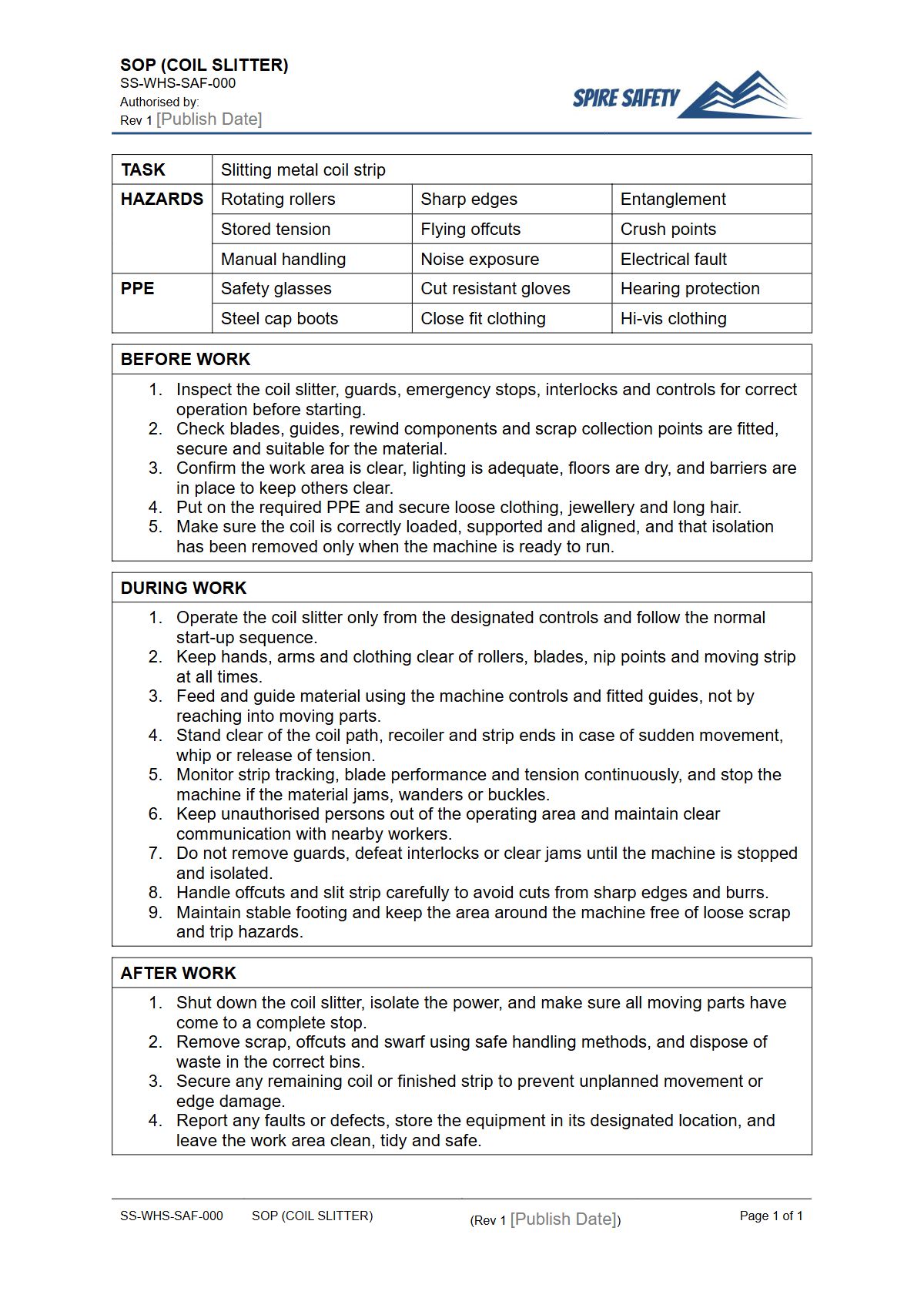
Download our free Safe Operating Procedure (Coil Slitter) Template. This customisable DOCX & PDF helps you outline safety steps for coil slitter use.
Free Safe Operating Procedure (Coil Slitter) Template
DOCX • 126 KB + PDF
Updated Oct 2026
No signup required
Purpose of the Free Safe Operating Procedure (Coil Slitter) Template
A Safe Operating Procedure (SOP) is a vital administrative control that provides step-by-step instructions on how to perform a task safely. For high-risk equipment like a coil slitter, a documented procedure is essential.
The primary purpose of this template is to help you clearly define pre-operational checks, operational steps, and shutdown procedures to manage hazards effectively. These include sharp edges from slit coils, nip points between rollers and blades, high-tension materials, and the risks of stored energy.
By standardising these processes, you create a consistent benchmark for operator training and competency assessment.
Implementing a thorough SOP contributes to a safer work environment and forms a key part of your overall safety management system. It's a practical tool for demonstrating due diligence and ensuring that all workers understand the expected safety behaviours.
This process is similar to how procedures for other metalworking equipment are managed, such as with a free Plasma Cutter SOP, where specific operational risks must be detailed.
Video walkthrough
How to use the Free Safe Operating Procedure (Coil Slitter) Template
This template is provided as a starting point. It is not a complete, ready-to-use document.
You must customise it to reflect the specific circumstances of your workplace.
To effectively use this template:
- Download the DOCX file and open it in your preferred word processor.
- Systematically work through each section, replacing the placeholder text with information specific to your coil slitter model, the types of materials you process (e.g., steel, aluminium), and your site's unique layout and environment.
- Consult with the machine operators, supervisors, and any available manufacturer's guidelines during the customisation process. Their direct experience is invaluable for creating a practical and effective document.
- Ensure the final SOP is integrated into your broader comprehensive WHS management systems.
- Important Note: We have created this template as a guide based on common industry practices and the model WHS framework. However, it is your responsibility as the PCBU to ensure the final, customised document accurately reflects your operational risks and meets all your legal obligations under relevant state or territory WHS legislation.
When to use a Coil Slitter SOP
An SOP for a coil slitter is not a document to be filed away and forgotten. It should be an active part of your daily operations.
Key times to use the SOP include during worker induction and onboarding, for specific task training, and as a refresher before operating the machinery. It serves as the basis for pre-start checks, ensuring the machine's guards, emergency stops, and interlocks are functional before any work begins. Even for simpler equipment, procedures are vital, as shown in our Step Ladder SOP.
The SOP should also be a primary reference document during incident investigations or near-miss reviews. It helps identify whether the established procedure was followed and if the procedure itself needs revision to prevent recurrence.
Regular reviews are also critical, and these can be scheduled as part of a wider WHS compliance auditing program to ensure ongoing relevance and effectiveness.
Who should use this SOP?
The Coil Slitter SOP should be used by several key roles within an organisation. Primarily, it is for the machinery operators who perform the task.
It provides them with clear, unambiguous instructions on how to work safely. Supervisors and line managers must use the SOP to oversee work, enforce safety standards, and conduct competency assessments.
They are responsible for ensuring operators understand and follow the procedure correctly.
Additionally, WHS managers and safety officers use the SOP as a tool for risk management, training development, and auditing purposes. The document provides a tangible record of the control measures in place for a specific high-risk task.
This is consistent with the need for clear procedures for other fabrication equipment, as outlined in our Brake Press SOP template. Finally, maintenance personnel may refer to the SOP for lockout/tagout procedures before conducting service or repairs.
Explore our full free WHS resources library for more templates and guides to support your safety management efforts across the workplace.
Common mistakes
Common mistakes to avoid
- Using a generic downloaded template without customising it for the specific machine and workplace.
- Failing to adequately train all operators on the content of the finalised SOP.
- Neglecting to review and update the SOP after a near miss, incident, or change in process.
- Assuming the SOP replaces the need for physical guards, interlocks, and emergency stops.
Legal references
Legal considerations
The following legal requirements may be relevant to this type of work.
- Work Health and Safety Act (Harmonised) — Provides the primary duties for protecting workers and other people from work health and safety risks.
- Work Health and Safety Regulations (Harmonised) — Sets out requirements supporting the management of workplace hazards and risks.
The following codes may be relevant to this type of work.
- Managing WHS Risks Code of Practice — Provides practical guidance on identifying hazards, assessing risks and applying effective controls.
- Work Health and Safety Consultation, Cooperation and Coordination Code of Practice — Provides practical guidance on consulting workers and coordinating with other duty holders.
- Managing the Work Environment and Facilities Code of Practice — Provides practical guidance on safe work environments, workplace facilities and related controls.
Did you know
Nip Point Dangers
The force at a nip point on industrial machinery can be immense, often exceeding several tonnes. An injury can occur in a fraction of a second, long before a person has time to react.
Steel Tension
A coil of steel being processed by a slitter is under significant tension. A sudden break can cause the metal to whip with extreme force, posing a severe impact hazard to anyone nearby.
FAQ
Frequently asked questions
01What are the main hazards of a coil slitter?
02Is an SOP a legal requirement for coil slitters in Australia?
03How often should a Coil Slitter SOP be reviewed?
04What's the difference between an SOP and a SWMS?
Share this resource
Free Safe Operating Procedure (Coil Slitter) Template
Browse Categories
How To Use It
- 1Download and open in Word or PDF.
- 2Replace the placeholders with your business details.
- 3Get it reviewed by a WHS specialist before rollout.
Need it customised?
Our WHS consultants can adapt this template to your site, run a gap analysis, or audit what you already have in place.
Book a Free Consultation WHS consulting servicesor call 1300 156 382
Related templates
- Free Safe Operating Procedure (Coil Spring Removal) Template
- Free Safe Operating Procedure (Coil Upender) Template
- Free Safe Operating Procedure (Coil Winder) Template
- Free Safe Operating Procedure (Coin Counter) Template
- Free Safe Operating Procedure (Cold Chain Dispatch) Template
- Free Safe Operating Procedure (Cold Chain Receiving) Template