
Free Safe Operating Procedure (Coil Spring Removal) Template
Download our free Safe Operating Procedure (Coil Spring Removal) Template. This DOCX & PDF resource helps manage high-risk vehicle maintenance tasks.
Free Safe Operating Procedure (Coil Spring Removal) Template
DOCX • 126 KB + PDF
Updated Oct 2026
No signup required
Purpose of the Free Safe Operating Procedure (Coil Spring Removal) Template
Working with vehicle suspension systems, particularly coil spring removal and installation, is a high-risk activity. The immense stored energy within a compressed spring can be released suddenly and violently if not handled correctly, leading to severe or fatal injuries.
This Free Safe Operating Procedure (Coil Spring Removal) Template provides a structured framework to help your organisation manage these risks effectively. It formalises a step-by-step process designed to guide workers, minimise the potential for human error, and create a safer workshop environment.
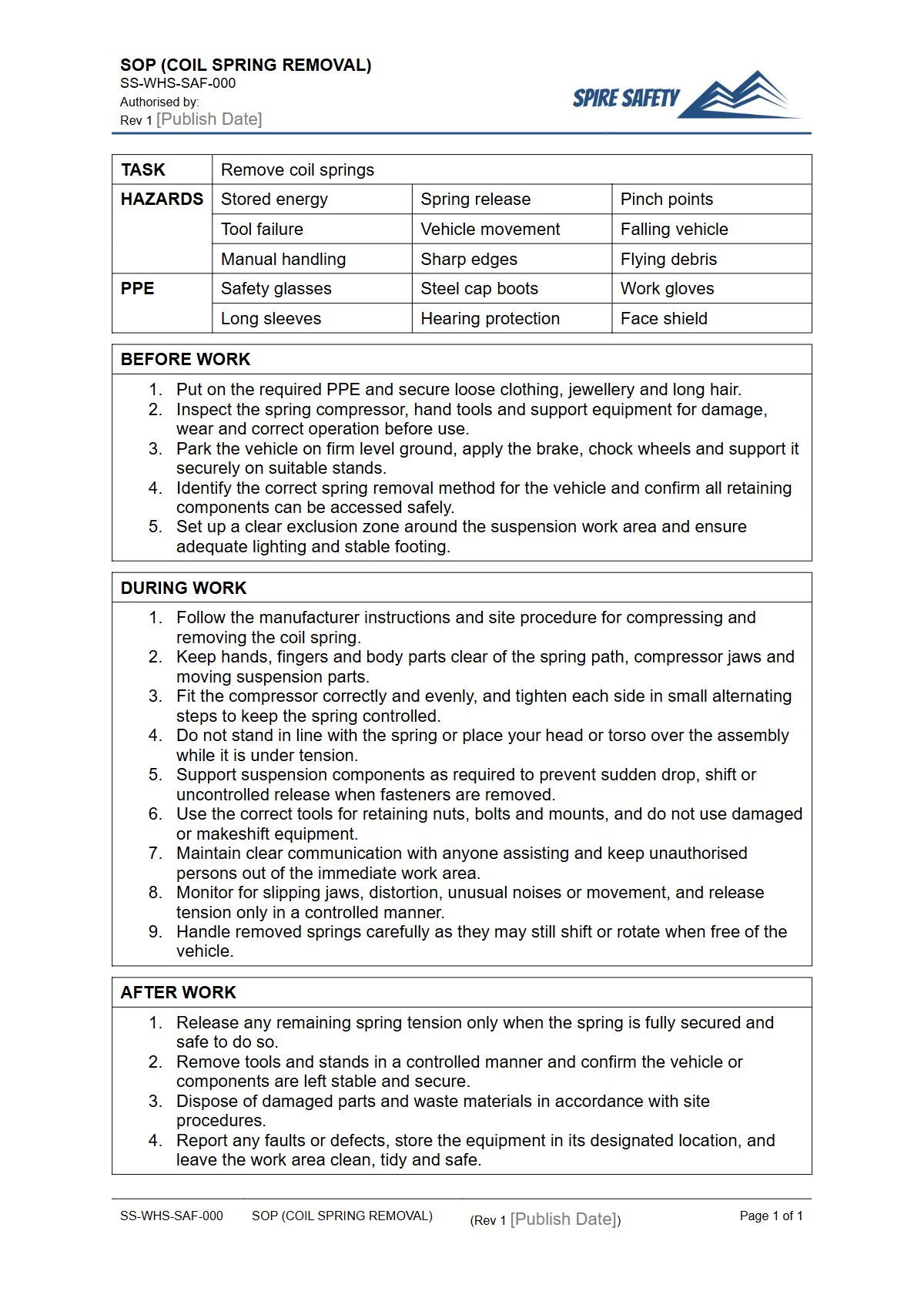
The SOP outlines critical safety checks, required personal protective equipment (PPE), and emergency protocols.
By implementing a clear SOP, you establish a consistent, documented method for performing the task, which is a cornerstone of any effective safety system. This document serves as an essential training tool for new technicians and a crucial reference for experienced ones.
It assists in meeting your primary duty of care under WHS legislation by providing and maintaining a safe system of work. Integrating this procedure is a practical step towards building robust WHS management systems in your automotive workshop or maintenance facility.
Video walkthrough
How to use the Free Safe Operating Procedure (Coil Spring Removal) Template
This template is provided in both DOCX and PDF formats for your convenience. The DOCX file is fully editable, allowing you to tailor the content to the specific equipment, tools, and conditions present in your workplace.
A generic procedure is not sufficient for compliance or safety; customisation is essential. You must review and modify the document to reflect the exact type of spring compressors (e.g., internal, external, strut-type), vehicles, and work environment your team uses.
It's crucial to remember that this is a template, not a finished document. We have provided a solid framework, but you must adapt it to the specific tools and context of your workplace.
Involve your experienced technicians in the customisation process to ensure the procedure is practical and reflects best practices on the floor. Once finalised, the SOP should be used for training and be readily accessible to all relevant personnel. While this SOP covers a high-risk mechanical task, other workshop machinery also requires formal procedures, such as our Free Brake Press SOP (Safe Operating Procedure) Template.
When to use this Safe Operating Procedure
A Safe Operating Procedure for coil spring removal should be consulted before and during every instance of the task. It is not merely a document for induction or initial training.
It serves as a pre-start checklist to ensure all safety measures are in place and as a reference guide during the job, especially if a worker is uncertain about a step. Regular use reinforces safe work habits and helps prevent complacency, which can be a significant factor in workshop incidents.
This SOP should be a mandatory component of any job that involves dismantling suspension struts or replacing coil springs on cars, 4WDs, or light trucks.
The procedure is also a valuable resource during incident investigations and safety audits. It provides a benchmark against which actual work practices can be measured.
For other high-energy workshop tasks, standardised procedures are equally important; you might also find our FREE Plasma Cutter SOP (Safe Operating Procedure) Template useful for your fabrication area.
Who should use it
This Safe Operating Procedure is intended for use by competent and qualified automotive technicians and mechanics. Personnel performing this task must have received specific training on the procedure, the correct use of the spring compressor, and the associated hazards.
Apprentices or trainees should only perform this task under the direct and constant supervision of a qualified tradesperson who can provide immediate guidance. Verifying the skills and knowledge of workers performing high-risk tasks is a key part of ensuring workplace safety, often reviewed during a WHS compliance auditing process.
Supervisors and workshop managers should also be thoroughly familiar with the SOP. They are responsible for ensuring that it is followed correctly, that workers are adequately trained, and that the specified equipment (including PPE) is provided and maintained in good condition.
Having SOPs for common equipment, like the one detailed in our Free Air Compressor SOP (Safe Operating Procedure) Template, ensures a consistent approach to safety across all workshop activities.
Key Elements Included in the Template
Our free template provides a comprehensive starting point, with sections covering the essential components of a robust SOP. It is organised to be clear, logical, and easy for workers to follow.
- Hazard Identification: Lists potential hazards such as stored energy release, component failure, crushing, and manual handling risks.
- Personal Protective Equipment (PPE): Specifies the minimum required PPE, including high-impact safety glasses or a face shield, steel-capped boots, and protective gloves.
- Pre-Operational Checks: Includes a checklist for inspecting the spring compressor tool for wear, cracks, or damage, and ensuring the work area is clear and stable.
- Step-by-Step Procedure: Details the sequence of actions for safely securing the vehicle, attaching the compressor, compressing the spring, and removing it.
- Emergency Procedures: Outlines immediate actions to take in case of an incident, such as tool failure or injury.
By customising and implementing this SOP, you take a significant step towards controlling a serious workplace hazard. For more document templates and safety guides, browse our complete free WHS resources library.
Common mistakes
Common mistakes to avoid
- Using an incorrectly sized or rated spring compressor for the job.
- Failing to properly inspect the compressor tool for cracks, stripped threads, or damage before use.
- Not securing the strut or suspension assembly firmly in a vice before compressing the spring.
- Unevenly tightening the compressor, causing the spring to bow and potentially slip out.
Legal references
Legal considerations
The following legal requirements may be relevant to this type of work.
- Work Health and Safety Act (Harmonised) — Provides the primary duties for protecting workers and other people from work health and safety risks.
- Work Health and Safety Regulations (Harmonised) — Sets out requirements supporting the management of workplace hazards and risks.
The following codes may be relevant to this type of work.
- Managing WHS Risks Code of Practice — Provides practical guidance on identifying hazards, assessing risks and applying effective controls.
- Work Health and Safety Consultation, Cooperation and Coordination Code of Practice — Provides practical guidance on consulting workers and coordinating with other duty holders.
- Managing the Work Environment and Facilities Code of Practice — Provides practical guidance on safe work environments, workplace facilities and related controls.
Did you know
Stored Energy
A standard vehicle coil spring, when compressed by just a few centimetres, can store thousands of newtons of force. If released uncontrollably, this energy is comparable to a small explosion, capable of launching components with lethal force.
FAQ
Frequently asked questions
01Is this SOP template suitable for all types of spring compressors?
02What PPE is essential for coil spring removal?
03How often should a Safe Operating Procedure for coil spring removal be reviewed?
04Can an apprentice perform coil spring removal using this SOP?
Share this resource
Free Safe Operating Procedure (Coil Spring Removal) Template
Browse Categories
How To Use It
- 1Download and open in Word or PDF.
- 2Replace the placeholders with your business details.
- 3Get it reviewed by a WHS specialist before rollout.
Need it customised?
Our WHS consultants can adapt this template to your site, run a gap analysis, or audit what you already have in place.
Book a Free Consultation WHS consulting servicesor call 1300 156 382
Related templates
- Free Safe Operating Procedure (Coil Upender) Template
- Free Safe Operating Procedure (Coil Winder) Template
- Free Safe Operating Procedure (Coin Counter) Template
- Free Safe Operating Procedure (Cold Chain Dispatch) Template
- Free Safe Operating Procedure (Cold Chain Receiving) Template
- Free Safe Operating Procedure (Cold Cutting Pipe) Template