
Free Safe Operating Procedure (Coil Grab) Template
Download our Free Safe Operating Procedure (Coil Grab) Template for Australian workplaces.
Free Safe Operating Procedure (Coil Grab) Template
DOCX • 126 KB + PDF
Updated Oct 2026
No signup required
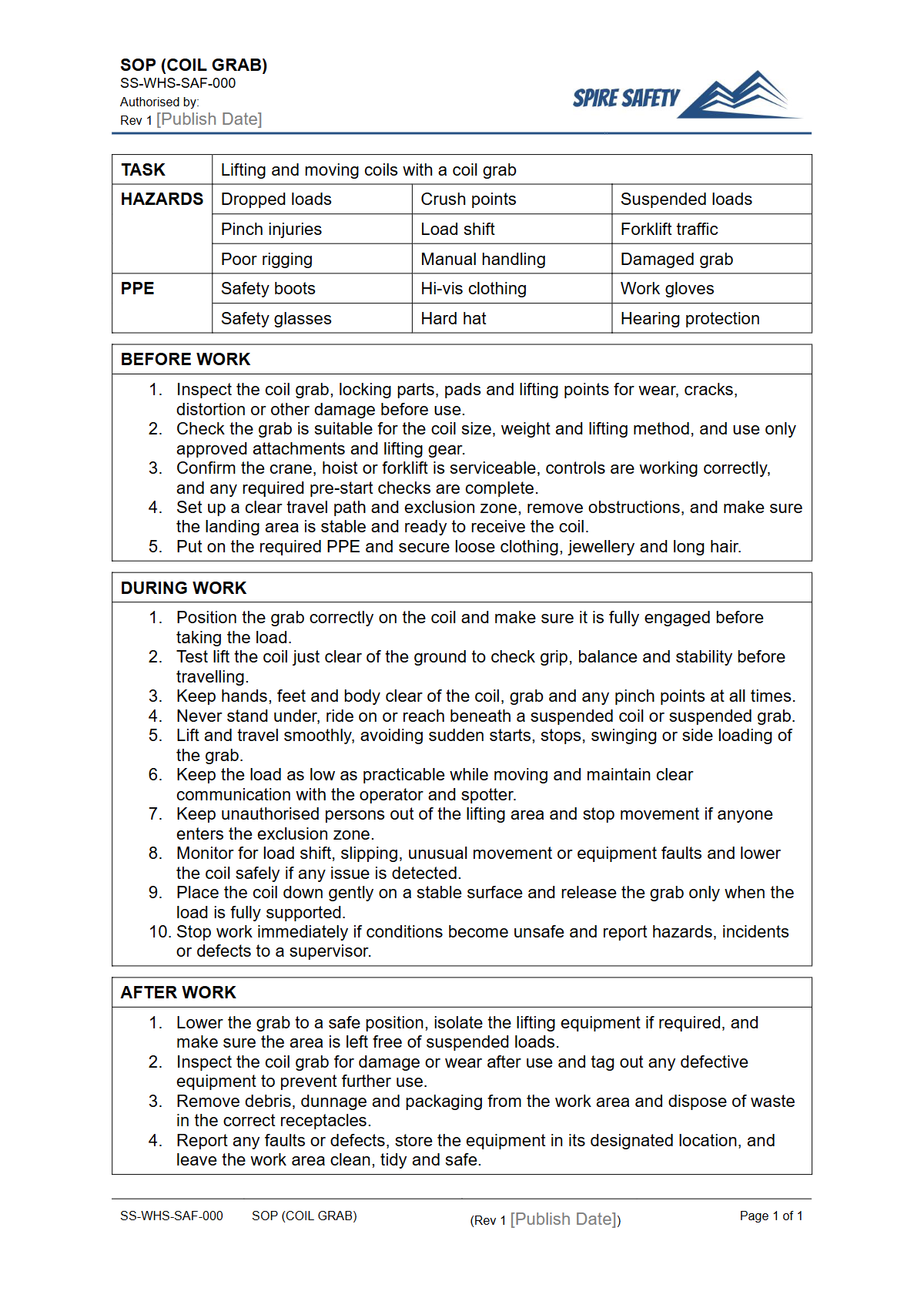
Purpose of the Free Safe Operating Procedure (Coil Grab) Template
Effectively managing high-risk tasks is a cornerstone of workplace safety. This free Safe Operating Procedure (Coil Grab) Template provides a structured starting point for documenting the essential safety steps for handling heavy coils.
Using a specialised coil grab is significantly safer than using slings or standard C-hooks, but it still introduces serious risks, including dropped loads, crushing injuries, and equipment damage. A documented SOP ensures that all operators follow a consistent, tested, and safe method every time, reducing the likelihood of incidents.
It forms a critical component of your overall WHS management systems, demonstrating a commitment to proactive risk control.
Video walkthrough
How to use the Free Safe Operating Procedure (Coil Grab) Template
This resource is available for immediate download in both DOCX and PDF formats. The DOCX version is fully editable, allowing you to tailor the content to your specific operational context.
While this Safe Operating Procedure for coil grab use is aligned with Australian WHS best practices, it must be customised to be effective.
Important: We've provided a solid foundation, but it is critical that you adapt this document to the specific coil grab models, overhead cranes, materials, workplace environment, and personnel at your site. You must consult the manufacturer’s instructions and complete a site-specific risk assessment.
If you need assistance, our WHS consulting team can help you develop and implement site-specific procedures.
When to Use a Coil Grab SOP
A Safe Operating Procedure for a coil grab should be used as a primary reference document in several key situations. It is essential for inducting and training new operators, ensuring they understand the approved method before ever touching the controls.
The SOP should also be used for regular refresher training to prevent complacency and bad habits from forming. Furthermore, it serves as a benchmark for workplace inspections and safety observations.
In the unfortunate event of an incident or near-miss involving a coil grab, the SOP will be a critical document for the investigation and any subsequent WHS compliance auditing activities.
Who Should Use This SOP
This document is intended for a range of personnel within an organisation. A Person Conducting a Business or Undertaking (PCBU) has the primary duty of care and can use this SOP to ensure a safe system of work is in place.
Managers and supervisors are responsible for implementing the procedure, training their teams, and ensuring it is followed. Crane operators, doggers, riggers, and other workers directly involved in the lifting operation must use the SOP as their guide for correct, safe task execution.
WHS Managers and advisors will also use this template as part of the broader safety framework.
Key Elements in a Coil Grab Safe Operating Procedure
A comprehensive SOP for coil handling should cover all phases of the operation. This template guides you through documenting these critical stages:
- Pre-Operational Checks: A detailed checklist to inspect the coil grab, crane, and lifting area for any faults or hazards before work begins. This includes checking hydraulic lines, mechanical grips, and control systems.
- Planning the Lift: Steps for confirming the coil's weight and dimensions, ensuring the grab is correctly rated, and planning the travel path to avoid personnel and obstacles.
- Safe Lifting and Handling: The core sequence of operations, including how to correctly position and engage the grab, perform a test lift, and move the load smoothly. Communication protocols between the operator and any spotters are also defined here.
- Emergency Procedures: Clear, actionable steps to take in the event of a power failure, hydraulic leak, or other malfunction that could result in a suspended or uncontrolled load.
- Shutdown and Storage: Correct procedures for disengaging the grab, powering down equipment, and storing the grab to prevent damage.
The principles of safe lifting equipment operation are universal, whether you are using a coil grab, a crane, or other machinery. For another example of a procedure for lifting equipment, you can review our FREE Telehandler SOP (Safe Operating Procedure) Template.
Integrating SOPs into Your Safety System
An SOP is most effective when it is part of a connected safety system. This procedure should be referenced in your risk assessments, training records, and maintenance logs.
Regularly reviewing and updating your SOPs—especially after an incident or when new equipment is introduced—is vital for maintaining a safe workplace. By building a comprehensive library of procedures for all high-risk tasks, you create a culture of safety and operational excellence.
You can find a wide range of other templates in our free WHS resources library to help build out your system.
Common mistakes
Common mistakes to avoid
- Using a grab that is not rated for the specific weight, width, and diameter of the coil.
- Failing to conduct daily pre-use inspections of the grab's mechanical, hydraulic, and electrical systems.
- Neglecting to establish and enforce a clearly marked exclusion zone for personnel beneath a suspended load.
- Improperly seating the grab on the coil, leading to a loose grip and potential for the load to slip during transit.
Legal references
Legal considerations
The following legal requirements may be relevant to this type of work.
- Work Health and Safety Act (Harmonised) — Provides the primary duties for protecting workers and other people from work health and safety risks.
- Work Health and Safety Regulations (Harmonised) — Sets out requirements supporting the management of workplace hazards and risks.
The following codes may be relevant to this type of work.
- Managing WHS Risks Code of Practice — Provides practical guidance on identifying hazards, assessing risks and applying effective controls.
- Work Health and Safety Consultation, Cooperation and Coordination Code of Practice — Provides practical guidance on consulting workers and coordinating with other duty holders.
- Managing the Work Environment and Facilities Code of Practice — Provides practical guidance on safe work environments, workplace facilities and related controls.
Did you know
The 'C-Hook' Problem
Traditional C-hooks, while simple, are a common source of lifting incidents. They can easily become unbalanced, leading to dropped loads. Modern coil grabs that grip the coil's inside or outside diameter provide a far more secure and stable lift.
FAQ
Frequently asked questions
01What is a coil grab?
02Is this SOP template compliant with Australian WHS laws?
03Can I use this SOP for different types of coils?
04Who is qualified to operate a coil grab?
Share this resource
Free Safe Operating Procedure (Coil Grab) Template
Browse Categories
How To Use It
- 1Download and open in Word or PDF.
- 2Replace the placeholders with your business details.
- 3Get it reviewed by a WHS specialist before rollout.
Need it customised?
Our WHS consultants can adapt this template to your site, run a gap analysis, or audit what you already have in place.
Book a Free Consultation WHS consulting servicesor call 1300 156 382
Related templates
- Free Safe Operating Procedure (Coil Lifter) Template
- Free Safe Operating Procedure (Coil Slitter) Template
- Free Safe Operating Procedure (Coil Spring Removal) Template
- Free Safe Operating Procedure (Coil Upender) Template
- Free Safe Operating Procedure (Coil Winder) Template
- Free Safe Operating Procedure (Coin Counter) Template