
Free Safe Operating Procedure (Coffee Machine) Template
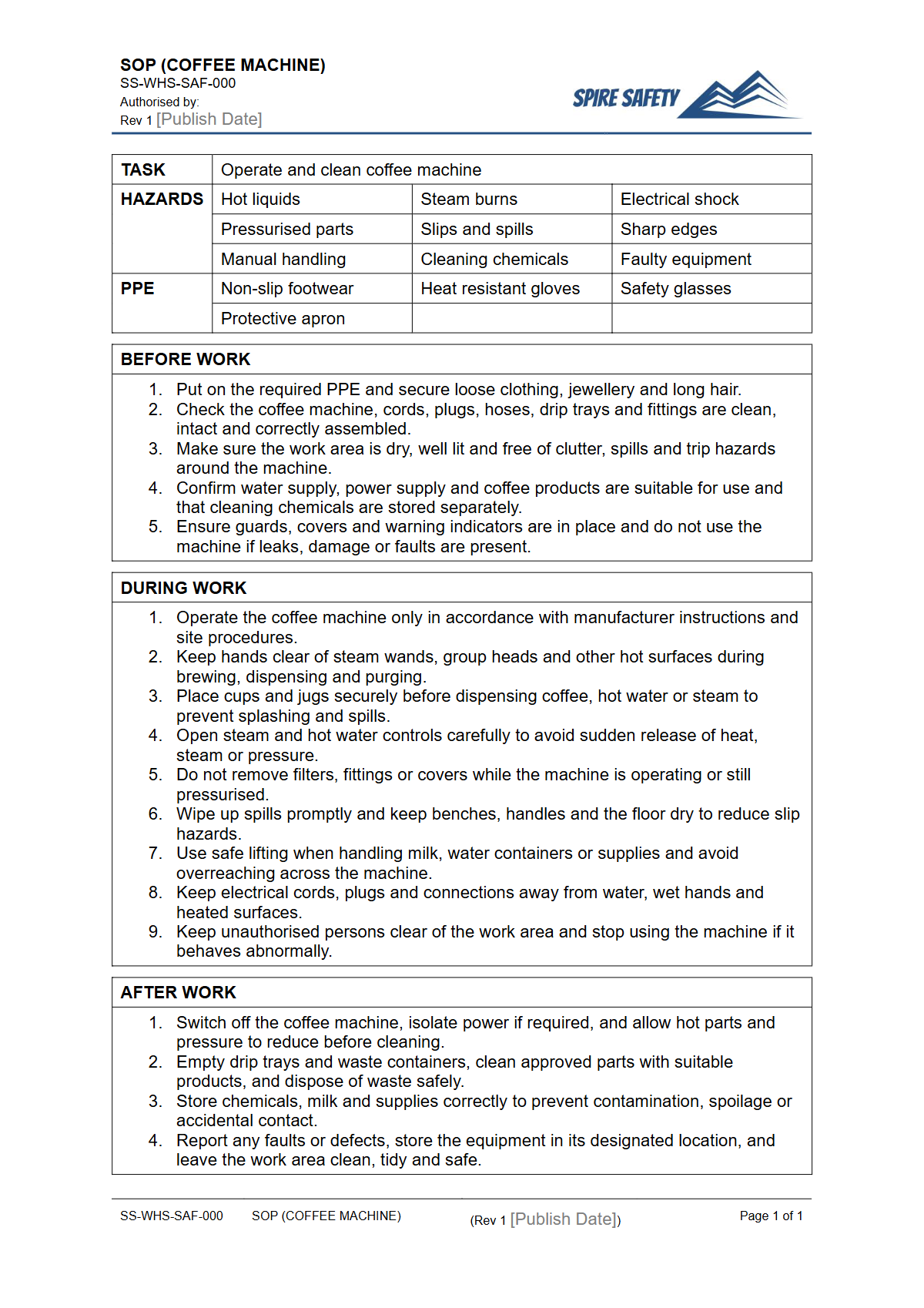
Download our free Safe Operating Procedure (Coffee Machine) Template to manage risks like burns, electrical hazards, and slips.
Free Safe Operating Procedure (Coffee Machine) Template
DOCX • 126 KB + PDF
Updated Oct 2026
No signup required
Purpose of this Free Safe Operating Procedure (Coffee Machine) Template
Operating a commercial or office coffee machine introduces several workplace hazards that must be managed. This Free Safe Operating Procedure (Coffee Machine) Template provides a structured starting point for documenting the required safety measures.
Using this Safe Operating Procedure (SOP) helps your organisation fulfil its duty of care by establishing and communicating a safe system of work for all users. It addresses common risks associated with coffee machines, including burns from hot surfaces and steam, electric shock from faulty equipment or spills, and slips, trips, and falls from wet floors.
A well-defined SOP is a critical tool for training and consistency. It ensures that every worker, from a full-time barista to an occasional office user, understands the correct steps for pre-operational checks, safe operation, cleaning, and shutdown.
Formalising these steps helps to minimise the risk of injury, prevent equipment damage, and maintain hygiene standards. This document serves as a practical component of your overall safety framework, demonstrating a proactive approach to risk management.
Video walkthrough
How to Use this Free Safe Operating Procedure (Coffee Machine) Template
This template is designed for easy customisation to reflect the specific equipment and environment at your workplace. After downloading the DOCX file, you must conduct a risk assessment on your coffee machine and its location to identify all relevant hazards and determine appropriate control measures.
You should edit the document to include:
- The specific make and model of your coffee machine.
- Site-specific details, such as the location of emergency stop buttons and relevant first aid kits.
- Your organisation’s procedures for reporting faults or incidents.
- Required Personal Protective Equipment (PPE), such as heat-resistant gloves if applicable.
- Details of who is authorised to perform maintenance and cleaning tasks.
Important: This is a template only. It is not a complete or ready-to-use document.
We are not familiar with your specific machinery, operational context, or legal obligations. You MUST customise this document to suit your workplace.
Integrating this SOP into your broader WHS management systems ensures it is part of a cohesive and effective safety strategy, rather than a standalone document.
When to Use a Safe Operating Procedure
A Safe Operating Procedure for a coffee machine should be used as a primary training document for any new worker who will be required to operate the equipment. It serves as the basis for their initial instruction and competency assessment.
It should be readily available near the machine as a quick reference guide for all staff, reinforcing correct procedures and emergency actions.
The SOP should also be reviewed during refresher training sessions to ensure ongoing adherence to safety standards. Furthermore, it is essential to consult and revise the SOP whenever there is a change in equipment, processes, or after an incident or near-miss occurs. Just as you would for emergency equipment, having a clear and accessible procedure is vital; you can find a similar structure in our Free Safe Operating Procedure (Defibrillator Operation) Template.
Who Should Use this Template
This template is intended for Persons Conducting a Business or Undertaking (PCBUs), managers, and supervisors responsible for workplace safety in environments like cafes, restaurants, hotels, and offices. They can use it to draft a site-specific SOP that forms a key part of their safety management system.
Direct users of the final, customised SOP include:
- Baristas and kitchen staff: Who use the machine frequently as part of their core duties.
- Office workers: Who may use the machine intermittently and require clear, simple instructions.
- Cleaning and maintenance staff: Who need to follow specific steps for safely cleaning and servicing the unit.
Developing robust SOPs for all common workplace equipment is a cornerstone of good safety practice. For instance, even seemingly simple items require formal procedures, as shown in our FREE Step Ladder SOP (Safe Operating Procedure) Template. If you need assistance developing or implementing these documents across your business, our WHS consulting team can provide expert guidance.
You can also explore our complete free WHS resources library for other useful templates.
Common mistakes
Common mistakes to avoid
- Using the template as-is without customising it for the specific machine model and workplace.
- Failing to train all users, including casual, temporary, or office staff who may use the machine infrequently.
- Neglecting the cleaning, descaling, and maintenance schedules detailed in the SOP and manufacturer's guide.
- Not making the SOP easily accessible to workers at the point of use.
Legal references
Legal considerations
The following legal requirements may be relevant to this type of work.
- Work Health and Safety Act (Harmonised) — Provides the primary duties for protecting workers and other people from work health and safety risks.
- Work Health and Safety Regulations (Harmonised) — Sets out requirements supporting the management of workplace hazards and risks.
The following codes may be relevant to this type of work.
- Managing WHS Risks Code of Practice — Provides practical guidance on identifying hazards, assessing risks and applying effective controls.
- Work Health and Safety Consultation, Cooperation and Coordination Code of Practice — Provides practical guidance on consulting workers and coordinating with other duty holders.
- Managing the Work Environment and Facilities Code of Practice — Provides practical guidance on safe work environments, workplace facilities and related controls.
Did you know
Burn Severity
Hot liquids are a leading cause of burns in the hospitality industry. Water at 70°C can cause a third-degree burn in less than one second of contact with skin, highlighting the importance of careful handling around coffee machines.
Electrical Risk
A faulty appliance combined with a wet environment significantly increases the risk of a severe electric shock. Regular testing and tagging of electrical equipment, as outlined in an SOP, is a critical control measure.
FAQ
Frequently asked questions
01What are the main hazards of using a commercial coffee machine?
02Is a Safe Operating Procedure legally required for a coffee machine in Australia?
03Who is responsible for training workers on the coffee machine SOP?
04How often should a coffee machine SOP be reviewed?
Share this resource
Free Safe Operating Procedure (Coffee Machine) Template
Browse Categories
How To Use It
- 1Download and open in Word or PDF.
- 2Replace the placeholders with your business details.
- 3Get it reviewed by a WHS specialist before rollout.
Need it customised?
Our WHS consultants can adapt this template to your site, run a gap analysis, or audit what you already have in place.
Book a Free Consultation WHS consulting servicesor call 1300 156 382
Related templates
- Free Safe Operating Procedure (Coil Car) Template
- Free Safe Operating Procedure (Coil Condenser Cleaning) Template
- Free Safe Operating Procedure (Coil Grab) Template
- Free Safe Operating Procedure (Coil Lifter) Template
- Free Safe Operating Procedure (Coil Slitter) Template
- Free Safe Operating Procedure (Coil Spring Removal) Template