
Free Safe Operating Procedure (Coil Condenser Cleaning) Template
Download our free Safe Operating Procedure (Coil Condenser Cleaning) template. This DOCX & PDF resource helps document safety steps for HVAC maintenance.
Free Safe Operating Procedure (Coil Condenser Cleaning) Template
DOCX • 126 KB + PDF
Updated Oct 2026
No signup required
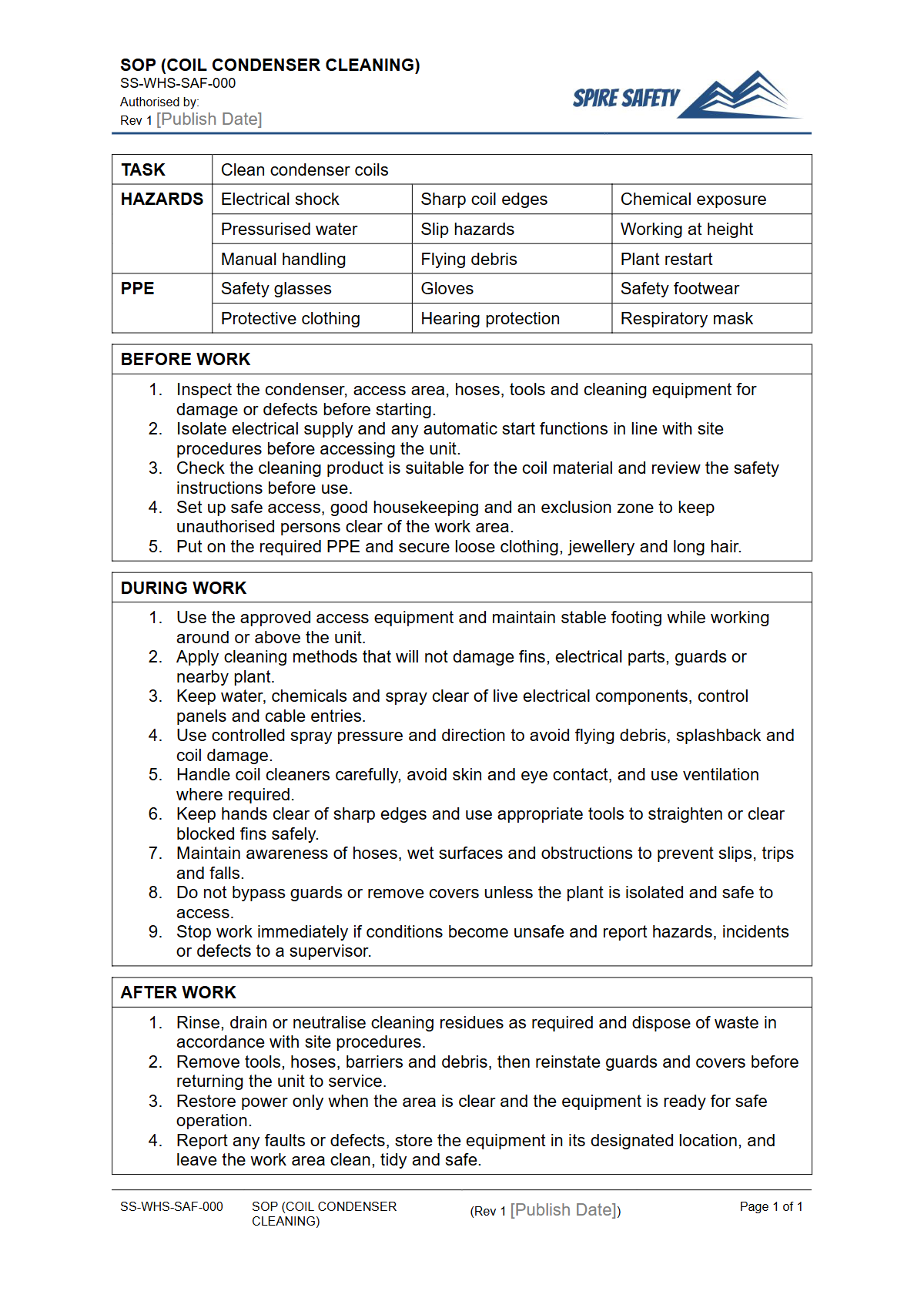
Purpose of the Free Safe Operating Procedure (Coil Condenser Cleaning) Template
Cleaning coil condensers on air conditioning and refrigeration units is a critical maintenance task that presents significant workplace health and safety risks. This Free Safe Operating Procedure (Coil Condenser Cleaning) Template provides a structured framework for documenting the required safety controls and step-by-step process.
Using a formal SOP helps organisations ensure tasks are performed consistently and safely, minimising risks such as electric shock, chemical exposure, and manual handling injuries. It is a fundamental tool for demonstrating a safe system of work, as required under Australian WHS legislation.
This procedure template outlines key safety considerations, from pre-operational checks and energy isolation to the correct use of cleaning chemicals and personal protective equipment (PPE). Formalising these steps helps reduce the likelihood of incidents and ensures that all personnel, regardless of experience level, follow a standardised, safe process.
The significant electrical hazards involved also make it prudent to ensure workers are familiar with emergency response, such as using a Safe Operating Procedure for Defibrillator Operation if the worst should occur.
Video walkthrough
How to use the Free Safe Operating Procedure (Coil Condenser Cleaning) Template
This template is available for download as a DOCX file for easy editing or a PDF for immediate use. It is designed as a starting point and must be customised to reflect the specific equipment, chemicals, and environmental conditions at your workplace.
A generic procedure is not sufficient for compliance; a person conducting a business or undertaking (PCBU) must conduct a thorough risk assessment and adapt the document accordingly.
To implement this SOP effectively, consult with the workers who perform the task. Their direct experience is invaluable for identifying practical hazards and effective controls.
Once customised, the SOP should be integrated into your broader comprehensive WHS management systems, used for training, and made readily accessible to all relevant personnel. Remember to review and update the document regularly, especially after an incident or when processes or equipment change.
Key Sections to Customise:
- List of specific plant and equipment models used.
- Names of approved cleaning chemicals and references to their Safety Data Sheets (SDS).
- Site-specific lockout/tagout (LOTO) procedures for electrical isolation.
- Required PPE based on your risk assessment (e.g., specific glove types, eye protection).
- Emergency procedures, including contact numbers and muster points.
Note: We have provided this template as a guide based on common industry practices and the model WHS framework. You must adapt it to suit the unique circumstances of your business and worksite.
When to Use This SOP
A Safe Operating Procedure for coil condenser cleaning should be used every time the task is performed. It serves as a practical checklist for technicians before and during the work.
It is also an essential document for several other purposes, including the induction and training of new employees, refresher training for existing staff, and as evidence of safety processes during WHS compliance auditing. Having a documented SOP ensures that safety standards do not slip over time and that all work is conducted to the same high standard.
Who Should Use This Procedure
This SOP is intended for use by all personnel involved in the maintenance of HVAC and refrigeration systems. This includes qualified HVAC technicians, maintenance workers, apprentices, and any supervisors overseeing the work.
Facility managers and PCBUs should also use the document to understand their responsibilities and ensure the correct safety systems are in place. For related machinery, a specific SOP like our free Air Compressor SOP should also be developed and implemented.
The procedure clarifies responsibilities and ensures that everyone, from the operator to the manager, understands the risks and the controls required to manage them safely. If the work involves accessing coils at height, additional procedures for elevated work platforms or ladders will be necessary.
You can use our free Step Ladder SOP as a starting point for those tasks. For complex scenarios or help with implementing robust safety documentation, engaging WHS consulting services can provide expert guidance.
You can also explore our complete free WHS resources library for other useful templates.
Common mistakes
Common mistakes to avoid
- Using the template 'as-is' without conducting a site-specific risk assessment first.
- Failing to properly train workers on the finalised SOP and verify their understanding.
- Neglecting to perform a full lockout/tagout (LOTO) procedure to isolate electrical energy before work begins.
- Using cleaning chemicals without first reviewing the Safety Data Sheet (SDS) for PPE and first aid requirements.
Legal references
Legal considerations
The following legal requirements may be relevant to this type of work.
- Work Health and Safety Act (Harmonised) — Provides the primary duties for protecting workers and other people from work health and safety risks.
- Work Health and Safety Regulations (Harmonised) — Sets out requirements supporting the management of workplace hazards and risks.
The following codes may be relevant to this type of work.
- Managing WHS Risks Code of Practice — Provides practical guidance on identifying hazards, assessing risks and applying effective controls.
- Work Health and Safety Consultation, Cooperation and Coordination Code of Practice — Provides practical guidance on consulting workers and coordinating with other duty holders.
- Managing the Work Environment and Facilities Code of Practice — Provides practical guidance on safe work environments, workplace facilities and related controls.
Did you know
Energy Hog
A dirty condenser coil can increase an air conditioning unit's energy consumption by 30% or more, significantly raising operating costs and carbon footprint.
Legal Duty
Under Australian model WHS laws, providing and maintaining a safe system of work is a primary duty of care for a PCBU. Documented SOPs are a key method for fulfilling this obligation.
FAQ
Frequently asked questions
01What are the main hazards in coil condenser cleaning?
02Is this SOP template enough for WHS compliance?
03Who is responsible for creating and implementing an SOP?
04How often should a Safe Operating Procedure be reviewed?
Share this resource
Free Safe Operating Procedure (Coil Condenser Cleaning) Template
Browse Categories
How To Use It
- 1Download and open in Word or PDF.
- 2Replace the placeholders with your business details.
- 3Get it reviewed by a WHS specialist before rollout.
Need it customised?
Our WHS consultants can adapt this template to your site, run a gap analysis, or audit what you already have in place.
Book a Free Consultation WHS consulting servicesor call 1300 156 382
Related templates
- Free Safe Operating Procedure (Coil Grab) Template
- Free Safe Operating Procedure (Coil Lifter) Template
- Free Safe Operating Procedure (Coil Slitter) Template
- Free Safe Operating Procedure (Coil Spring Removal) Template
- Free Safe Operating Procedure (Coil Upender) Template
- Free Safe Operating Procedure (Coil Winder) Template