
Free Safe Operating Procedure (Coil Car) Template
Download our free Safe Operating Procedure (Coil Car) template. This customisable DOCX & PDF resource helps document safe work systems for coil car operations.
Free Safe Operating Procedure (Coil Car) Template
DOCX • 126 KB + PDF
Updated Oct 2026
No signup required
Purpose of the Free Safe Operating Procedure (Coil Car) Template
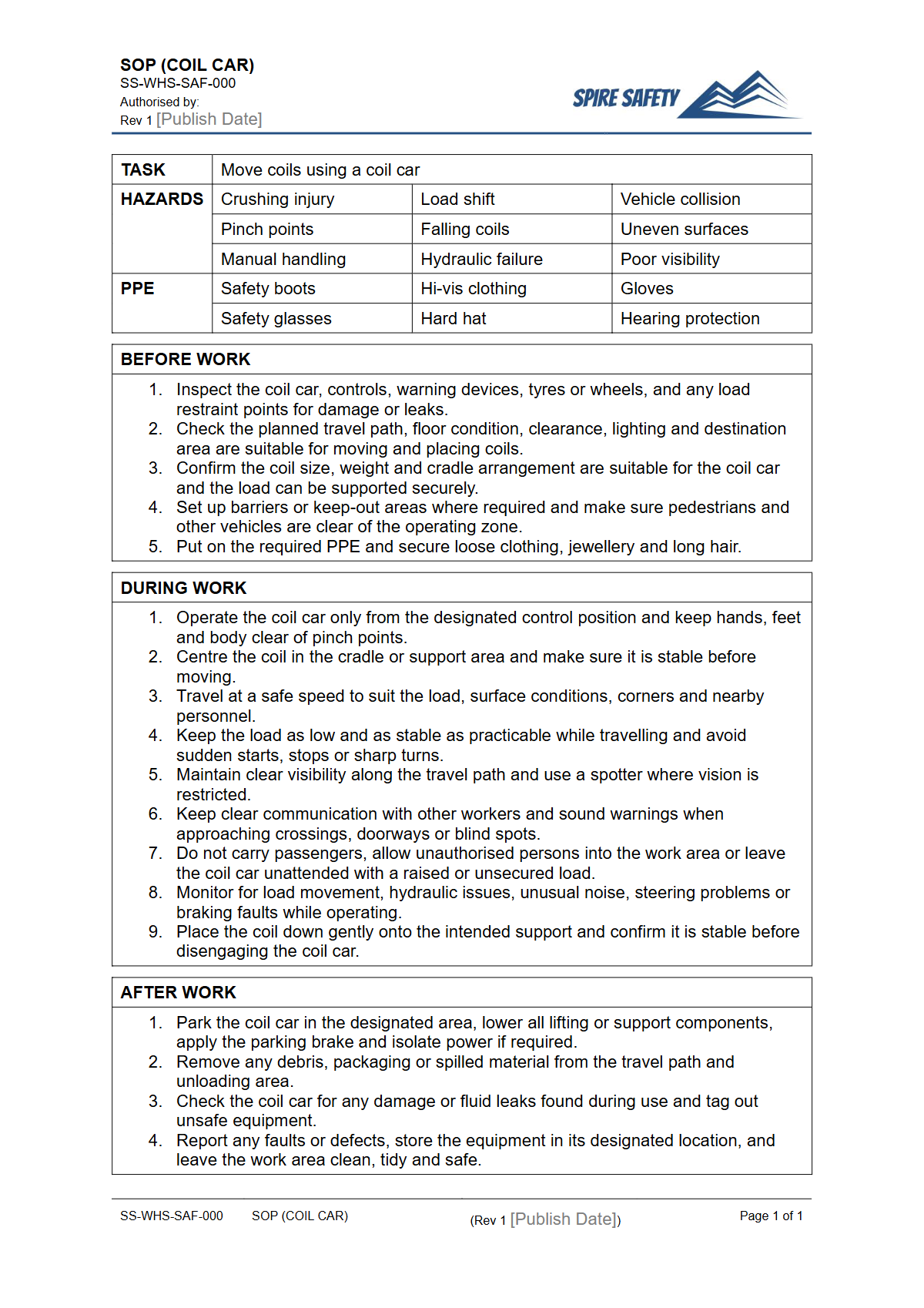
This Free Safe Operating Procedure (Coil Car) Template provides a structured framework for documenting the safe use of coil cars in your workplace. Coil cars are specialised pieces of plant used to lift, transport, and position heavy steel coils, typically for feeding them into processing lines like slitters or presses.
The operation involves significant hazards, including crushing, pinch points, shearing, and risks associated with the massive stored energy in the coils themselves.
Using a formal SOP helps your organisation meet its duties under WHS legislation to provide and maintain safe systems of work. It establishes a clear, repeatable, and authorised method for performing the task, reducing the risk of incidents caused by procedural errors or operator uncertainty.
This document serves as a practical tool for hazard management, similar in function to our Brake Press Safe Operating Procedure, by outlining risk controls for a specific piece of high-risk machinery.
Video walkthrough
How to use the Free Safe Operating Procedure (Coil Car) Template
This document is a starting point designed for customisation. After downloading the DOCX or PDF file, you must adapt it to the specific context of your workplace.
Consult with coil car operators, supervisors, and maintenance personnel to ensure the final procedure is accurate, practical, and effective.
IMPORTANT: This is a template only. To be effective, you MUST customise this document to reflect the specific coil car models, attachments, workplace layout, types of coils handled, and existing operational procedures at your site.
We are not liable for any incidents arising from the use of this un-customised template.
A single procedure is most effective when it is integrated into your overall safety framework. For a holistic approach to risk management, these documents should be part of comprehensive WHS management systems that govern all aspects of workplace safety.
What this Safe Operating Procedure Covers
Our template provides a logical structure to guide you in documenting the necessary safety information. Key sections included are:
- Associated Hazards & Risk Controls: A section to list potential dangers (e.g., unexpected movement, hydraulic failure, load instability) and the control measures to mitigate them.
- Required Personal Protective Equipment (PPE): Specifies the necessary PPE, such as high-visibility clothing, steel-capped boots, hard hats, and gloves.
- Pre-Operational Checks: A checklist of inspections to be performed before each use, covering hydraulic systems, controls, structural integrity, and the immediate work area.
- Step-by-Step Operating Sequence: A clear, sequential guide for safely loading, transporting, lifting, and unloading a coil.
- Shutdown and Emergency Procedures: Instructions for normal shutdown, emergency stops, and basic lockout/tagout (LOTO) requirements for maintenance.
Standardising these steps across all operators is crucial for safety in an environment that may also involve other equipment, such as that covered in a Telehandler SOP.
When to use a Coil Car SOP
A finalised Safe Operating Procedure for a coil car should be used consistently throughout your operations. Key applications include:
- Training and Induction: As a core training document for new operators and a refresher for existing ones.
- Competency Verification: To assess an operator's understanding and ability to follow safe work methods.
- Pre-Start or Toolbox Talks: As a reference document for discussing specific hazards before starting a shift.
- Incident Investigation: As a baseline to determine if procedural deviations contributed to an incident or near miss.
It also provides a clear standard for supervisors to use when monitoring work practices, ensuring consistency alongside other procedural documents like a plasma cutter SOP.
Who should use this Safe Operating Procedure
This template is intended for use by several key roles within an organisation:
- WHS Managers and Advisors: To develop and standardise safety documentation aligned with Australian WHS principles.
- Supervisors and Team Leaders: To implement the procedure, train their teams, and monitor compliance on the workshop floor.
- Operators: As the end-users who must be trained on, and adhere to, the final site-specific SOP to perform their tasks safely.
- Maintenance Personnel: To understand the correct procedures for isolating and de-energising the coil car before conducting maintenance or repairs.
Beyond the Template: Ongoing Safety
An SOP is a dynamic document, not a static one. To remain effective, it must be reviewed and updated regularly.
A review should be triggered annually, after any incident or near miss involving the coil car, when the equipment is modified, or when the process changes. This continuous improvement cycle is vital for maintaining a safe workplace.
Verifying that the documented procedures are actually being followed is equally important, often achieved through regular WHS compliance auditing and workplace observations.
This template is an excellent starting point for formalising your coil car operating procedures and strengthening your safety management system. For more procedural guides and checklists, browse our complete free WHS resources library.
Common mistakes
Common mistakes to avoid
- Failing to customise the template for specific site conditions and coil car models.
- Neglecting to involve experienced operators during the drafting and review process.
- Not providing adequate training on the finalised, site-specific SOP.
- Treating the SOP as a substitute for a comprehensive risk assessment of the task.
Legal references
Legal considerations
The following legal requirements may be relevant to this type of work.
- Work Health and Safety Act (Harmonised) — Provides the primary duties for protecting workers and other people from work health and safety risks.
- Work Health and Safety Regulations (Harmonised) — Sets out requirements supporting the management of workplace hazards and risks.
The following codes may be relevant to this type of work.
- Managing WHS Risks Code of Practice — Provides practical guidance on identifying hazards, assessing risks and applying effective controls.
- Work Health and Safety Consultation, Cooperation and Coordination Code of Practice — Provides practical guidance on consulting workers and coordinating with other duty holders.
- Managing the Work Environment and Facilities Code of Practice — Provides practical guidance on safe work environments, workplace facilities and related controls.
Did you know
Incredible Weight
The steel coils handled by coil cars are incredibly heavy, commonly weighing between 10 and 30 tonnes. This immense weight makes controlled handling and preventative maintenance critical to avoiding catastrophic equipment failure or load drops.
FAQ
Frequently asked questions
01What is a coil car and why does it need an SOP?
02Is this free coil car SOP template ready to use immediately?
03Who is responsible for implementing a Safe Operating Procedure for a coil car?
04How often should an SOP for a coil car be reviewed?
Share this resource
Free Safe Operating Procedure (Coil Car) Template
Browse Categories
How To Use It
- 1Download and open in Word or PDF.
- 2Replace the placeholders with your business details.
- 3Get it reviewed by a WHS specialist before rollout.
Need it customised?
Our WHS consultants can adapt this template to your site, run a gap analysis, or audit what you already have in place.
Book a Free Consultation WHS consulting servicesor call 1300 156 382
Related templates
- Free Safe Operating Procedure (Coil Condenser Cleaning) Template
- Free Safe Operating Procedure (Coil Grab) Template
- Free Safe Operating Procedure (Coil Lifter) Template
- Free Safe Operating Procedure (Coil Slitter) Template
- Free Safe Operating Procedure (Coil Spring Removal) Template
- Free Safe Operating Procedure (Coil Upender) Template