
Free Safe Operating Procedure (Coach Interior Cleaning) Template
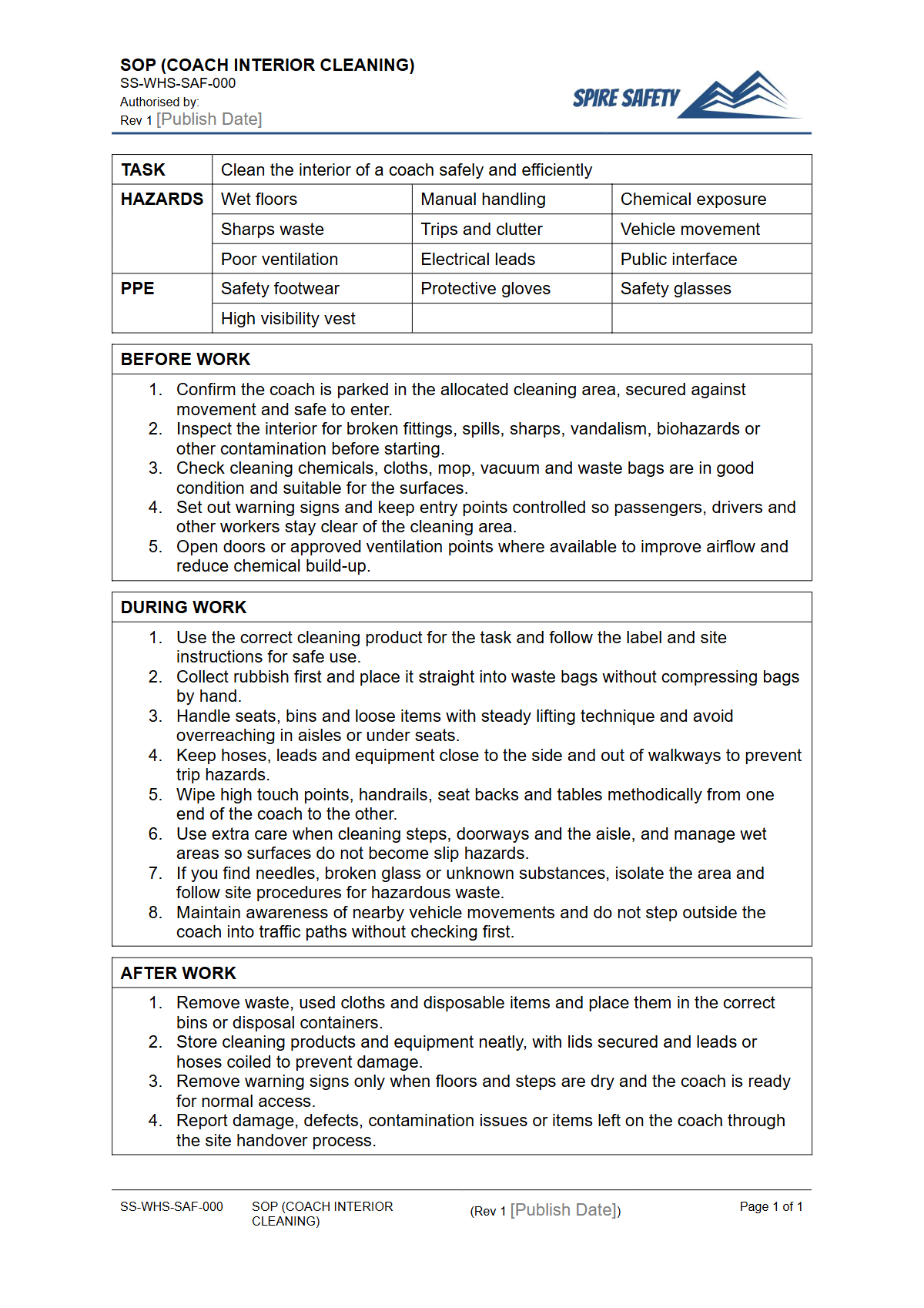
Download our free Safe Operating Procedure (Coach Interior Cleaning) Template. This customisable DOCX & PDF helps you document safe work practices.
Free Safe Operating Procedure (Coach Interior Cleaning) Template
DOCX • 126 KB + PDF
Updated Oct 2026
No signup required
Purpose of the Free Safe Operating Procedure (Coach Interior Cleaning) Template
This Free Safe Operating Procedure (Coach Interior Cleaning) Template provides a structured framework for documenting the risks and controls associated with cleaning the interior of buses and coaches. A Safe Operating Procedure (SOP) is a critical administrative control that outlines a step-by-step process for performing a task safely.
Using this template helps organisations in the transport and tourism sectors establish and communicate safe work methods, manage WHS risks, and provide clear instructions to workers.
Properly implemented, an SOP for coach cleaning addresses hazards such as chemical exposure from cleaning agents, musculoskeletal injuries from manual tasks, and slips, trips, and falls. It forms a key part of your safety management system, demonstrating a commitment to worker health and safety.
Developing a robust safety framework involves more than just individual procedures; it requires a comprehensive WHS management system to integrate all safety documentation and practices effectively.
Video walkthrough
How to use the Free Safe Operating Procedure (Coach Interior Cleaning) Template
This template is provided in both DOCX and PDF formats for your convenience. The DOCX version is fully editable, allowing you to tailor the content to the specific environment, chemicals, equipment, and processes used in your organisation.
It is essential that you customise this document to reflect your unique operational risks and control measures. A generic procedure is not sufficient for demonstrating compliance or ensuring worker safety.
Important: We have provided a solid foundation, but you must consult with your workers who perform the cleaning tasks. Their direct input is invaluable for creating a practical and effective procedure that accurately reflects how the work is done.
You should also reference the Safety Data Sheets (SDS) for all cleaning chemicals used to ensure appropriate personal protective equipment (PPE) and handling instructions are included. After customisation, the SOP should be used for training and regular reinforcement of safe work practices.
When to use it
A Safe Operating Procedure for coach interior cleaning should be developed and implemented before any workers are assigned the task. It should be readily available at the location where the work is performed, either in digital or physical format.
This SOP is a living document and should be reviewed and updated whenever there are changes to the task, such as the introduction of new cleaning agents, new equipment (e.g., vacuum cleaners, steam cleaners), or after an incident or near-miss occurs.
It is also a vital tool for worker induction and training. New employees must be trained on the contents of the SOP before commencing work.
Regular toolbox talks can also reference the SOP to refresh knowledge and reinforce key safety behaviours. For tasks that require reaching higher areas, such as cleaning ceiling panels or high windows, it's crucial to also have a Safe Operating Procedure for step ladder use.
Who should use it
This SOP should be used by all personnel involved in the cleaning of coach interiors, including full-time cleaners, drivers who perform cleaning duties, and maintenance staff. Supervisors and managers are responsible for ensuring the SOP is implemented correctly, that workers are trained in its use, and that the specified control measures are in place and functional.
Health and Safety Representatives (HSRs) can also use the document as a reference during workplace inspections and consultations.
Effectively managing WHS goes beyond a single procedure. If you need expert guidance to adapt this template or evaluate your overall safety framework, our specialist WHS consulting services can provide targeted support.
Regular reviews of your procedures are essential, and this process can be formalised through a WHS compliance audit to ensure ongoing effectiveness.
In the event of a medical emergency, such as a severe allergic reaction to cleaning chemicals or an injury, having clear instructions for first aid is critical. This reinforces the need for procedures covering potential emergencies, like our defibrillator operation SOP. This coach cleaning SOP is one of many templates available in our free WHS resources library to help you build a safer workplace.
Common mistakes
Common mistakes to avoid
- Using incorrect or improperly diluted cleaning chemicals, increasing risk.
- Failing to ensure adequate ventilation when using volatile substances.
- Not allowing surfaces to dry completely before the vehicle returns to service, creating slip hazards.
- Neglecting to consult with cleaning staff when drafting or reviewing the procedure.
Legal references
Legal considerations
The following legal requirements may be relevant to this type of work.
- Work Health and Safety Act (Harmonised) — Provides the primary duties for protecting workers and other people from work health and safety risks.
- Work Health and Safety Regulations (Harmonised) — Sets out requirements supporting the management of workplace hazards and risks.
The following codes may be relevant to this type of work.
- Managing WHS Risks Code of Practice — Provides practical guidance on identifying hazards, assessing risks and applying effective controls.
- Work Health and Safety Consultation, Cooperation and Coordination Code of Practice — Provides practical guidance on consulting workers and coordinating with other duty holders.
- Managing the Work Environment and Facilities Code of Practice — Provides practical guidance on safe work environments, workplace facilities and related controls.
Did you know
Chemical Safety Data
Under Australian WHS Regulations, suppliers must provide a Safety Data Sheet (SDS) for any hazardous chemical. The SDS is a critical document for completing your risk assessment and SOP.
Slips, Trips, and Falls
Slips, trips, and falls are a leading cause of workplace injuries in Australia. Good housekeeping procedures during and after cleaning are vital to prevent wet or cluttered surfaces from causing an incident.
FAQ
Frequently asked questions
01What key hazards should be included in a coach interior cleaning SOP?
02Does this SOP template cover specific COVID-19 or infectious disease cleaning protocols?
03Who is legally responsible for creating a Safe Operating Procedure?
04How often should an SOP for coach cleaning be reviewed?
Share this resource
Free Safe Operating Procedure (Coach Interior Cleaning) Template
Browse Categories
How To Use It
- 1Download and open in Word or PDF.
- 2Replace the placeholders with your business details.
- 3Get it reviewed by a WHS specialist before rollout.
Need it customised?
Our WHS consultants can adapt this template to your site, run a gap analysis, or audit what you already have in place.
Book a Free Consultation WHS consulting servicesor call 1300 156 382
Related templates
- Free Safe Operating Procedure (Coach Luggage Loading) Template
- Free Safe Operating Procedure (Coating Thickness Gauge) Template
- Free Safe Operating Procedure (Cobot Operation) Template
- Free Safe Operating Procedure (Coffee Grinder) Template
- Free Safe Operating Procedure (Coffee Machine) Template
- Free Safe Operating Procedure (Coil Car) Template