
Free Safe Operating Procedure (Coach Luggage Loading) Template
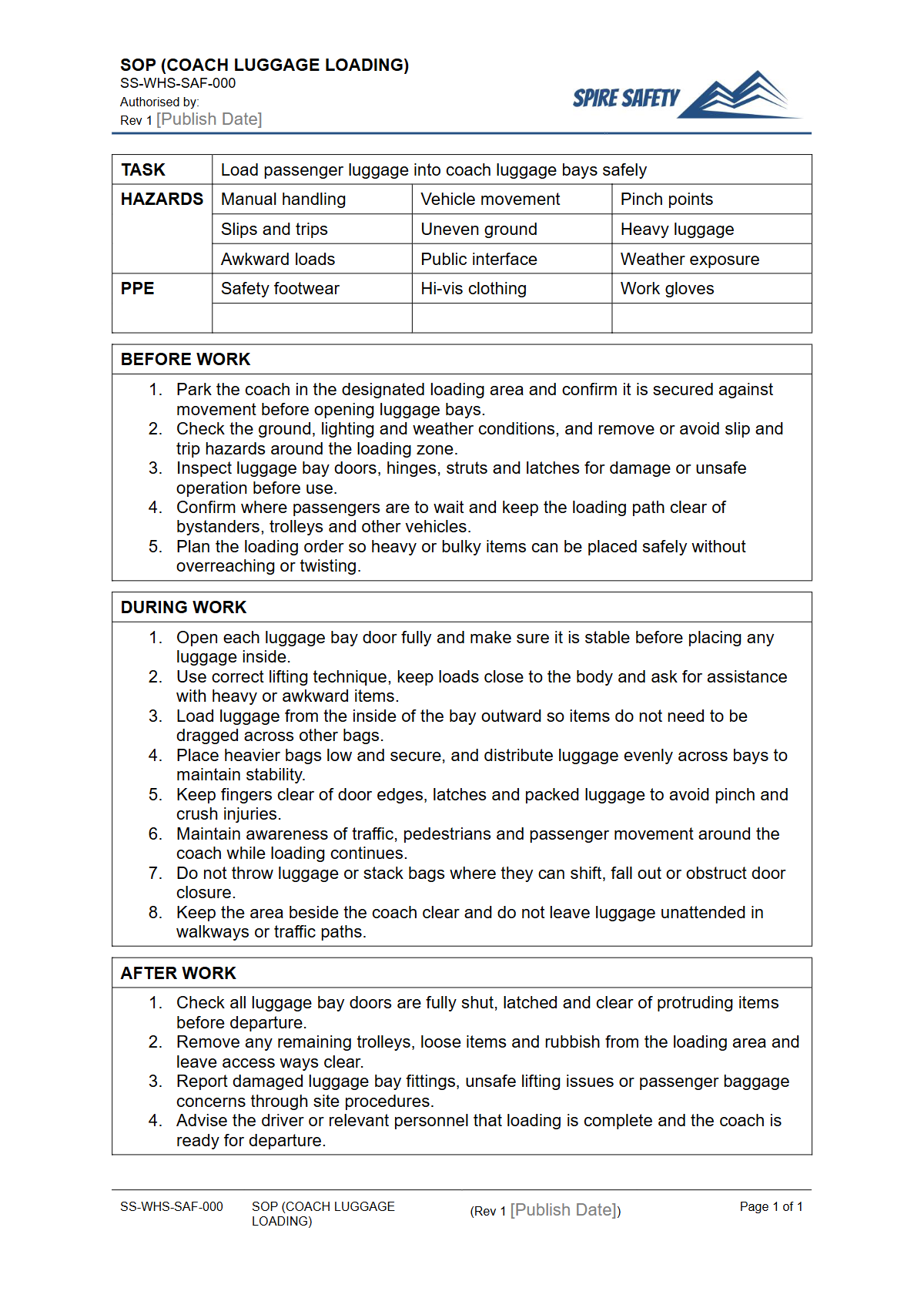
Download our free Safe Operating Procedure for coach luggage loading. This DOCX & PDF template helps manage manual handling risks.
Free Safe Operating Procedure (Coach Luggage Loading) Template
DOCX • 126 KB + PDF
Updated Oct 2026
No signup required
Purpose of the Free Safe Operating Procedure (Coach Luggage Loading) Template
Loading and unloading luggage from a coach is a repetitive task with significant risks, primarily related to hazardous manual tasks. This Free Safe Operating Procedure (Coach Luggage Loading) Template provides a structured framework for documenting the safest way to perform this job.
It helps organisations meet their duty of care by outlining key steps, potential hazards, and the control measures required to prevent musculoskeletal injuries, sprains, and strains. Implementing a clear Safe Operating Procedure (SOP) is a fundamental part of a proactive approach to workplace health and safety, ensuring all workers follow a consistent, risk-assessed method.
A well-defined SOP serves as a critical training tool for new and existing employees, clarifying expectations for safe work behaviour. It formally documents the sequence of actions required to handle passenger luggage correctly, from initial assessment of the load to final placement in the storage compartment.
This process helps minimise the risk of injury and demonstrates a commitment to a safe system of work. Integrating specific SOPs like this one is a cornerstone of effective WHS management systems, providing practical guidance at the operational level.
Video walkthrough
How to use the Free Safe Operating Procedure (Coach Luggage Loading) Template
This template is provided in both DOCX and PDF formats for your convenience. The DOCX file is fully editable, allowing you to adapt it to the unique circumstances of your operation.
It is essential to customise this document before use. It is not a complete, out-of-the-box solution; safety procedures must be specific to the equipment, environment, and personnel involved.
Customising Your Safe Operating Procedure
To effectively adapt this template, you should:
- Conduct a site-specific risk assessment: Identify all potential hazards associated with luggage loading at your locations, considering different coach models, storage layouts, lighting, and ground surfaces.
- Consult with your workers: Involve coach drivers, ground crew, and any other personnel who perform the task. Their firsthand experience is invaluable for identifying practical risks and effective control measures.
- Insert specific details: Add information about your company's policies, including specific weight limits for single items, procedures for handling oversized or fragile baggage, and emergency contact details.
- Review and approve: Once customised, the SOP should be formally reviewed and approved by a competent person within your organisation before it is implemented.
By tailoring this document, you create a practical tool that reflects your actual work practices. If you require expert assistance in developing or reviewing your safety documentation, our WHS consulting team can provide tailored support.
When to use it
This Safe Operating Procedure should be the primary reference document for all personnel involved in handling coach luggage. It must be readily accessible in the workplace, whether in a printed folder on the coach or as a digital file on a company device.
It should be actively used during induction training for new employees to establish safe habits from day one. It also serves as the basis for regular refresher training and toolbox talks to reinforce correct procedures and address any emerging issues.
If tasks involve accessing high storage bays, procedures should also reference your step ladder SOP to ensure safe work at height practices are followed.
Who should use it
The primary users of this SOP are the workers who physically perform the task, including coach drivers, tour guides, and dedicated baggage handlers. They need to understand and follow the outlined steps to protect themselves and others from injury.
Additionally, supervisors and managers must use the SOP to train staff, monitor performance, and ensure procedures are being followed correctly. In the event of an incident, the SOP serves as a benchmark for investigating what went wrong.
Documenting procedures for all hazardous tasks, from manual handling to equipment use like in a Circular Saw SOP (Safe Operating Procedure) Template, is crucial for a comprehensive safety system.
Furthermore, this procedure should be integrated with your broader emergency plans. For example, a worker suffering from overexertion or a sudden medical issue while lifting requires a swift and effective response.
Having clear instructions for emergencies, including access to first aid and the use of life-saving equipment, is vital. You can support this by also implementing our Safe Operating Procedure (Defibrillator Operation) template for your workplace.
This document is just one of many templates available to help you build a safer workplace. You can explore our complete free WHS resources library for more checklists, procedures, and forms.
Common mistakes
Common mistakes to avoid
- Twisting the back while lifting or lowering luggage instead of moving the feet.
- Lifting heavy or awkwardly shaped bags alone when assistance is required.
- Failing to use available mechanical aids or team lifting for very heavy items.
- Poor housekeeping, leaving trip hazards like straps or other bags in the work area.
Legal references
Legal considerations
The following legal requirements may be relevant to this type of work.
- Work Health and Safety Act (Harmonised) — Provides the primary duties for protecting workers and other people from work health and safety risks.
- Work Health and Safety Regulations (Harmonised) — Sets out requirements supporting the management of workplace hazards and risks.
The following codes may be relevant to this type of work.
- Managing WHS Risks Code of Practice — Provides practical guidance on identifying hazards, assessing risks and applying effective controls.
- Work Health and Safety Consultation, Cooperation and Coordination Code of Practice — Provides practical guidance on consulting workers and coordinating with other duty holders.
- Managing the Work Environment and Facilities Code of Practice — Provides practical guidance on safe work environments, workplace facilities and related controls.
Did you know
Manual Handling Statistics
According to Safe Work Australia, serious claims resulting from body stressing and manual handling are the most common type of workplace injury, highlighting the importance of proper procedures.
The Danger of Twisting
Twisting your spine while carrying a load can increase the pressure on your spinal discs by several times compared to lifting straight, dramatically increasing the risk of a back injury.
FAQ
Frequently asked questions
01What are the main hazards of loading coach luggage?
02What is a safe lifting technique for handling luggage?
03Is there a legal weight limit for a single piece of luggage in Australia?
04How often should a Safe Operating Procedure for luggage loading be reviewed?
Share this resource
Free Safe Operating Procedure (Coach Luggage Loading) Template
Browse Categories
How To Use It
- 1Download and open in Word or PDF.
- 2Replace the placeholders with your business details.
- 3Get it reviewed by a WHS specialist before rollout.
Need it customised?
Our WHS consultants can adapt this template to your site, run a gap analysis, or audit what you already have in place.
Book a Free Consultation WHS consulting servicesor call 1300 156 382
Related templates
- Free Safe Operating Procedure (Coating Thickness Gauge) Template
- Free Safe Operating Procedure (Cobot Operation) Template
- Free Safe Operating Procedure (Coffee Grinder) Template
- Free Safe Operating Procedure (Coffee Machine) Template
- Free Safe Operating Procedure (Coil Car) Template
- Free Safe Operating Procedure (Coil Condenser Cleaning) Template