
Free Safe Operating Procedure (Cobot Operation) Template
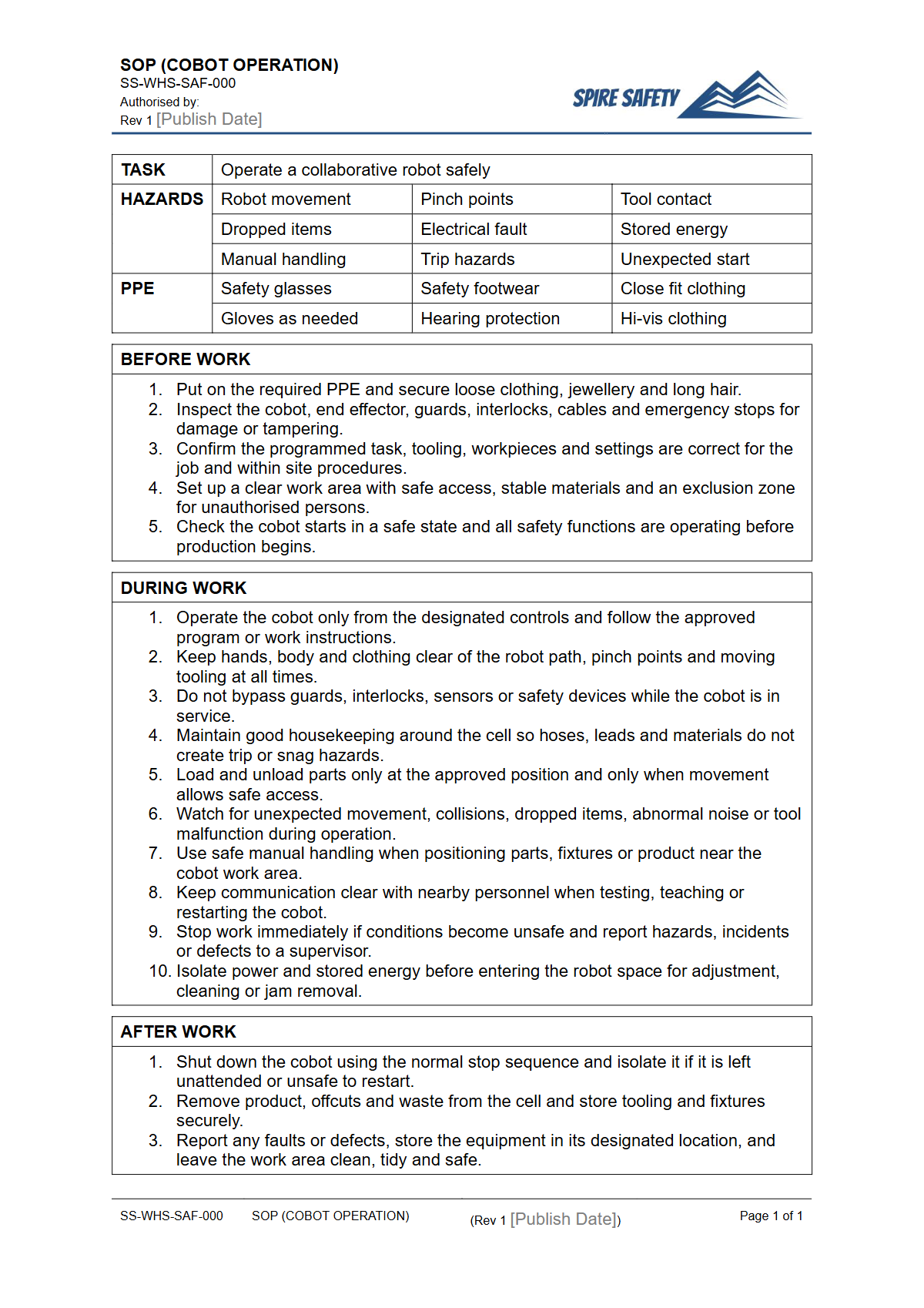
Download our free Safe Operating Procedure (Cobot Operation) template. This DOCX and PDF resource helps outline safe work steps for collaborative robots.
Free Safe Operating Procedure (Cobot Operation) Template
DOCX • 126 KB + PDF
Updated Oct 2026
No signup required
Purpose of the Free Safe Operating Procedure (Cobot Operation) Template
This Free Safe Operating Procedure (Cobot Operation) Template provides a structured framework for documenting the safe use of collaborative robots in your workplace. Cobots, while designed to work alongside humans, still introduce specific hazards that must be managed.
A documented SOP ensures that all operators follow a consistent, pre-approved process, minimising the risk of incidents and injuries. It serves as a vital tool for worker training, operational consistency, and demonstrating due diligence in managing workplace risks.
By clearly defining steps for pre-operational checks, task execution, and shutdown, this template helps formalise your safety protocols, aligning your operations with Australian WHS best practices.
A well-developed SOP is a critical component of a broader safety system. It should be informed by a thorough risk assessment of the entire robotic cell, including the robot arm, end-effector (gripper), and the workpiece itself.
Similar principles apply when documenting procedures for other automated equipment, as seen in our Safe Operating Procedure for conveyor belts, where the interaction between human and machine is paramount.
Video walkthrough
How to use the Free Safe Operating Procedure (Cobot Operation) Template
This template is provided in both DOCX and PDF formats for your convenience. The DOCX file is fully editable, allowing you to adapt the content to the specific cobot models, tasks, and environmental conditions found in your workplace.
It is crucial to methodically work through each section, consulting with operators, supervisors, and health and safety representatives to ensure the final document is practical and comprehensive. Integrating these procedures is a key function of effective WHS management systems, ensuring safety is embedded in daily operations.
Important: This is a template only. It must be customised to reflect the specific hazards and control measures relevant to your site.
We are not responsible for the outcomes of any documentation you create using this template. You must consult with your team and conduct a site-specific risk assessment before finalising and implementing the procedure.
To effectively use this template:
- Download: Select the DOCX format to begin customisation.
- Assess: Conduct a thorough risk assessment for each task the cobot will perform. Identify hazards related to impact, crushing, trapping, and unexpected movements.
- Consult: Involve the workers who will operate the cobot. Their direct experience is invaluable for creating procedures that are practical and effective.
- Customise: Add, remove, and edit sections to detail your specific pre-start checks, operational steps, emergency stops, and shutdown procedures. Include brand and model information.
- Approve: Have the final SOP reviewed and signed off by a competent person, such as a manager or WHS advisor.
- Train: Use the finalised SOP as a basis for training all relevant personnel. Ensure competency is verified before any operator works with the cobot.
When to use it
A Safe Operating Procedure for cobot operation should be developed and in place before the equipment is first used. It is a living document that should be referred to regularly and reviewed periodically.
Specific triggers for creating or reviewing the SOP include the introduction of a new cobot, a change in the task the cobot performs, modification to the robotic cell, or after an incident or near miss occurs. Regular reviews as part of your scheduled WHS compliance auditing program ensure the procedure remains current and effective against emerging risks or changes in legislation.
Who should use it
This template is designed for use by Persons Conducting a Business or Undertaking (PCBUs), managers, supervisors, and WHS professionals responsible for creating and implementing safety documentation. The final, approved Safe Operating Procedure is a critical tool for operators and maintenance staff who interact directly with the cobot.
It ensures they have clear, accessible instructions on how to perform their work safely, understand the associated risks, and know the correct response in an emergency. The principles of safe machinery operation extend to other equipment in a workshop, such as those covered in our free Brake Press SOP template.
Developing comprehensive SOPs for complex machinery can be challenging. If you require expert assistance to ensure your documentation is robust and fit-for-purpose, consider engaging specialist WHS consulting services.
You can also explore our complete free WHS resources library for other useful templates and guides.
Common mistakes
Common mistakes to avoid
- Assuming cobots are inherently safe and require no risk assessment or SOP.
- Failing to consider the hazards of the 'end-of-arm-tooling' (e.g., sharp grippers or hot weld guns).
- Neglecting to train workers on emergency stop procedures and recovery processes.
- Using a generic template without customising it for the specific tasks and workplace conditions.
Legal references
Legal considerations
The following legal requirements may be relevant to this type of work.
- Work Health and Safety Act (Harmonised) — Provides the primary duties for protecting workers and other people from work health and safety risks.
- Work Health and Safety Regulations (Harmonised) — Sets out requirements supporting the management of workplace hazards and risks.
The following codes may be relevant to this type of work.
- Managing WHS Risks Code of Practice — Provides practical guidance on identifying hazards, assessing risks and applying effective controls.
- Work Health and Safety Consultation, Cooperation and Coordination Code of Practice — Provides practical guidance on consulting workers and coordinating with other duty holders.
- Managing the Work Environment and Facilities Code of Practice — Provides practical guidance on safe work environments, workplace facilities and related controls.
Did you know
A Gentle Touch
Most cobots are designed to stop automatically if they make contact with a person with a force that is generally no more than that of a firm handshake. This force-limiting technology is a key feature that allows for safe collaboration.
Cobot vs. Robot
The global market for cobots is one of the fastest-growing segments of industrial automation, primarily because they are easier to program, more flexible, and have a lower upfront cost than traditional industrial robots.
FAQ
Frequently asked questions
01What is a cobot and how is it different from a traditional industrial robot?
02Is a Safe Operating Procedure legally required for a cobot in Australia?
03How often should a Cobot Operation SOP be reviewed?
04What should be included in the risk assessment for a cobot?
Share this resource
Free Safe Operating Procedure (Cobot Operation) Template
Browse Categories
How To Use It
- 1Download and open in Word or PDF.
- 2Replace the placeholders with your business details.
- 3Get it reviewed by a WHS specialist before rollout.
Need it customised?
Our WHS consultants can adapt this template to your site, run a gap analysis, or audit what you already have in place.
Book a Free Consultation WHS consulting servicesor call 1300 156 382
Related templates
- Free Safe Operating Procedure (Coffee Grinder) Template
- Free Safe Operating Procedure (Coffee Machine) Template
- Free Safe Operating Procedure (Coil Car) Template
- Free Safe Operating Procedure (Coil Condenser Cleaning) Template
- Free Safe Operating Procedure (Coil Grab) Template
- Free Safe Operating Procedure (Coil Lifter) Template