
Free Safe Operating Procedure (Cloth Spreader) Template
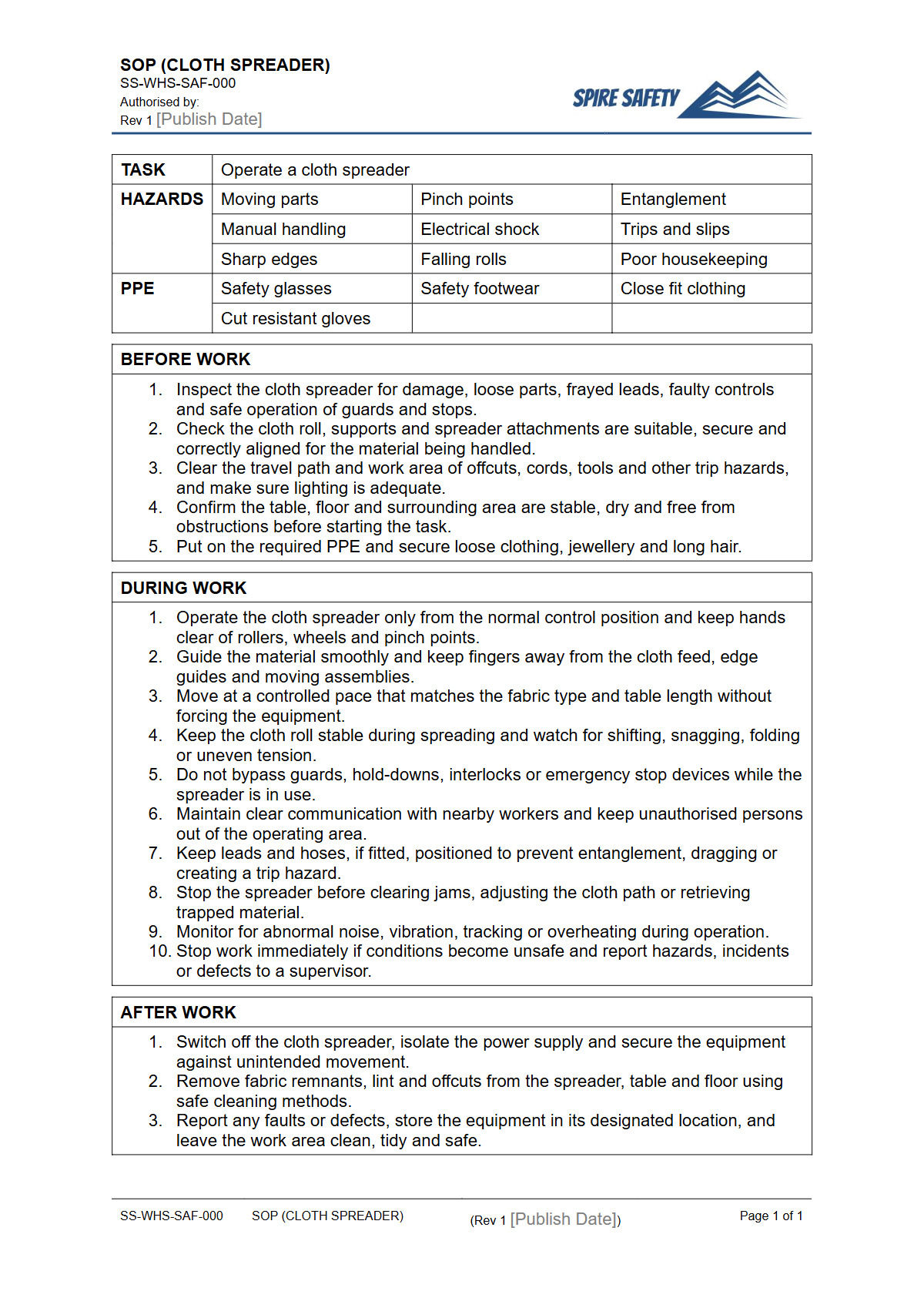
Manage risks with our free Safe Operating Procedure (Cloth Spreader) template. This DOCX & PDF helps outline safety controls for textile machinery.
Free Safe Operating Procedure (Cloth Spreader) Template
DOCX • 126 KB + PDF
Updated Oct 2026
No signup required
Purpose of the Free Safe Operating Procedure (Cloth Spreader) Template
Operating machinery like an automated or manual cloth spreader involves significant risks, including entanglement, cuts, and crushing injuries. This free Safe Operating Procedure (Cloth Spreader) Template provides a structured framework to help your organisation document a safe system of work.
A documented SOP is a fundamental tool for standardising tasks, training employees, and demonstrating your commitment to meeting health and safety obligations. It helps ensure every operator follows the same verified steps, minimising the chance of incidents and injuries.
By clearly defining pre-operational checks, step-by-step instructions, and emergency procedures, this template helps you manage hazards at the source. It serves as a foundation for consistent training and competency assessments, ensuring workers understand the risks and control measures before they use the equipment. Having clear, documented procedures is also essential for other high-risk machinery, as outlined in resources like our free Brake Press SOP.
Video walkthrough
How to use the Free Safe Operating Procedure (Cloth Spreader) Template
This document is a starting point, not a finished product. To make it effective, you must adapt it to the specific context of your workplace.
Important: We have drafted this template to be comprehensive, but you must customise it to reflect your unique operational environment. This includes adding details about your specific cloth spreader model, the types of fabric used, workplace layouts, and the control measures identified through your own risk assessment process. A generic SOP that doesn't align with your reality offers a false sense of security and fails to provide adequate protection. Integrating SOPs into your broader safety framework is key for building effective WHS management systems.
Follow these steps to implement the SOP:
- Consultation: Involve the workers who operate the cloth spreader every day. Their hands-on experience is invaluable for identifying practical hazards and effective controls that might be missed from a purely theoretical perspective.
- Customisation: Edit the DOCX file to fill in all company-specific information. Detail the make and model of your equipment, list required Personal Protective Equipment (PPE), and specify the exact shutdown and isolation procedures.
- Review and Approval: Have a competent person, such as a supervisor or WHS manager, review and approve the finalised document before it is issued. This ensures accuracy and alignment with your organisation's safety policies.
- Training: Train all operators on the contents of the new SOP. Don't just hand them the document; walk them through each step, explain the reasoning behind the safety controls, and confirm their understanding. Keep records of this training.
- Review: Schedule regular reviews of the SOP (e.g., annually, or after an incident) to ensure it remains current. Regular checks are a core part of safety assurance activities like WHS compliance auditing.
When to use a Cloth Spreader SOP
A Safe Operating Procedure for a cloth spreader should be a primary reference document used in several key situations. It is not a document to be filed away and forgotten.
Use it when inducting and training new operators to establish a strong safety foundation from day one. It should also be used for refresher training for existing staff to prevent complacency and reinforce safe work habits.
The SOP serves as a daily on-the-job reference for operators to confirm correct procedures, especially for non-routine tasks like clearing a jam or performing minor adjustments. Following an incident or near miss, the SOP is a critical tool for investigation to determine if procedural gaps contributed to the event. The principles apply to other workshop equipment, which should also have its own specific procedure, such as a circular saw SOP.
Who should use this document
This SOP is intended for multiple roles within an organisation, each with different responsibilities.
- Operators: The primary users of the SOP. They must follow the documented steps for every task to ensure their own safety and that of their colleagues.
- Supervisors and Team Leaders: Responsible for ensuring operators are trained on the SOP and adhere to it during daily work. They use it as a tool for monitoring performance and enforcing safety standards.
- WHS Managers/Advisors: Use the SOP as a key component of the overall safety management system. They oversee its development, review, and implementation, ensuring it aligns with legal requirements and organisational policy. They may seek external advice from professional WHS consulting services to validate their safety systems.
- Maintenance Personnel: Refer to the SOP for lockout/tagout and isolation procedures before conducting any maintenance, repairs, or cleaning to prevent accidental equipment activation.
By using this template, you can streamline the process of creating a vital safety document. For more templates and safety resources, explore our complete free WHS resources library.
Common mistakes
Common mistakes to avoid
- Using a generic template without customising it for the specific make and model of the cloth spreader.
- Failing to consult with the actual operators of the equipment when drafting the procedure.
- Not providing adequate training on the finalised SOP, assuming workers will just read and follow it.
- Forgetting to schedule regular reviews, leaving the SOP outdated as equipment or processes change.
Legal references
Legal considerations
The following legal requirements may be relevant to this type of work.
- Work Health and Safety Act (Harmonised) — Provides the primary duties for protecting workers and other people from work health and safety risks.
- Work Health and Safety Regulations (Harmonised) — Sets out requirements supporting the management of workplace hazards and risks.
The following codes may be relevant to this type of work.
- Managing WHS Risks Code of Practice — Provides practical guidance on identifying hazards, assessing risks and applying effective controls.
- Work Health and Safety Consultation, Cooperation and Coordination Code of Practice — Provides practical guidance on consulting workers and coordinating with other duty holders.
- Managing the Work Environment and Facilities Code of Practice — Provides practical guidance on safe work environments, workplace facilities and related controls.
Did you know
Entanglement Hazard
The moving parts of textile machinery are a leading cause of serious injuries in the manufacturing industry, primarily through entanglement of clothing, hair, or limbs.
Lockout/Tagout (LOTO)
A robust LOTO procedure is a critical component of any machinery SOP, ensuring equipment is properly de-energised before maintenance or cleaning to prevent unexpected startups.
FAQ
Frequently asked questions
01What should be included in a cloth spreader SOP?
02Is this SOP template compliant with Australian WHS law?
03How often should we review our cloth spreader SOP?
04Who is responsible for writing the Safe Operating Procedure?
Share this resource
Free Safe Operating Procedure (Cloth Spreader) Template
Browse Categories
How To Use It
- 1Download and open in Word or PDF.
- 2Replace the placeholders with your business details.
- 3Get it reviewed by a WHS specialist before rollout.
Need it customised?
Our WHS consultants can adapt this template to your site, run a gap analysis, or audit what you already have in place.
Book a Free Consultation WHS consulting servicesor call 1300 156 382
Related templates
- Free Safe Operating Procedure (Clothing Aid Cleaning) Template
- Free Safe Operating Procedure (Clothing Rack Handling) Template
- Free Safe Operating Procedure (Club Change Room Clean) Template
- Free Safe Operating Procedure (Club Equipment Cleaning) Template
- Free Safe Operating Procedure (CNG Refuelling) Template
- Free Safe Operating Procedure (Coach Interior Cleaning) Template