
Free Safe Operating Procedure (Clothing Aid Cleaning) Template
Download our free Safe Operating Procedure (Clothing Aid Cleaning) template.
Free Safe Operating Procedure (Clothing Aid Cleaning) Template
DOCX • 126 KB + PDF
Updated Oct 2026
No signup required
Purpose of the Free Safe Operating Procedure (Clothing Aid Cleaning) Template
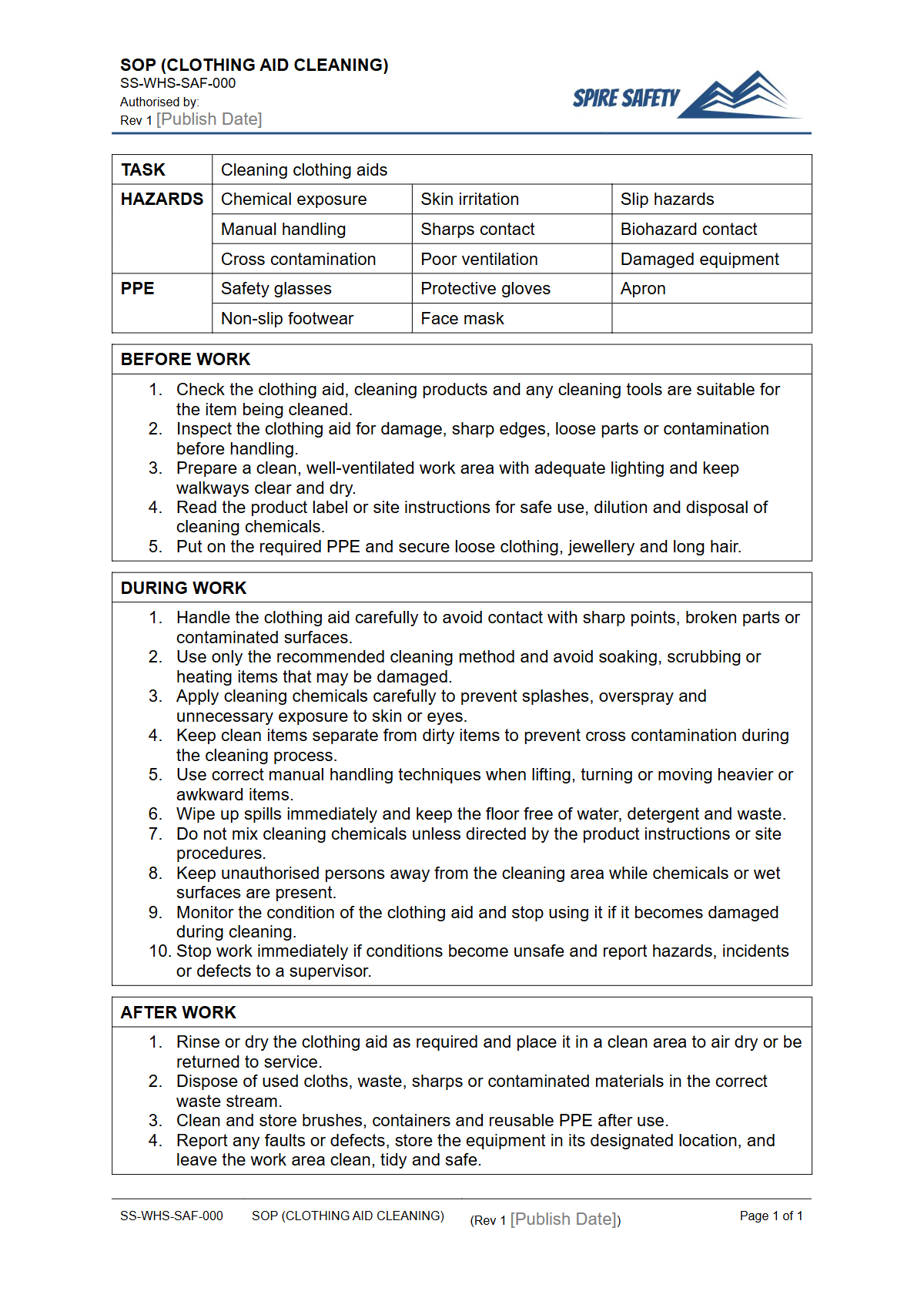
Establishing a clear, documented process for cleaning clothing aids is essential for maintaining hygiene, preventing cross-contamination, and protecting both care recipients and workers. This Free Safe Operating Procedure (Clothing Aid Cleaning) Template provides a structured framework for outlining the required steps, safety precautions, and responsibilities associated with this critical task.
Using a standardised procedure ensures consistency in cleaning standards, reduces the risk of infection, and minimises worker exposure to cleaning chemicals. A well-defined SOP is a fundamental component of a robust WHS management system, demonstrating a commitment to health and safety in environments like aged care, disability support, and healthcare.
This template helps your organisation define the sequence of actions for cleaning items such as stocking donners, button hooks, and long-handled shoe horns. It prompts you to specify the required Personal Protective Equipment (PPE), approved cleaning agents, and disposal methods for waste.
By formalising these steps, you create a reliable reference point for training, supervision, and incident investigation, ensuring the task is performed safely and effectively every time.
Video walkthrough
How to use the Free Safe Operating Procedure (Clothing Aid Cleaning) Template
This Safe Operating Procedure template is provided as a starting point in both DOCX and PDF formats. To implement it effectively, you must adapt it to the specific context of your workplace.
Start by downloading the DOCX file and reviewing its contents against your existing processes, equipment, and chemical inventory. Identify the specific types of clothing aids used at your facility and the manufacturers' recommendations for cleaning and disinfection.
You should also consider the environment where the cleaning will occur, noting access to water, ventilation, and storage for chemicals and PPE.
Important: This document must be customised to reflect your organisation's specific hazards and control measures. We have provided a comprehensive framework, but you must consult your Safety Data Sheets (SDS), conduct a risk assessment, and involve your workers to ensure the final procedure is practical and safe for your unique situation.
Just as you would detail specific checks in our Safe Operating Procedure for defibrillator operation, you must add details here about your specific cleaning agents, dilution rates, and contact times.
When to use it
A Safe Operating Procedure for cleaning clothing aids should be used as a primary training document for any worker required to perform this task. It is particularly important during the induction of new employees to establish correct habits from the outset.
The SOP should also be a central part of regular refresher training to reinforce safe work practices and communicate any updates to the procedure. Furthermore, it serves as a critical reference tool for supervisors monitoring work practices.
The SOP should be readily accessible in the cleaning area for quick consultation. It is also an essential document to review following any hygiene-related incident, near miss, or when introducing new types of clothing aids or cleaning chemicals to the workplace.
Who should use it
This SOP is designed for use by all personnel involved in the handling and cleaning of clothing aids. This includes, but is not limited to, aged care workers, disability support workers, healthcare assistants, personal carers, and dedicated cleaning or sterilisation staff.
Supervisors and managers are responsible for ensuring the SOP is implemented correctly, that workers are adequately trained, and that the procedure is reviewed and updated as required. If you are unsure how to conduct the necessary risk assessments or deliver effective training for this task, it may be beneficial to seek specialist WHS consulting to ensure your processes are sound.
Training on this SOP ensures all workers understand the risks, such as biological hazards and chemical exposure, and the control measures in place to protect them. This process is similar to ensuring competency for other workplace tasks, whether it's using simple equipment covered by a free step ladder SOP or operating more complex machinery.
The goal is to create a consistent and safe approach across your entire team.
Regularly reviewing and updating your SOPs is a key part of maintaining safety standards and demonstrating continuous improvement. For a complete overview of available documentation to support your safety management system, you can browse our extensive free WHS resources library for other templates and checklists.
Common mistakes
Common mistakes to avoid
- Using the template as-is without customising it for specific workplace chemicals, equipment, and risks.
- Failing to adequately train workers on the finalised SOP and verify their understanding.
- Not providing the correct Personal Protective Equipment (PPE) specified in the procedure.
- Using incorrect cleaning agents or dilution ratios, which can damage the aids or be ineffective for disinfection.
Legal references
Legal considerations
The following legal requirements may be relevant to this type of work.
- Work Health and Safety Act (Harmonised) — Provides the primary duties for protecting workers and other people from work health and safety risks.
- Work Health and Safety Regulations (Harmonised) — Sets out requirements supporting the management of workplace hazards and risks.
The following codes may be relevant to this type of work.
- Managing WHS Risks Code of Practice — Provides practical guidance on identifying hazards, assessing risks and applying effective controls.
- Work Health and Safety Consultation, Cooperation and Coordination Code of Practice — Provides practical guidance on consulting workers and coordinating with other duty holders.
- Managing the Work Environment and Facilities Code of Practice — Provides practical guidance on safe work environments, workplace facilities and related controls.
Did you know
Infection Control
The Australian Commission on Safety and Quality in Health Care highlights that effective cleaning and disinfection of reusable patient care equipment is a critical strategy in preventing healthcare-associated infections (HAIs).
FAQ
Frequently asked questions
01What is a clothing aid?
02Why is a specific SOP needed for cleaning clothing aids?
03Does this template list specific cleaning chemicals to use?
04How often should this Safe Operating Procedure be reviewed?
Share this resource
Free Safe Operating Procedure (Clothing Aid Cleaning) Template
Browse Categories
How To Use It
- 1Download and open in Word or PDF.
- 2Replace the placeholders with your business details.
- 3Get it reviewed by a WHS specialist before rollout.
Need it customised?
Our WHS consultants can adapt this template to your site, run a gap analysis, or audit what you already have in place.
Book a Free Consultation WHS consulting servicesor call 1300 156 382
Related templates
- Free Safe Operating Procedure (Clothing Rack Handling) Template
- Free Safe Operating Procedure (Club Change Room Clean) Template
- Free Safe Operating Procedure (Club Equipment Cleaning) Template
- Free Safe Operating Procedure (CNG Refuelling) Template
- Free Safe Operating Procedure (Coach Interior Cleaning) Template
- Free Safe Operating Procedure (Coach Luggage Loading) Template