
Free Safe Operating Procedure (Clegg Hammer) Template
Download our free Safe Operating Procedure (Clegg Hammer) Template.
Free Safe Operating Procedure (Clegg Hammer) Template
DOCX • 126 KB + PDF
Updated Oct 2026
No signup required
Purpose of the Free Safe Operating Procedure (Clegg Hammer) Template
This Free Safe Operating Procedure (Clegg Hammer) Template provides a structured foundation for documenting the safety requirements for using a Clegg Impact Soil Tester. Designed for civil construction, geotechnical engineering, and landscaping projects, this template helps organisations establish and communicate a safe system of work.
It outlines key steps from pre-start checks to operation and maintenance, forming a critical part of a comprehensive safety management system.
A Safe Operating Procedure (SOP), also known as a Safe Work Procedure (SWP), is a formal document that details the logical steps to perform a task safely. For equipment like the Clegg Hammer, an SOP helps manage risks such as manual handling strain, impact injuries, and environmental hazards.
By standardising the procedure, you ensure every worker performs the task with the same level of safety, supporting effective training and supervision. This document is a key component in demonstrating how your organisation fulfils its duty of care under Australian WHS laws and contributes to your overall WHS management systems.
Video walkthrough
How to use the Free Safe Operating Procedure (Clegg Hammer) Template
This template is provided in both DOCX and PDF formats for your convenience. To use it, simply download the file and open it in your preferred word processor.
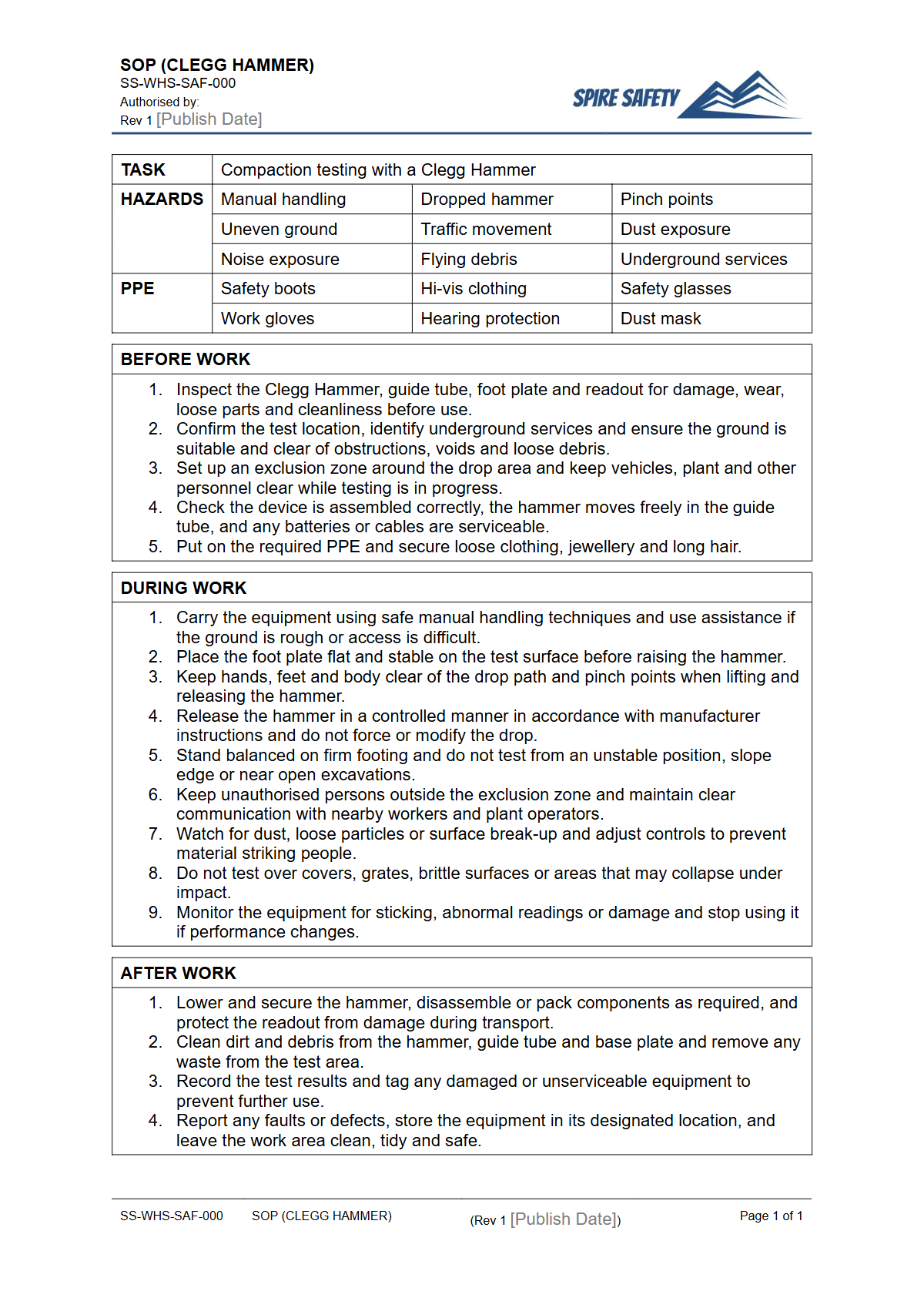
The document is structured with clear headings covering PPE, risk controls, operational steps, and emergency responses. Your task is to review and adapt each section to align with your specific operational context.
Important: This document is a template only. You must customise it to reflect the specific Clegg Hammer model you use, the unique conditions of your worksite, and your organisation's internal policies.
We are not responsible for its application; it is your responsibility to ensure the final document is fit for your purpose and has been created in consultation with your workers.
When to use it
An SOP for a Clegg Hammer is not just a document to be filed away; it is an active tool for risk management. It should be used as a primary reference for several key activities, including:
- Worker Training and Induction: Use the SOP to train new workers on the correct and safe method for operating the Clegg Hammer.
- Pre-Start Meetings and Toolbox Talks: Refer to the SOP during daily briefings to remind workers of the key hazards and controls before testing begins.
- Risk Assessment Reviews: The SOP serves as a practical output of your risk assessment, detailing the control measures you have implemented.
- Audits and Inspections: During a safety audit, this document provides clear evidence of your established procedures. Having robust documentation is vital for successful WHS compliance auditing.
- Incident Investigations: If an incident occurs, the SOP can be used to determine if procedures were followed and if they need to be updated.
Who should use it
This Safe Operating Procedure is relevant to various roles within a construction, geotechnical, or engineering environment. The primary audience includes:
- Geotechnical Technicians & Engineers: The direct operators of the equipment who must follow the procedure for every test.
- Site Supervisors & Forepersons: Those responsible for overseeing the work, ensuring workers are trained on the SOP and are following it correctly.
- WHS/OHS Advisors & Managers: Safety professionals who develop, implement, and review safety documentation as part of the wider safety system.
- Civil Construction Workers: Any worker tasked with assisting in or performing soil compaction testing.
For organisations managing a wide range of heavy equipment, it is best practice to have specific SOPs for each item. For example, the process for operating a large earthmover is fundamentally different, requiring a document like our FREE Dozer SOP Template.
What's covered in the template?
Our template provides a comprehensive starting point with clearly defined sections to guide your customisation. Key areas include:
- Required Personal Protective Equipment (PPE): Specifies PPE like steel-capped boots, gloves, and safety glasses.
- Hazard Identification & Risk Controls: A table to list potential hazards (e.g., manual handling, impact, awkward postures) and the corresponding control measures.
- Pre-Operational Checks: A checklist of steps to ensure the Clegg Hammer is in safe working order before use.
- Step-by-Step Operating Sequence: A logical flow of actions for conducting a test safely and accurately.
- Post-Operational Tasks: Instructions for cleaning, storing, and reporting any faults with the equipment.
By formalising procedures for all equipment, even simple tools, you build a stronger safety culture. This same principle applies to tasks involving working at height, which can be documented using our FREE Step Ladder SOP Template.
A well-drafted SOP is a powerful tool. It goes beyond simple instructions, acting as a training guide, a risk control measure, and a clear communication channel for your organisation’s safety expectations. For more tools to enhance your safety framework, you can browse our complete free WHS resources library.
Common mistakes
Common mistakes to avoid
- Failing to inspect the guide tube and hammer for damage or debris before use.
- Dropping the hammer from an inconsistent height, leading to inaccurate readings.
- Using the device on uneven or unsuitable surfaces like loose gravel or hard pavement.
- Neglecting to wear appropriate PPE, particularly safety glasses and steel-capped boots.
Legal references
Legal considerations
The following legal requirements may be relevant to this type of work.
- Work Health and Safety Act (Harmonised) — Provides the primary duties for protecting workers and other people from work health and safety risks.
- Work Health and Safety Regulations (Harmonised) — Sets out requirements supporting the management of workplace hazards and risks.
The following codes may be relevant to this type of work.
- Managing WHS Risks Code of Practice — Provides practical guidance on identifying hazards, assessing risks and applying effective controls.
- Work Health and Safety Consultation, Cooperation and Coordination Code of Practice — Provides practical guidance on consulting workers and coordinating with other duty holders.
- Managing the Work Environment and Facilities Code of Practice — Provides practical guidance on safe work environments, workplace facilities and related controls.
Did you know
The Clegg Impact Value
The measurement provided by a Clegg Hammer is known as the Clegg Impact Value (CIV). It is a simple and effective indicator of soil strength and bearing capacity used widely in road construction and earthworks.
SOPs and Procedural Memory
Consistently following an SOP helps build 'procedural memory' in workers. This ensures safe work practices become second nature, which is especially critical during high-pressure situations or non-routine tasks.
FAQ
Frequently asked questions
01What is a Clegg Hammer and why does it need an SOP?
02Is this template suitable for all types of soil impact testers?
03Who is responsible for customising the Clegg Hammer SOP?
04How often should a Safe Operating Procedure be reviewed?
Share this resource
Free Safe Operating Procedure (Clegg Hammer) Template
Browse Categories
How To Use It
- 1Download and open in Word or PDF.
- 2Replace the placeholders with your business details.
- 3Get it reviewed by a WHS specialist before rollout.
Need it customised?
Our WHS consultants can adapt this template to your site, run a gap analysis, or audit what you already have in place.
Book a Free Consultation WHS consulting servicesor call 1300 156 382
Related templates
- Free Safe Operating Procedure (Clinic Couch Cleaning) Template
- Free Safe Operating Procedure (Clinical Waste Handling) Template
- Free Safe Operating Procedure (Cloth Spreader) Template
- Free Safe Operating Procedure (Clothing Aid Cleaning) Template
- Free Safe Operating Procedure (Clothing Rack Handling) Template
- Free Safe Operating Procedure (Club Change Room Clean) Template