
Free Safe Operating Procedure (Circuit Breaker Test) Template
Streamline electrical safety with our free Safe Operating Procedure (Circuit Breaker Test) template. Aligned with Australian WHS standards.
Free Safe Operating Procedure (Circuit Breaker Test) Template
DOCX • 126 KB + PDF
Updated Oct 2026
No signup required
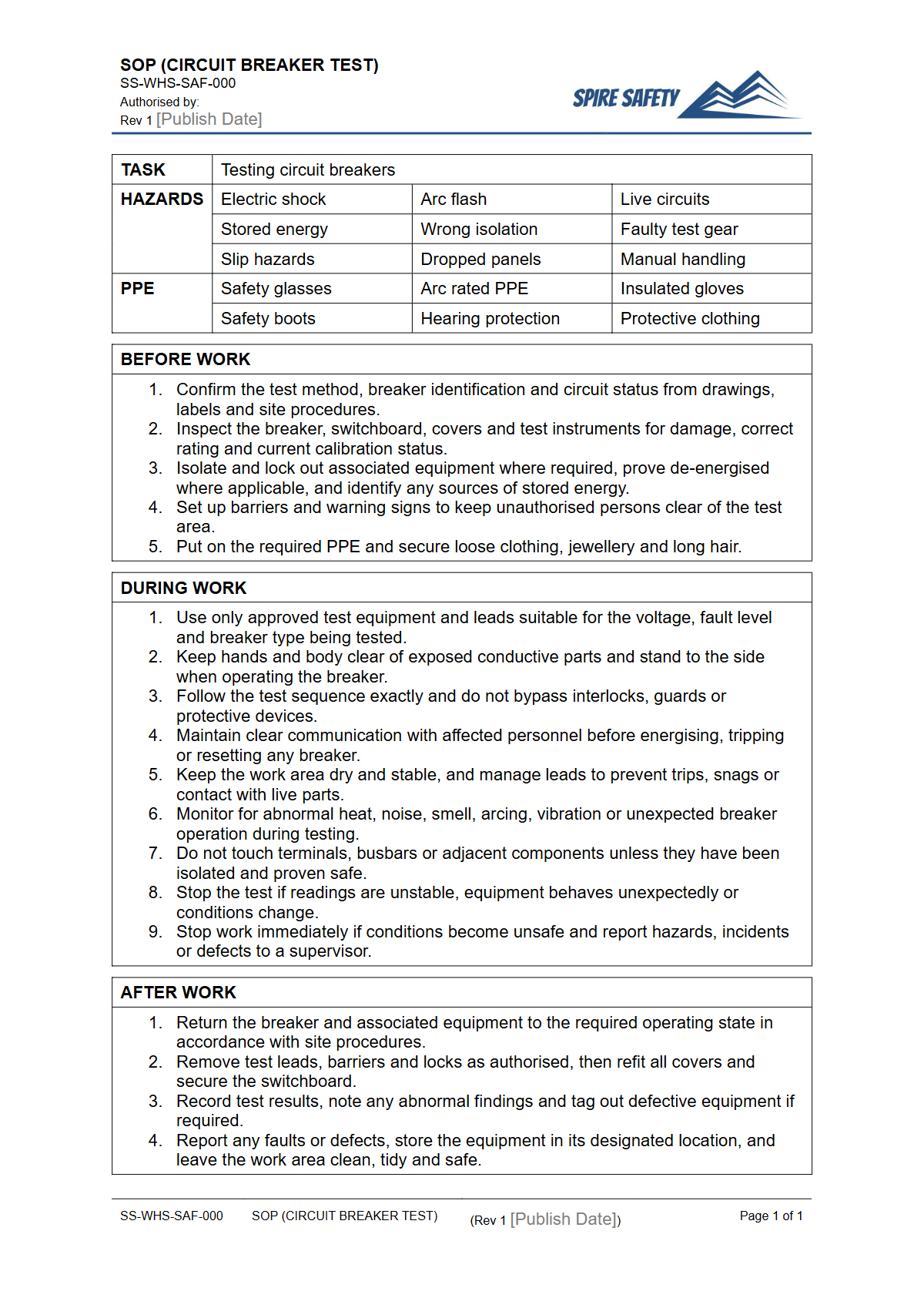
Purpose of the Free Safe Operating Procedure (Circuit Breaker Test) Template
Testing circuit breakers is a critical task for maintaining electrical safety and system integrity in any Australian workplace. A documented procedure ensures this high-risk activity is performed consistently and safely every time.
This free Safe Operating Procedure (Circuit Breaker Test) template provides a structured framework for outlining the required steps, safety controls, and responsibilities, helping to prevent electrical shock, arc flash incidents, and equipment damage. By standardising the process, organisations can effectively manage electrical hazards and demonstrate due diligence in their safety practices.
A well-drafted SOP is a fundamental building block of a proactive safety culture. It serves as a training tool for new personnel, a reference for experienced electricians, and a key document within your overall WHS management systems. Implementing clear, task-specific procedures like this one helps to minimise human error and ensures that critical safety checks, such as verifying de-energisation, are never overlooked.
This leads to a safer work environment, improved equipment reliability, and reduced operational downtime.
Video walkthrough
How to use the Free Safe Operating Procedure (Circuit Breaker Test) Template
This document is designed as a starting point. Once downloaded, you must systematically work through each section and adapt the content to your specific operational context.
This involves identifying the makes and models of circuit breakers in use, the specific test equipment required, and the unique environmental factors of your site. It is crucial to conduct a risk assessment for the task in your environment before finalising the procedure.
IMPORTANT: This is a template only. We have provided a structured starting point, but you MUST customise this Safe Operating Procedure to reflect the specific equipment, personnel, and risks in your workplace.
Generic procedures are insufficient for managing site-specific hazards. For more examples and guidance, you can explore our complete free WHS resources library.
When to use this Safe Operating Procedure
A circuit breaker test SOP should be used whenever testing is required. This includes several key scenarios:
- Routine Maintenance: As part of a scheduled preventative maintenance program to ensure circuit breakers will function as designed in an overcurrent or short-circuit situation.
- Commissioning: Before new or refurbished electrical equipment is put into service to verify correct installation and operation.
- Fault Finding: When troubleshooting electrical faults to determine if a circuit breaker is the source of the problem.
- Post-Repair Verification: After repairs have been made to a circuit or related components to confirm the system is safe to re-energise. Keeping emergency response equipment maintained is just as vital, as covered in our Free Safe Operating Procedure (Defibrillator Operation) Template.
Who should use this Safe Operating Procedure
Testing of circuit breakers is prescribed electrical work and must only be carried out by a competent person. In Australia, this typically means a qualified and licensed electrician who has the necessary training, knowledge, and experience to perform the task safely.
Trainees or apprentices may perform the task only under the direct supervision of a qualified person. Personnel must be proficient in lockout-tagout (LOTO) procedures, competent in using the specific test equipment, and trained to recognise and control the associated hazards, including arc flash. Competency for high-risk work is non-negotiable, a principle that also applies to tasks detailed in our FREE Plasma Cutter SOP (Safe Operating Procedure) Template.
Implementing Additional Controls
Beyond the procedure itself, a safe system of work requires additional controls. This includes ensuring all test equipment is calibrated and in good working order, providing appropriate arc-rated personal protective equipment (PPE), and establishing clear communication protocols, especially when multiple workers are involved.
Regular reviews and updates to the SOP are also essential to reflect any changes in equipment, processes, or regulations. Conducting periodic WHS compliance auditing can help verify that procedures are being followed correctly in practice and remain effective. Similar principles apply to the maintenance of other critical plant, such as those outlined in the Free Air Compressor SOP (Safe Operating Procedure) Template.
Common mistakes
Common mistakes to avoid
- Failing to perform a proper lockout-tagout (LOTO) procedure before starting work.
- Using multimeters or other test equipment that is not properly rated for the voltage or category of the system.
- Not wearing adequate or correctly rated arc flash PPE.
- Neglecting to record test results for maintenance history and compliance tracking.
Legal references
Legal considerations
The following legal requirements may be relevant to this type of work.
- Work Health and Safety Act (Harmonised) — Provides the primary duties for protecting workers and other people from work health and safety risks.
- Work Health and Safety Regulations (Harmonised) — Sets out requirements supporting the management of workplace hazards and risks.
The following codes may be relevant to this type of work.
- Managing WHS Risks Code of Practice — Provides practical guidance on identifying hazards, assessing risks and applying effective controls.
- Work Health and Safety Consultation, Cooperation and Coordination Code of Practice — Provides practical guidance on consulting workers and coordinating with other duty holders.
- Managing the Work Environment and Facilities Code of Practice — Provides practical guidance on safe work environments, workplace facilities and related controls.
Did you know
Arc Flash Temperatures
An arc flash is an electrical explosion that can reach temperatures of up to 20,000°C — four times hotter than the surface of the sun. Appropriate PPE is critical.
The First Breaker
The forerunner to the modern thermal-magnetic circuit breaker used in homes and businesses worldwide was invented by Hugo Stotz in 1924.
FAQ
Frequently asked questions
01What is the difference between a circuit breaker and a fuse?
02How often should circuit breakers be tested in Australia?
03What PPE is required for testing circuit breakers?
04Can a non-electrician test a circuit breaker using this SOP?
Share this resource
Free Safe Operating Procedure (Circuit Breaker Test) Template
Browse Categories
How To Use It
- 1Download and open in Word or PDF.
- 2Replace the placeholders with your business details.
- 3Get it reviewed by a WHS specialist before rollout.
Need it customised?
Our WHS consultants can adapt this template to your site, run a gap analysis, or audit what you already have in place.
Book a Free Consultation WHS consulting servicesor call 1300 156 382
Related templates
- Free Safe Operating Procedure (Clean Linen Trolley) Template
- Free Safe Operating Procedure (Clean Load Inspection) Template
- Free Safe Operating Procedure (Clean Utility Room) Template
- Free Safe Operating Procedure (Cleaners Room Cleaning) Template
- Free Safe Operating Procedure (Clegg Hammer) Template
- Free Safe Operating Procedure (Clinic Couch Cleaning) Template