
Free Safe Operating Procedure (Chocolate Tempering) Template
Download our free Safe Operating Procedure (Chocolate tempering) template. This DOCX & PDF resource helps manage kitchen and hospitality risks.
Free Safe Operating Procedure (Chocolate Tempering) Template
DOCX • 126 KB + PDF
Updated Oct 2026
No signup required
Purpose of the Free Safe Operating Procedure (Chocolate Tempering) Template
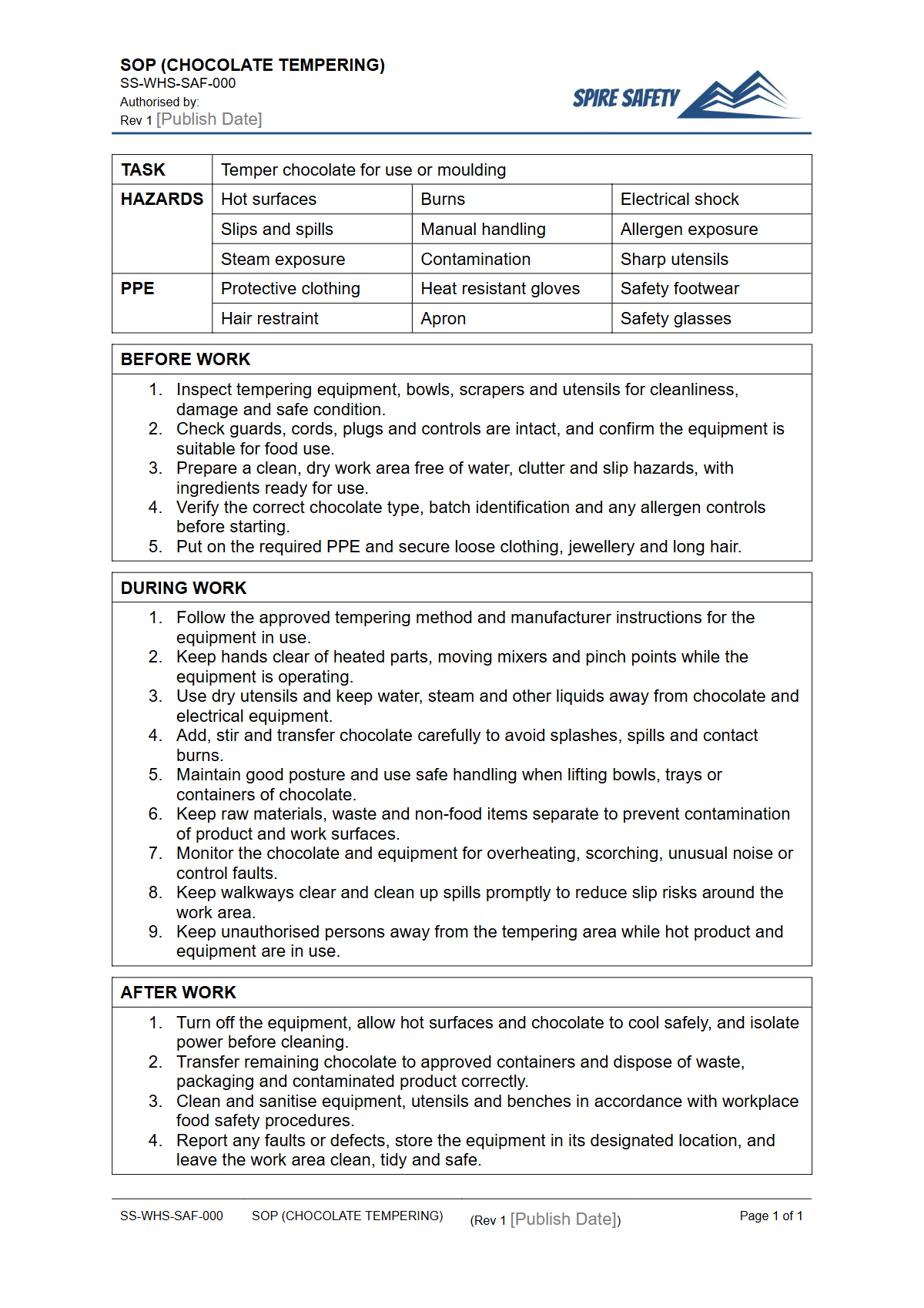
Our Free Safe Operating Procedure (Chocolate Tempering) Template provides a structured starting point for businesses to document safe work practices. Chocolate tempering, while a creative process, involves significant hazards, including severe burns from molten chocolate, electrical risks from machinery, and slip hazards from spills.
This SOP template helps you systematically address these risks by outlining the required steps for pre-operational checks, safe operation, cleaning, and shutdown of tempering equipment. Formalising these procedures is a critical component of risk management and demonstrates a commitment to worker safety.
Implementing documented procedures like this one is a foundational activity in building a robust safety framework. A comprehensive approach integrates individual SOPs into broader WHS management systems, ensuring safety is consistently managed across all business operations.
This template assists in meeting your duty of care by providing clear, accessible instructions to your team.
Video walkthrough
How to use the Free Safe Operating Procedure (Chocolate Tempering) Template
To effectively use this Safe Operating Procedure for chocolate tempering, you must adapt it to your specific operational context. This involves conducting a thorough risk assessment of your equipment, ingredients, and work environment.
The template is designed to be populated with details unique to your business, such as the make and model of your tempering machine, specific types of personal protective equipment (PPE) required (e.g., thermal gloves, non-slip footwear), and emergency contact information.
Important: We provide this template as a starting point. You must customise it with your specific site, equipment, and procedural details to ensure it is relevant and effective for your workplace.
Generic procedures are insufficient for managing specific risks. If you require expert assistance in tailoring this document or conducting a risk assessment, our WHS consulting team can provide practical support.
When to use it
A Safe Operating Procedure for chocolate tempering should be used consistently as part of your daily operations. It is an essential tool for training new employees, providing refresher training for existing staff, and for supervisors conducting competency observations.
The SOP should be located in a visible and easily accessible place near the tempering equipment so workers can reference it before and during the task. It also serves as a critical document during incident investigations or safety audits, providing a benchmark for expected safe behaviour.
Furthermore, it should be integrated into your emergency planning. While the SOP focuses on the task itself, it should also reference what to do if something goes wrong, such as a burn or electrical fault.
This can include cross-referencing other key documents, like your Free Safe Operating Procedure (Defibrillator Operation) Template, to ensure a coordinated response in a medical emergency.
Who should use it
This SOP is intended for all personnel involved with chocolate tempering machines. This includes:
- Operators: Chocolatiers, pastry chefs, and kitchen hands who perform the task must be trained on and follow the procedure.
- Supervisors and Managers: Team leaders and managers use the SOP to deliver training, verify competency, and ensure work is performed safely.
- Maintenance Staff: Anyone responsible for cleaning, servicing, or repairing the equipment should be familiar with the SOP, particularly the sections on isolation and lock-out tag-out procedures.
Even staff performing related tasks, such as retrieving bulk ingredients from high shelves, can be exposed to risks. A holistic approach to safety means considering all associated activities, which might require separate procedures such as our FREE Step Ladder SOP (Safe Operating Procedure) Template.
What to include in your SOP
When customising the template, ensure it covers these key areas:
- Required PPE: List all mandatory personal protective equipment, such as heat-resistant gloves, safety glasses, aprons, and enclosed non-slip shoes.
- Pre-Operational Checks: Detail the daily checks required before use, like inspecting power cords for damage, ensuring guards are in place, and checking the work area is clear of trip hazards.
- Step-by-Step Operating Instructions: Clearly outline each step of the tempering process, from adding chocolate to setting temperatures and decanting the final product.
- Cleaning and Shutdown: Provide safe instructions for powering down, isolating energy sources, and cleaning the machine to prevent residue build-up and bacterial growth.
- Emergency Procedures: Specify actions for foreseeable emergencies, including first aid for burns, procedures for electrical shock, and spill containment.
Once implemented, the effectiveness of your SOP should be periodically reviewed. Regular workplace inspections and WHS compliance auditing can help identify any gaps between the documented procedure and actual work practices. For more templates and safety documents, browse our complete free WHS resources library.
Common mistakes
Common mistakes to avoid
- Failing to customise the template with site-specific machine details and hazards.
- Neglecting to include procedures for cleaning, maintenance, and handling spills.
- Treating the SOP as a 'set and forget' document instead of reviewing and updating it regularly.
- Providing the document to staff without practical training and competency checks.
Legal references
Legal considerations
The following legal requirements may be relevant to this type of work.
- Work Health and Safety Act (Harmonised) — Provides the primary duties for protecting workers and other people from work health and safety risks.
- Work Health and Safety Regulations (Harmonised) — Sets out requirements supporting the management of workplace hazards and risks.
The following codes may be relevant to this type of work.
- Managing WHS Risks Code of Practice — Provides practical guidance on identifying hazards, assessing risks and applying effective controls.
- Work Health and Safety Consultation, Cooperation and Coordination Code of Practice — Provides practical guidance on consulting workers and coordinating with other duty holders.
- Managing the Work Environment and Facilities Code of Practice — Provides practical guidance on safe work environments, workplace facilities and related controls.
Did you know
The Science of Stability
Chocolate tempering is the process of creating stable Beta V crystals in the cocoa butter. This specific crystalline structure is what gives well-tempered chocolate its signature snap, sheen, and smooth melt.
Scald Risk
Hot liquids, including molten chocolate which can reach over 50°C, can cause serious partial-thickness burns (scalds) in seconds. Documented procedures and appropriate PPE are critical for prevention.
FAQ
Frequently asked questions
01What are the main hazards in chocolate tempering?
02Is a Safe Operating Procedure legally required for chocolate tempering in Australia?
03How often should an SOP for chocolate tempering be reviewed?
04Who is responsible for training workers on this SOP?
Share this resource
Free Safe Operating Procedure (Chocolate Tempering) Template
Browse Categories
How To Use It
- 1Download and open in Word or PDF.
- 2Replace the placeholders with your business details.
- 3Get it reviewed by a WHS specialist before rollout.
Need it customised?
Our WHS consultants can adapt this template to your site, run a gap analysis, or audit what you already have in place.
Book a Free Consultation WHS consulting servicesor call 1300 156 382
Related templates
- Free Safe Operating Procedure (Chute Clearing) Template
- Free Safe Operating Procedure (Cinema Floor Cleaning) Template
- Free Safe Operating Procedure (Cinema Screen Cleaning) Template
- Free Safe Operating Procedure (Cinema Seat Cleaning) Template
- Free Safe Operating Procedure (Cinema Spill Cleanup) Template
- Free Safe Operating Procedure (Circuit Breaker Test) Template